













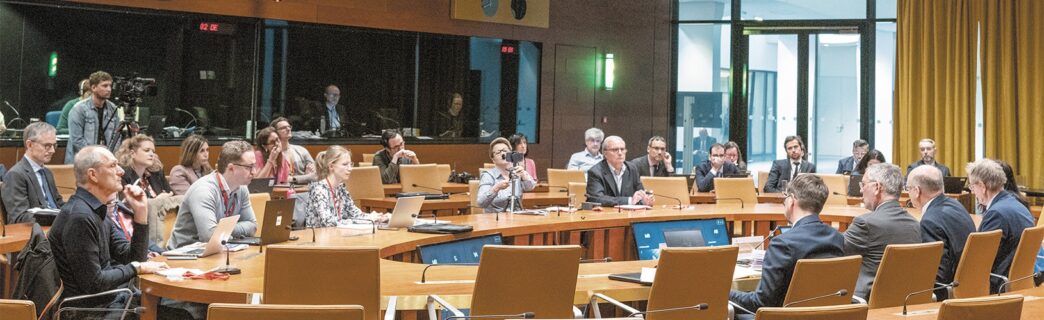
At its annual press conference in Luxembourg on June 4th, led by the Court’s President Koen Lenaerts and the General Court President Marc van der Woude, the Court of Justice of the European Union (CJEU) presented a year marked by institutional reform, high judicial activity and a push for greater public transparency. The CJEU’s Annual Report 2025 sets out key events, statistics and major case-law developments; it records 1,878 cases brought before the Court during the year, and 2,301 cases resolved by it.
The central development was the effects of the judicial reform introduced by Regulation 2024/2019. Since October 1st, 2024, preliminary references falling exclusively within six technical areas (VAT, excise duties, customs, tariff classification, passenger rights and emissions trading) may be transferred from the CJEU to the General Court through a ‘one-stop shop’ mechanism, meaning that national courts still submit all requests to the CJEU, which then screens them and decides whether to keep the case or send it to the General Court. In 2025, most such requests examined were transferred to the General Court, which is presented as evidence that the reform is already redistributing workload.
The year’s case law placed the CJEU at the centre of politically sensitive EU governance disputes. The Court held Malta’s investor-citizenship scheme contrary to EU law, stating that Union citizenship cannot result from a commercial transaction. The General Court annulled the Commission’s refusal to give access to text messages linked to the Pfizer COVID-19 vaccine negotiations; and early Digital Services Act litigation took place.
The institutional message from this is not only centred on efficiency. The Court is using the reform to reshape how EU justice is both delivered and explained. More technical, high-volume preliminary decisions are being channelled to the General Court, while the CJEU preserves greater capacity for cases with broader constitutional significance. At the same time, broadcast hearings, publication of written observations in preliminary ruling cases, audiovisual debriefings and the redesigned Curia communications ecosystem point to a more public-facing model of judicial authority. This is also the direction set for 2026, with the new Curia website, upgraded search tools and Curia Web TV intended to make case-law more accessible to citizens and legal professionals.
The report presents the CJEU as an institution in transition. Commentators have already framed the 2024 reform as a structural recalibration of EU judicial architecture; the Court’s own outlook suggests that the next test will be whether this redistribution of work can improve speed without weakening legal coherence or the authority of its (preliminary) rulings.
Sources
- https://curia.europa.eu/site/jcms/p1_1000084259/en/cjeu-annual-press-conference-2026
- https://curia.europa.eu/site/jcms/p1_1000081821/
- https://eur-lex.europa.eu/eli/reg/2024/2019/oj
- https://www.europeanpapers.eu/e-journal/2024-reform-eu-judicial-system-transformation-court-justice-constitutional-court
- https://curia.europa.eu/site/upload/docs/application/pdf/2025-04/cp250052en.pdf
- https://curia.europa.eu/site/upload/docs/application/pdf/2025-05/cp250060en.pdf
- https://curia.europa.eu/site/upload/docs/application/pdf/2025-09/cp250105en.pdf