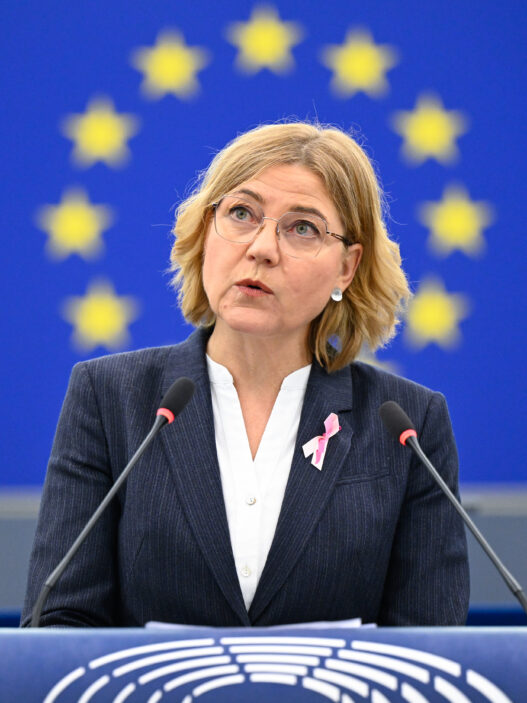








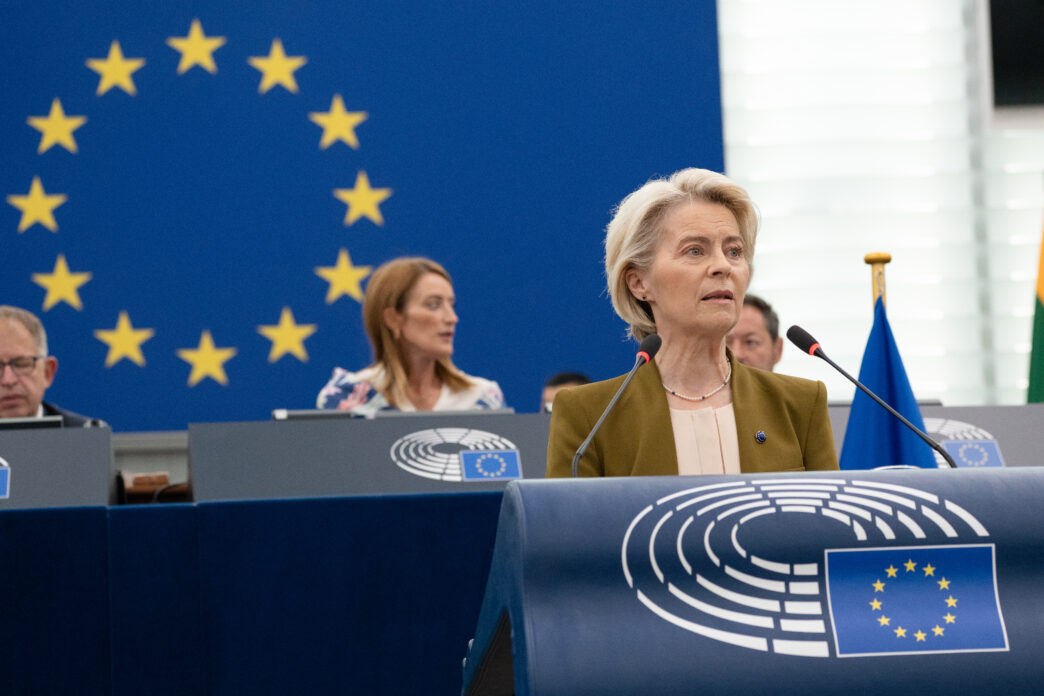
On 10 September 2025, Ursula von der Leyen delivered her fifth State of the European Union address in Strasbourg, the first since securing a second mandate as president of the European Commission. She began with a phrase that immediately set the tone: “Europe is in a fight.” The choice of words resonated even more strongly, as on the same day, Poland informed the world that Russian drones had entered its territory.
This confirms the weakening, if not the dismissal, of the Union as a peace project and puts forward a narrative of Europe as a power project. This aligns with the von der Leyen-II Commission’s priorities, which rank defence and security issues as the top two priorities. The underlying claim is that Europe must now cultivate the capacities, alliances, and social foundations required to act independently in a world marked by conflict, uncertainty, and economic fragmentation.
This rhetorical turn is not new. The war in Ukraine had already shattered the illusion that Europe had definitively removed the threat of war from its borders. Since 2022, the security dimension has haunted every European policy debate, from energy to digital regulation. But the insistence on Europe being “in a fight” reflects a broader recognition: the Union cannot rely solely on the attraction of its norms and market. It must acquire hard power, industrial strength, and above all, the legitimacy to mobilise them—this would thus be the rationale behind the adoption of “a new era for European Defence and Security” as a top priority for the Commission.
With war on the continent, households under pressure from inflation and energy costs, an information sphere saturated by manipulation, and a global economy looking increasingly like a zero-sum game, von der Leyen sought to convince Europeans that the Union not only recognises the scale of the challenges but also has the tools to address them through the SAFE programme (a €150 billion defence fund) or strategic autonomy frameworks like the Net-Zero Industry Act. Yet the picture she painted of a fragile Europe inevitably invites another question: Does her portrayal also mirror her own political vulnerability, given the growing criticism of her legitimacy and methods of governance? 
The State of the Union as Democratic Ritual
Since 2010, each Commission President has delivered an annual address to the European Parliament. The speech is not required by the treaties, but it has become a meaningful political ritual. It is not a European equivalent of the U.S. President’s State of the Union—there is no constitutional obligation, no nationally televised prime-time moment—but its significance lies precisely in its context.
The president of the Commission is not directly elected by European citizens. She owes her position to the Parliament, which votes to confirm her appointment. The State of the Union address thus functions as a form of accountability: the Commission reporting to those who have the democratic legitimacy to hold it to account. It also serves another purpose: strengthening the role of the Parliament as the arena of European politics. Since the Lisbon Treaty, the Parliament has been endowed with greater powers, and this speech symbolises the ongoing, if incomplete, process of parliamentarization of the Union.
Yet the address also reflects the presidentialization of European politics. Von der Leyen’s tenure has accentuated the influence of the Commission president as both a policy driver and a political figurehead. This concentration of visibility has brought rewards—her leadership during the COVID-19 pandemic and in the early days of the Ukraine war boosted her profile—but also significant costs. Critics have accused her of “authoritarian” management, bypassing collective processes, and sidelining dissent. The fact is that the strengthening of the European Commissioner’s influence over the decision-making process does not necessarily lead to greater efficiency, as the content of her decisions or strategic positions often creates divisions. The case of humanitarian aid to Gaza is revealing, as von der Leyen has been criticised for expressing her support for Israel and now lacks support for her call to tighten sanctions against Israel, given the humanitarian situation. In short, while Ursula von der Leyen is making her mark in the way she approaches issues at the European level, her strong-arm tactics paradoxically make her less able to unite people and build support. The fact that she faced a censure motion in Parliament, and that opinion polls now show growing discontent across member states, further highlights the increasing fragility of the president.
Against this backdrop, her rhetorical insistence on independence and unity acquires a double meaning. It projects Europe’s strength outward while seeking to consolidate her own authority inward.
The Emotional Politics of Security
Von der Leyen’s emphasis on independence and security is unsurprising in light of the geopolitical environment. But the way these themes were presented deserves attention. The human consequences of the war in Ukraine and the suffering in Gaza were evoked with powerful, emotional language. By framing security and defence through the lens of humanitarian tragedy, von der Leyen made these themes difficult to contest. To disagree with her policy direction would risk appearing indifferent to human suffering.
This strategy sheds light on a fundamental issue: Europe remains deeply divided on how to act. Whether on arms deliveries to Ukraine, the recognition of Palestine, or sanctions regimes, member states hold divergent views shaped by history, geography, and domestic politics. The Commission president’s choice to appeal to emotions, however, could suggest that von der Leyen not only tries to unite political actors. It is also a call to the whole society, as the revelations, through testimonies and images concerning the situation of children in both Ukraine and Gaza, have profoundly affected European citizens, sometimes creating divisions on how to respond to these circumstances.
Emphasising the universally shocking nature of these situations, the Commissioner highlights the need to involve civil society in defending the human values upheld by the European project. This increased commitment could then take the form of developing an economic defence industry or initiatives such as European Defence Week.
The Economic Dimension: Between Ambition and Fragmentation
This connection between defence issues and industrial development highlights the priority given to European economic independence. Von der Leyen invoked the reports by Mario Draghi and Enrico Letta, which had outlined ambitious roadmaps for Europe: simplifying the single market, mobilising continental savings, and creating ‘lead markets’ in clean and digital technologies. The idea was to give Europe the scale and coherence needed to compete with the United States and China.
Progress has been minimal. Implementation has stalled, with less than 10% of Draghi’s recommendations having been adopted, and in some cases, regressed, with the dismissal of the idea of a common public debt. The Green Deal, once celebrated as the cornerstone of Europe’s industrial strategy, has faced delays, resistance from member states, and a dilution of its initial ambitions. The “Clean Industrial Deal” has been compromised by regulatory rollbacks, with strong criticisms levelled against plans to forbid the production of thermal motors. The Union appears trapped in a cycle of announcing transformative projects that falter in execution.
This reflects a structural problem. The EU possesses immense market power, but its capacity to direct production remains limited. Industrial policy remains largely in the hands of member states. Coordination is weak, competencies are fragmented, and national governments are reluctant to cede further sovereignty to Brussels. This results in duplication, loss of efficiency, and a lack of strategic consistency, which the adoption of omnibus measures would aim to address by simplifying European standards.
But simplification is not enough, and it is telling that the Commission President glossed over budgetary issues, particularly that of joint borrowing. While NextGenerationEU is often cited as an example of economic success, it is not certain that this type of success can be replicated at will, not only because the EU does not have a common borrowing authority or flexible budgetary rules that would allow for the rapid reallocation of funds between different priorities such as defence or green technologies, but also because there is a reluctance to mobilise such tools. Once again, the omission of the idea of joint borrowing to finance European investment plans speaks volumes.
Values as Strategy
This is where the appeal to values, which is constant in the Commission president’s speech, could be seen as a way to give more legitimacy to the project of European sovereignty.
From the war in Ukraine to household concerns or information integrity, what’s consistently at stake is identifying areas where the Union’s legitimacy is questioned. The different dimensions addressed throughout the speech—defence, industry, energy, information integrity, and social cohesion—form a single strategic continuum in a context where boundaries between war and economy, between the market and the political arena, appear more blurred than before. While these areas have always been inseparable, the liberal paradigm, characterised by a belief in free trade and limited state influence on markets, has never been so fragile, as it is now under attack from the very power that seemed to embody its very essence: the United States.
This means defining what European independence would entail, not only in terms of ideas, but also in terms of the capacity to embody those ideas. In other words, it is less a question of asserting that Europe is independent than of proving it can finance, build, and secure the material (pre)conditions of its values. Defence plants that can operate without bottlenecks, power grids that support electrification without failures, data centres that do not compromise sovereignty for convenience, and affordable clean mobility that keeps peripheral regions connected: these are the tangible expressions of freedom. If the EU wants to be sovereign, where is its sovereignty? How does it guarantee its sovereignty? Who guarantees it? On what basis of legitimacy?
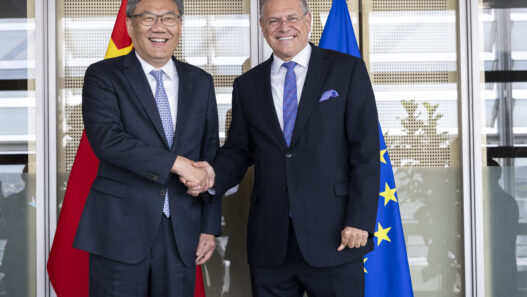
This is where the emphasis on values, through the defence of freedom and in particular, free speech, takes on its full meaning. But appealing to values, however effective, means sticking to this stance until the end. The risk of appealing to values is that it leaves one open to criticism of a ‘double standard’ if those values are not upheld. In fact, while von der Leyen insists on the need for a sovereign Europe on the international stage, she makes almost no mention of Europe’s relationship with China, despite the Asian powerhouse being previously labelled a “systemic rival“.
Given that the president has made defence and security issues a major focus of her current term, this absence is striking. While the decision to focus on the issue of EU independence and security may be justified by its capacity to protect the EU’s core values, it also requires coherent strategic choices, the adoption of which cannot be based solely on appeals to emotion, however profound they may be. The unity of Europeans, arguably found in the values they share, exists first and foremost in the discussions they have on how to promote those values. However, the method she has adopted so far is struggling to bring people together, and analysis of her speech does not suggest that she is seeking to engage Europeans on the issues that concern them.
Conclusion: The Centrality of the How
The 2025 State of the Union was a call to arms, framed in the language of independence and sovereignty. It captured the scale of Europe’s challenges and articulated a doctrine in which values are inseparable from infrastructures. But its blind spots and silences—on China, on financing, on unity—highlight the structural fragilities of the Union itself.
Von der Leyen’s weaknesses mirror those of Europe: ambitious in vision, hesitant in implementation, vulnerable in legitimacy. The fight she declared is therefore not only against external threats but also against internal doubts—about governance, about democracy, about the very capacity of Europeans to act together.
In this sense, the decisive question is not the what or the why of European independence. It is the how: how policies are crafted, how alliances are built, how legitimacy is secured. Only by answering these questions can Europe transform its rhetoric of sovereignty into the reality of independence.