








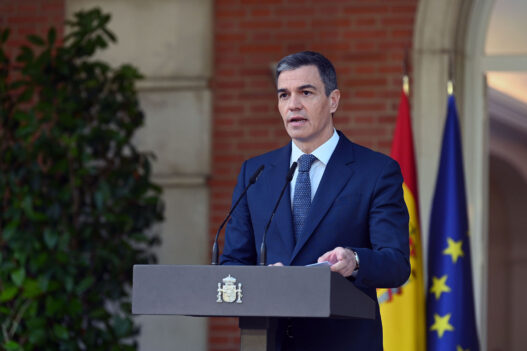
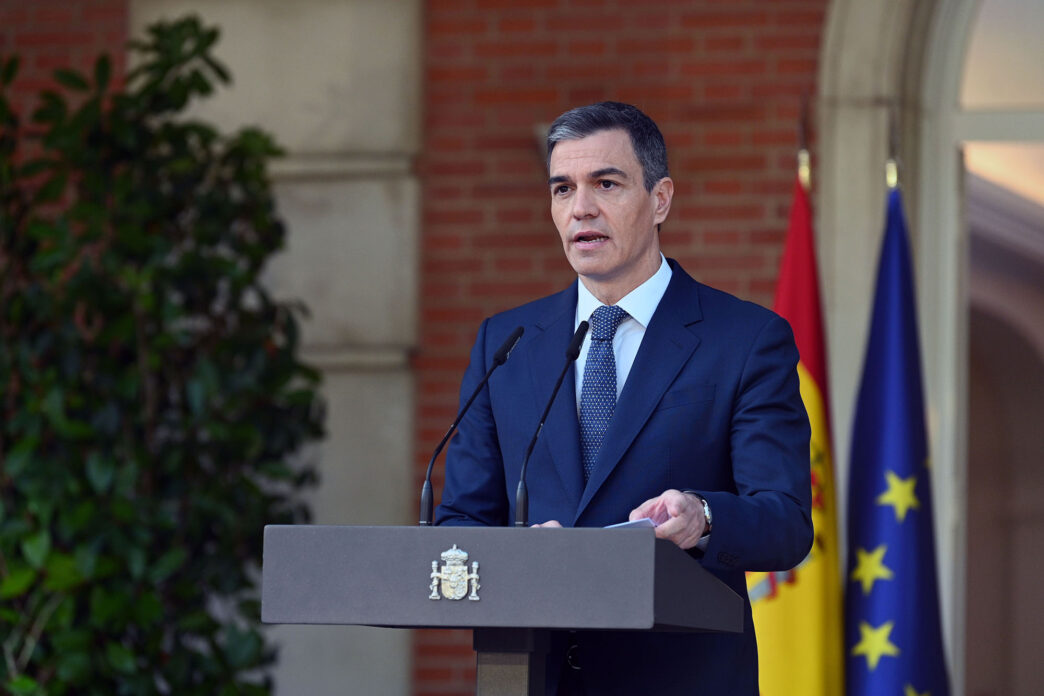
On the 8th of September, the Prime Minister of Spain, Pedro Sánchez, announced restrictions on Israel for the ongoing conflict in Gaza. The Prime Minister said Spain will use multiple sanctions to pressure the Israeli government to stop the killings in Gaza.
- Spain will ban ships and aircraft transporting weapons to Israel from using its ports or airspace.
- The government will increase aid to the Palestinian Authority and the UN Relief and Works Agency (UNRWA).
- It will impose an embargo on goods produced in Israeli settlements in the occupied Palestinian territories.
- It will prohibit entry into Spain to individuals who have participated directly in what Sánchez termed “genocide” in Gaza.
The official response by Israeli Foreign Minister Gideon Sa’ar was sharp and direct. Sa’ar accused the Spanish governing party of using the Gaza case as a cover for their current corruption problems, and also called the Spanish government antisemitic. At the same time, Israel announced two Spanish officials, Yolanda Díaz (Second Deputy Prime Minister and Minister of Labor) and Sira Rego (Minister of Youth and Childhood), as persona non grata. As a response to it, the Spanish government recalled its ambassador, Ana María Salomón Pérez, from Tel Aviv for consultation. This recall of the ambassador proves the seriousness of the currently negative diplomatic relationship between Israel and Spain.
The restrictions on ships that are carrying weapons for Israel are not a unique case in Madrid, since the Hispanic state already denied the entry of a Danish freighter, Marianne Danica, that was carrying arms towards Israel back in May 2024. The case indicated several international disagreements, out of which Washington’s reaction was the sharpest. The U.S. started an investigation into the denied access for the freighter, although it is important to note that there are still no official results of the investigation. Although the case in May 2024 was unique, it still shows that the Spanish government is taking this way of confrontation seriously and is brave to use its legal power to support its political stance.

Spain’s motivation
From the Spanish government’s position, there were several motivating factors which pushed the Prime Minister to announce the restrictions. 
(1) First of all, this case is crucial for the Spanish government itself, since the socialist coalition is backed by left-wing allies, who are strongly supporting Palestine against Israel. At the same time, the government is under public pressure, since several polls resulted in the same way; according to the Elcano Royal Institute, 78% of the respondents supported the recognition of Palestine in 2024, and 82% of the respondents from the Institute’s yearly Barometer in 2025 believe Israel is committing genocide in the Gaza region. Although the Spanish government has recognized Palestine as an independent and sovereign state in 2024, the government still feels the need to push forward in the case of the Gaza conflict.
(2) Secondly, dealing with political cases that are strongly connected to the Mediterranean region was often in the focus of the Spanish foreign policy. In some cases, Spain is referred to as ‘the bridge’ between the European Union and the Muslim countries. To fulfill this role, Spain often acts as a negotiator between the two groups. In 2024, for example, they organized a high-profile meeting between European and Muslim states.
(3) Lastly, Spain often uses the “moral” and “justice” reasons to justify their actions on the global stage. In this exact case, the Spanish government uses the Arms Trade Treaty article 6(3), which says each state has the right to prohibit arms transportation if it is suspected to be used for genocide. By referring to international law, Madrid is aiming to justify its embargo against Israel; however, not all the actors of the international community are supporting the Spanish actions.
How does this affect the Israeli arms importation?
Although Spain is not an important arms trading partner for Israel (approximately less than 1% of the imported arms for Israel is coming from the Hispanic state), the restriction can be important in light of the state’s geographical location. Since Spain is neighboring the Strait of Gibraltar (which is the western entry point of the Mediterranean), the country is crucial for controlling the shipping routes around this area. At the same time, Tel Aviv is still heavily dependent on the U.S. arms export, since approximately 69% of its arms importation originates from Washington. Although the current Spanish restrictions are not making the trade between the U.S. and Israel impossible, they have forced the two powers to re-strategise their trading routes, avoiding the Spanish territories. At the same time, Madrid is risking a possible restrictive reaction from Washington, which could answer with similar restrictions against Spanish ships in the U.S. territories. A possible restriction on Spanish exports towards the United States could deeply hurt the already fragile Spanish economy, since approximately 5% of the Spanish exportation is targeting the U.S.
Conclusion
Spain’s September 2025 decision to impose sweeping restrictions on arms transfers to Israel represents far more than a technical embargo: it is a deliberate act of political signaling. While the material impact on Israel’s defense industry is minimal, the symbolic and strategic implications are substantial. By invoking Article 6(3) of the Arms Trade Treaty and framing its action in humanitarian terms, Madrid positions itself as a defender of international law and moral responsibility in the Mediterranean. The May 2024 Marianne Danica case already showed Spain’s willingness to confront Israel and its allies through port denials. The September 2025 measures elevate this approach into a full policy line, one that differentiates Spain within the EU and tests transatlantic solidarity. Whether this gamble pays off will depend on whether Spain’s example inspires broader European action or leaves Madrid isolated with little to show beyond strained alliances. In either case, Spain has made clear that it intends to leverage both its geography and its normative commitments to shape the politics of the Gaza war far beyond its own borders, but the actual compliance with the stricter measures is still pending.