









Introduction
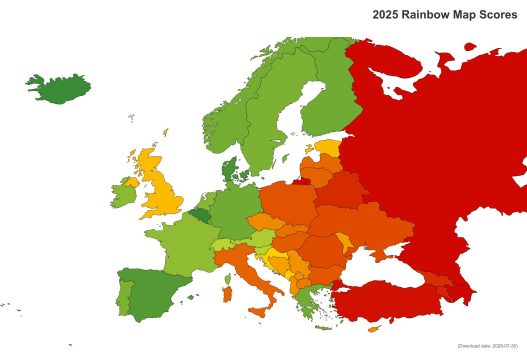
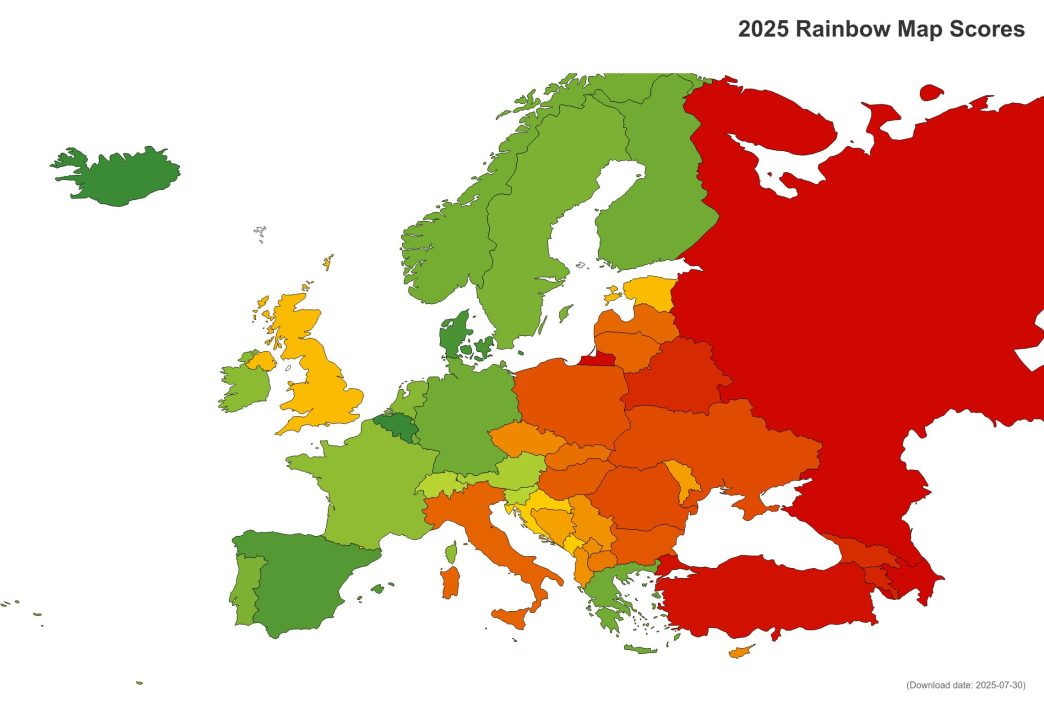
ILGA-Europe has recently released its Rainbow Map for 2025, which, at first sight, showcases a profound division regarding the endorsement of LGBTIQ+ rights across Europe. While some countries, such as Norway, Slovenia and Greece, have advanced towards equality, enacting laws spanning equal rights to donate blood, assisted reproduction or same-sex marriage, other countries such as Italy, Bulgaria or Slovakia are actively deepening the crackdown on LGBTIQ+ rights, banning LGBTIQ+ people from accessing basic services, failing to protect them from attacks and portraying them as enemies to tradition and national identity. However, when analysing this map, it is paramount to consider that, even if mapping LGBTIQ+ rights can be a powerful tool for activists, policy-makers and journalists to evaluate and monitor the state of affairs in each country by highlighting areas of improvement, it can also simplify complex social realities and create utopias and dystopias that do not necessarily match the experiences of LGBTIQ+ people, for the good and the bad.
Mapping LGBTIQ+ rights across Europe: The pivotal role of ILGA-Europe
ILGA-Europe is an independent, international non-governmental umbrella organisation uniting over 750 LGBTIQ+ organisations from 54 countries across Europe and Central Asia. Since its creation in 1996, becoming the European branch of ILGA-World, it has sought to coordinate political action on an international level to pursue LGBTIQ+ rights and fight against discrimination on the grounds of sexual orientation, sex and gender identity.
Every year since 2009, ILGA-Europe has released a Rainbow Map where European countries, not just those part of the EU, are ranked from 0 to 100 – 0 representing gross violation of human rights and discrimination and 100 representing the full respect of human rights and equality. For this process, they categorise a variety of laws and policies adopted by governments that have a direct impact on the lives of LGBTIQ+ people, award them a certain percentage and use this quantitative data to construct a scale that measures the level of respect for LGBTIQ+ rights in a particular country. But, what are these categories and what type of laws and policies have to be in place for a country to fulfil the necessary conditions to be considered fully equal?
ILGA-Europe examines legislation progresses and regressions by using a set of 76 criteria, which are in turn grouped into seven main categories: (1) equality and non-discrimination (access to goods, services, employment, education, health and blood donations, ban on conversion therapies and existence of equality action plans), (2) family (same-sex marriage and other forms of civil relationships, access to adoption and medically assisted reproduction), (3) hate crime and hate speech, (4) legal gender recognition (administrative and legal instruments, restrictions to self-determination and medical requirements), (5) intersex bodily integrity (prohibition of medical intervention without informed consent and access to justice and reparations), (6) civil society space (appropriate exercise of freedoms of assembly, association and expression) and (7) access to asylum protection. 
Generalising and categorising: Is it always accurate?
While this categorisation is extensive and covers a great number of dimensions, from protections against discrimination to ensuring advocacy work can be safely carried out in public spaces and the political arena, several issues stem from the manner in which they are showcased through mapping. Why can it be problematic to rank countries solely based on policies? What are the aspects that are ignored in the process?
According to Francesca Romana Ammaturo and Koen Slootmaeckers (2024), mapping countries based on quantitative measures can lead to unintended consequences that cannot be controlled and that are beyond the objective information that is being conveyed by them. In the case of the Rainbow Map, ranking countries is more than just counting laws; it creates a division between those who comply and respect, and those who ignore or hate, generating an otherness that can lead to the fabrication of utopias and dystopias that do not necessarily represent reality.
Countries in Western Europe, such as Iceland, Denmark or Malta, where there are more laws and policies protecting the LGBTIQ+ community covering different areas of social life, may appear to be more friendly towards LGBTIQ+ people and could therefore be perceived as utopian, progressive states where full equality has been almost achieved. On the opposite hand, Eastern European countries, including Russia, Georgia or Romania, are framed as dystopian, archaic, backward-thinking and unsafe for LGBTIQ+ people.
However, these collective imaginaries might not match the reality of the people living there, since the scale only considers legislation and, in any case, programs launched by governments to combat discrimination. This is the case in countries such as Spain, France or Belgium, where LGBTIQ+ people enjoy many of the same rights as heterosexual and cissexual people, but are currently experiencing a rise in cases of harassment and hatred towards the LGBTIQ+ community, in particular the trans community, not only from certain sectors of society, but also from political parties.
This superficial hierarchisation and division into “friendly” and “unfriendly” countries, which often conflates citizens with governments, not only might not mirror the experiences of LGBTIQ+ people, but it obscures and underestimates extensive movements of resistance and advocacy networks in low-ranked states and leaves little space to acknowledge the work of activists and human rights defenders that are very vocal about the institutional and social oppression they endure.
For example, on June 28th 2025, up to 200,000 people from different parts of Hungary and other countries marched through the streets of Budapest, defying the ban on Budapest Pride imposed by Prime Minister Viktor Orban, who had earlier in March amended the right to assembly to make gatherings such as Pride illegal. This large congregation of people demonstrates the existence of an organised social movement that fights for LGBTIQ+ rights in the country that can even bring the government’s legitimacy down.
Going beyond marriage: Dismantling social institutions
Building utopias and dystopias on whether governments pass policies protecting or repressing the LGBTIQ+ community also presents a different issue, which has been widely spoken about within feminist and LGBTIQ+ movements: That is the tendency to believe that legislation on key issues, such as same-sex marriage or adoption, are the ultimate goals to be achieved, and that once these types of bills are adopted, social change will not only follow, but will be accelerated, relying on the power the state possesses to promote social change.
However, assuming marriage and adoption as the end of the path only reinforces and perpetuates the traditional cisheterosexual idea of family, thwarting the potential of the LGBTIQ+ community to crush the institution of marriage and the idea of relationships themselves. By considering marriage and adoption as the representation of full equality, we risk falling into the trap of cisheterosexuality by adjusting to the social standards expected from the LGBTIQ+ community – a traditional family based on binary conceptions of human sexuality. Instead, dissident LGBTIQ+ relationships and identities, such as polyamory, non-binarism and intersexuality, can make a social transformation of relationships possible, disrupting the way we conceive social life.
Other issues
Two additional matters can be unveiled from the Rainbow Map. The first one refers to the significant gaps that exist between urban and rural areas in all countries, both high and low-ranked, since it is common to observe a higher social acceptance in cities than in smaller towns – as suggested by Marleen Hasselt, Niels Spierings and Saskia Glas (2025). Therefore, a disaggregation into regions, instead of states, would provide a more accurate representation of LGBTIQ+ life experiences.
The second issue relates to how creating a map that encompasses the entirety of the LGBTIQ+ community, with their wide differences in experiences and needs, can be problematic, given that more gains in rights and protection of LGB people have been granted compared to trans and intersex people. If the map were divided into submaps, we would observe very different results. For instance, in the United Kingdom, the LGB community enjoys wider recognition and more protection compared to the intersex and trans community.
Conclusions
Many of the issues discussed here have been recognised by ILGA-Europe, which has emphasised that the Rainbow Map is not a representation of LGBTIQ+ experiences and has stated that high-ranked countries do not, by any means, imply more safety for LGBTIQ+ people nor provide information about social acceptance; the same applies for low-ranked countries. Nevertheless, this map is still useful for activists, journalists and policy-makers, as these indicators become useful tools for understanding what the main areas of improvement are as well as the countries that are progressing more slowly.
However, the unintended consequences discussed above must be taken seriously, especially in times when we are observing a higher polarisation and tension regarding LGBTIQ+ rights. While mapping always implies a simplification of reality that affects the way we perceive certain countries as friendly or unfriendly, reality, as human behaviour, is more complex than we think.