









The EU’s Common Foreign and Security Policy (CFSP) has long been the subject of scrutiny and reform debates. At the core of these debates is the unanimity requirement – a rule that demands all Member States (MS) agree on foreign policy decisions. While designed to ensure unity, this approach often leads to gridlock.
Is the shift to Qualified Majority Voting (QMV) a way to unlock the EU’s foreign policy potential, or is it – as some claim – just a solution to the wrong problem? In this article, I argue that adopting QMV is not only appropriate but urgently needed to strengthen both internal coherence and external credibility.
The Status Quo: Designed to Fail?
Under Articles 24 and 31 of the Treaty on the European Union (TEU), the CFSP is governed by unanimity. This allows any single MS to veto a decision regardless of broad consensus among the rest. Nevertheless, exceptions such as passerelle clauses, found in Article 48(7) TEU, allow the EU to streamline decision-making by shifting from unanimity to qualified majority voting or from special to ordinary legislative procedures without formal treaty amendments. However, despite this flexibility, these mechanisms remain politically untapped.
This structure has led to policy paralysis on multiple occasions: 
- Greece in 2017 and Hungary in 2021 vetoed statements condemning China.
- Hungary in 2022 and 2024 blocked EU aid packages to Ukraine.
- Poland and Hungary in 2023 jointly blocked a statement on migration.
These incidents show that unanimity not only delays action but gives disproportionate power to individual Member States, often those accused of undermining EU values themselves.
The specific incidents were chosen as examples to illustrate the relevance and long-term nature of this issue. It is vital to recognise that against this background, recent events like the decision not to suspend the EU-Israel Association Agreement make it even more compelling to strive for change.
The “Wrong Problem” Thesis – A Misdiagnosis?
Some authors argue that democratic backsliding, not procedural dysfunction, is the real issue in EU foreign policy. Wessel and Pomorska, both professors of law in the Netherlands, caution that switching to QMV could undermine legitimacy and sideline dissenting states.
But this argument overlooks a key dynamic: unanimity enables backsliding. The Hungarian case is illustrative: Budapest used its veto to extract concessions on frozen EU funds tied to rule of law violations. The result? A weakened internal stance on values and a damaged external image of unity.
If QMV had applied, Hungary would not have been able to block the aid packages. The EU could have retained leverage and reinforced its values, internally and abroad. That is because the EU had previously frozen 7,5 billion euros worth of EU funds directed to Hungary based on fears that those funds could be used to continue the alleged corruption violations as well as backsliding of the rule of law. It had also blocked the release of 5,8 billion worth of Covid recovery funds as a response to democratic backsliding caused by judicial independence concerns.
As a response, Hungary used its veto power by holding the other MS hostages in the CFSP decisions as a bargaining chip to reduce the suspended EU funds to 6,3 billion euros as well as to force the EU to release the Covid recovery funds.
The EU ultimately conceded to the Hungarian demands to secure the urgently needed aid package for Ukraine, but upon the condition that Hungary shall complete 27 anti-corruption reforms and implement judicial independence reforms. However, it can be argued that the rule of law in Hungary has since deteriorated.
This episode sets a troubling precedent: it risks encouraging other Member States to exploit the veto mechanism as leverage to obtain EU funds, even while breaching core EU values.
QMV Would Enhance Ownership, Not Undermine It
Critics claim QMV would erode the legitimacy and “ownership” of foreign policy decisions. But in reality, most CFSP decisions are already made informally by consensus – a process that masks genuine dissent.
Under QMV, minority voices would be recorded transparently, allowing opposing states to clearly articulate their stance without obstructing collective action. This not only enhances democratic accountability but promotes genuine pluralism and visibility in decision-making.
Moreover, QMV can be introduced via passerelle clauses, which still require unanimous agreement to activate, preserving democratic legitimacy. A treaty-based shift would further allow for the European Parliament’s and the Court of Justice of the European Union’s (CJEU) involvement in the CFSP, reducing democratic deficit concerns.
Are Smaller States at Risk of Being Sidelined?
A Reinforced Qualified Majority Voting (RMV) model as enshrined in article 238(3)(b) Treaty on the Functioning of the EU – requiring 72% of MS representing 65% of the population – could serve as a compromise. It ensures broad buy-in while avoiding deadlock. Though not yet applicable in CFSP without treaty change, RMV offers a pragmatic bridge between efficiency and inclusiveness.
The Institutional Contradiction in EU External Action
One of the lesser-discussed issues is the inconsistency between different branches of EU external policy. While trade and development operate under QMV with Commission and Parliament oversight, CFSP remains governed by unanimity with minimal supranational involvement.
This creates legal incoherence. For example, a Member State that abstains from a CFSP act (such as a sanction decision) may still be bound by the resulting regulation under Article 215 TFEU, adopted by QMV. Constructive abstention – which should provide flexibility – thus becomes a legal paradox.
Such inconsistencies not only complicate governance but undermine the EU’s credibility on the international stage.
Conclusion: Start with Procedure to Tackle Substance
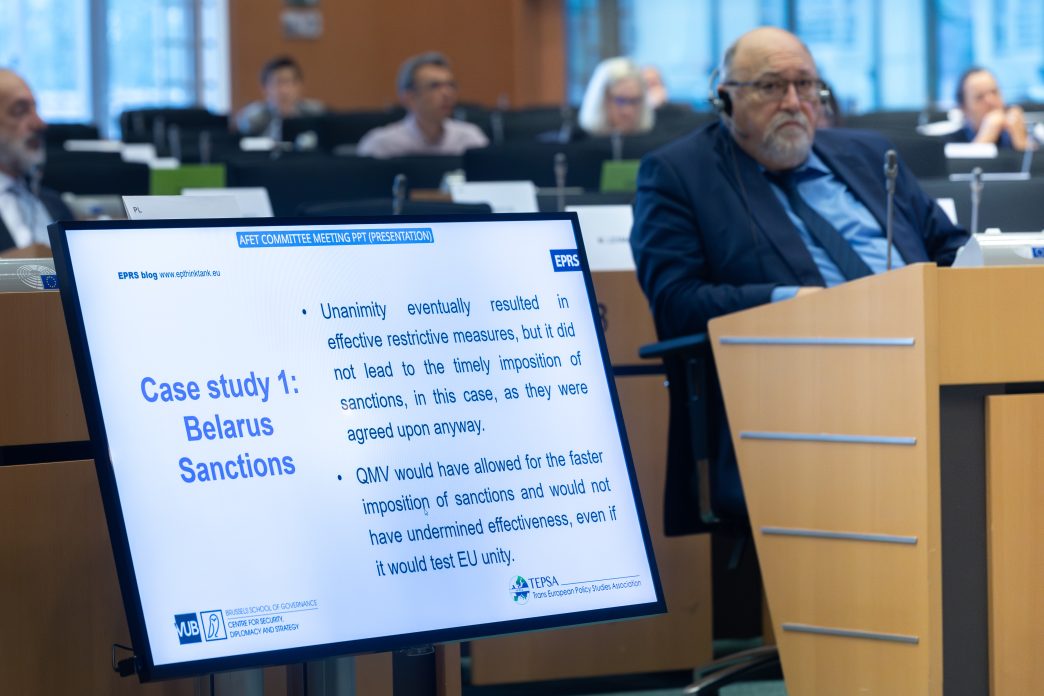
Shifting to QMV in EU foreign policy will not solve all the Union’s problems — but it will remove a powerful tool of obstruction from Member States undermining the Union’s values.
QMV can:
- Prevent hostage-taking by single MS
- Enhance transparency and political accountability
- Improve the EU’s external credibility
- Preserve democratic legitimacy via unanimous entry points (passerelle clauses or treaty change)
Rather than being a distraction, procedural reform is the precondition for deeper structural integrity. As the CFSP faces urgent challenges – both internal and external – the time for change is now.