








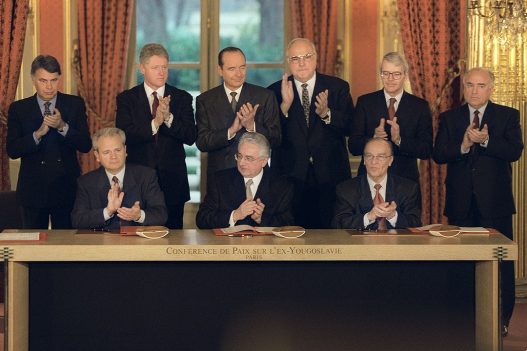
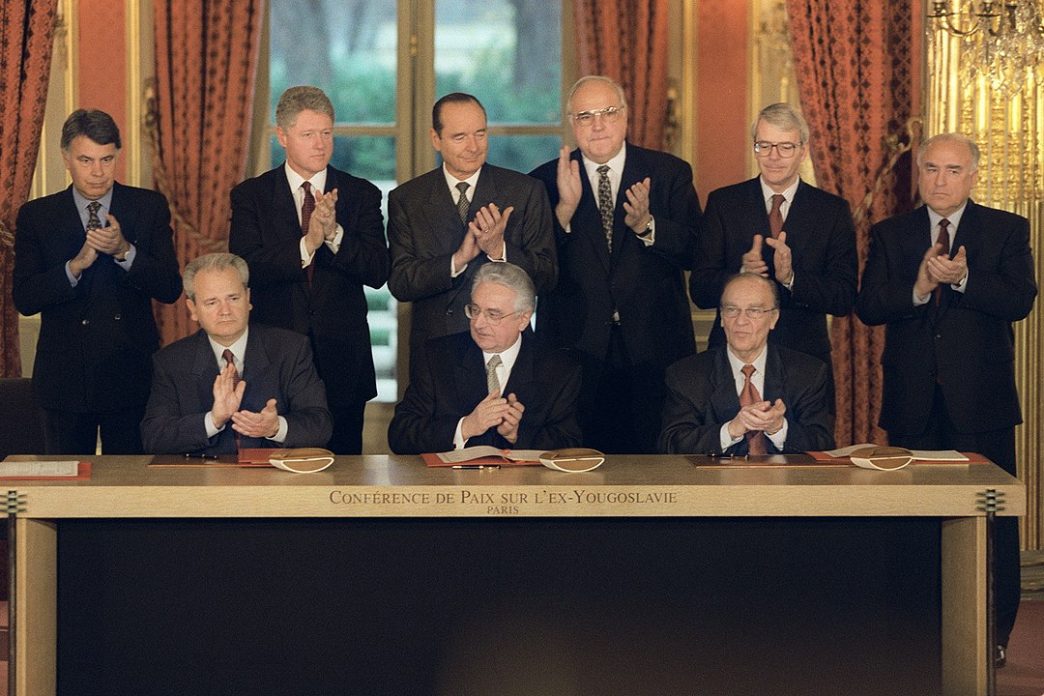
As Bosnia and Herzegovina (BiH) approaches the thirtieth anniversary of the Dayton Accords, the country remains largely paralysed. The Bosniak-Croat communities represented by the Federation have minimal engagement with the Serb Republic and vice versa, leaving BiH effectively divided between its two autonomous entities. Local economic development, which has already demonstrated its value in encouraging inter-community contact and strengthening social cohesion, may offer a practical route forward. In this context, local businesses could play a critical role in addressing the divisions rooted in the Bosnian conflict. This raises the question, should the European Union explore targeted, localised support for private sector development in BiH as a potential pathway towards positive peace?
The value of an accord goes as far as the meaning that we, collectively, attribute to it. As such, while deal-making may remain the business of the upper echelons of formal politics, the translation of this deal into a positive, workable and sustainable peace is a deeply personal process. A process driven by society as a whole, by individuals and communities alike.
With the Dayton accords nearing their thirtieth birthday this November, ‘peace’ in BiH remains a formal concept. The accords, which ended the Bosnian civil war by effectively splitting the country into two autonomous entities, left BiH with no practical, tangible pathway to peace. Few incentives were left for the Serb, Bosniak and Croat communities to collaborate and work towards establishing a joint identity or national unity. This left the country stuck in a structural negative peace – that is, peace primarily as the absence of war.
For Bosnia and Herzegovina, this leaves us with the question of how to reconstruct this negative peace into a positive peace. How to mobilise popular support for the creation of a shared national identity. And how to move society to not only collectively accept and implement a deal, but to translate and transform it into a workable, society-wide peace. 
A proven and effective means to translate an accord into a positive peace is through economic collaboration. Economic collaboration provides a very natural incentive for the creation of social cohesion. Through value chain integration, creating networks of suppliers that intersect communities, groups are incentivised to work together. After all, for a local business to operate, it needs supplies. If these supplies can be sourced locally and affordably, from providers of different communities, meaningful trade and social connections can be built.
Successful programmes, such as the ILO’s work in Iraq or VNG-International’s work in Somaliland, show that through targeted investments in local economic networks, communities can be connected sustainably. Through setting up physical infrastructure and incentivising SMEs to cooperate across community boundaries, trade can be incentivised and social cohesion furthered. In BiH, some locally-led initiatives already hint at the potential of cooperation between actors in the Serb, Bosniak and Croat entities and communities. Agricultural cooperatives that span both autonomous entities, or manufacturing enterprises sourcing inputs across ethnic lines, demonstrate that business incentives can at times outpace political ones. These examples, though currently limited, suggest that with the right support, cross-entity economic ties could become more common and more resilient.
For the EU, investing in business-led cooperation may be more politically neutral and less contentious than institutional reform, while still producing socially significant outcomes. Where EU-led institutional reform processes such as the 2024 Western Balkans Growth Plan have partially run aground due to rigid ethno-political structures, alternative approaches such as localised economic development may be a more pragmatic route for building cohesion and gradual reform. Support could take the form of targeted grants, access to regional value chains, or platforms that enable inter-entity SME collaboration.
Of course, such economic integration does not occur in a vacuum. Political elites often have little interest in undermining the ethnic divisions that sustain their power. In some cases, business is tightly linked to patronage networks that reinforce separation rather than cooperation. The local SME space, however, offers a relatively apolitical socio-economic environment that would allow for the EU to make meaningful investments without upending existing high-level political interests. Especially through the promise of profit without the requirement of national- or federal-level reform, local economic development can be leveraged relatively risk-free.
Nevertheless, some risks exist when supporting local businesses whilst limiting the EU’s usual conditionality on an institutional level. Inter-community relations could be added to the due diligence provisions for EU-led SME investments, ensuring that business support contributes to cohesion rather than entrenching existing divisions. EU assistance could prioritise micro and small enterprises operating in mixed or border areas, where the potential for inter-entity cooperation is highest. Investment should not be limited to infrastructure but should also address business capacity, market access and administrative barriers. Reviving or strengthening cross-entity chambers of commerce could offer a neutral platform for cooperation, while robust monitoring and evaluation mechanisms are essential to assess the broader social impact of economic linkages and adjust programming accordingly.
While no single approach will resolve BiH’s deep divisions, promoting cross-community economic cooperation represents a pragmatic step towards a more integrated society. Peace, if it is to take root, must have a socio-economic logic that reaches people’s daily lives. The European Union, as a long-standing partner for those seeking peace in the Western Balkans, could play a pivotal role in this process, through creating those economic incentives that help build the social structures needed for a sustainable, positive peace.