










Türkiye was officially granted candidate status for full membership in 1999, following the Helsinki Summit of the European Council. Türkiye now uniquely holds the longest-lasting candidate status, with over 26 years. Why is Türkiye still not a member state? Do they have a realistic chance of gaining full -membership status anytime soon?
Europe has spoken a lot about enlargement, often forgetting what expansion truly costs. For over 26 years, Türkiye has stood alongside Europe as a partner, a candidate, but never as a full member state. Türkiye, which once fuelled optimism among European and Turkish people, now feels like an unfinished and unspoken sentence.
Türkiye’s EU Journey: How it All Began
Türkiye’s path to European integration began in 1959 when it applied to become an associate member of the European Economic Community (EEC). This exhibited Türkiye’s desire to align with the West during the Cold War, considering Türkiye’s NATO membership and geopolitical location. Aligning with Western institutions provided Türkiye with further securıty guarantees and economic development opportunities. The Ankara Agreement of 1963 created a pathway for Turkish integration through the following phases: 
- Phase 1: Preparation,
- Phase 2: Transition,
- Phase 3: Integration.
However, Türkiye did not apply officially for membership until 1987. Its application, in fact, received little enthusiasm because of the volatile political situation due to the previous 1980 coup as well as Türkiye’s negative track on human rights during the 1980s, per Amnesty International’s “Torture in Türkiye” report.
Türkiye’s membership bid – now transferred to the recently established European Union (EU) – was off to a new start after the Greek-Turkish Earthquake Diplomacy in 1999 resulted in Greece lifting its opposition to Türkiye’s EU candidacy. Accession negotiations started in 2005, but were suspended again in 2021.
The decision of the European Council in 2004 to open formal accession negotiations with Türkiye was mostly met with celebrations and was understood as a major diplomatic success for the Turkish government. Türkiye’s accession was seen as a strategic opportunity by the European Council to promote a stable political environment in the Middle Eastern and Eastern Mediterranean regions.
Reformist Era: The Early 2000s
After Istanbul’s mayor Recep Tayyip Erdogan was imprisoned and banned in 1997, he created the Justice and Development Party (AKP) in 2001 and came to power in the very first election his party participated in. The European Union viewed his rise with cautious optimism, as significant concerns remained about institutional weaknesses and incomplete adherence to the Copenhagen Criteria. However, Prime Minister Erdogan’s central goal was to modernize Türkiye by reforms, follow the Copenhagen Criteria, and increase its legitimacy on the world stage.
To the newly formed government, EU accession was a priority. Erdogan implemented several reforms, such as:
- abolishing the death penalty,
- expanding the freedom of expression,
- increasing minority rights, especially for Kurds,
- and reducing the influence of the military in governance, in accordance with the Copenhagen Criteria, strengthening Türkiye’s EU bid.
After working on these reforms, Türkiye officially opened the accession talks with the EU in 2005. It is still considered a historical peak of optimism for Türkiye’s EU membership.
The EU saw Erdogan’s leadership initially as a turning point for Türkiye and the world, proving Muslim-majority countries can apply democratic norms while pursuing European integration.
Erdogan’s Strategic Turn: Consolidation of Power
After 2007, this momentum, as well as Erdogan’s interest in the EU, started to fade away. Erdogan’s motivations were not purely idealistic. It was rather a tool to weaken the influence of military and judicial institutions, consolidating power, and legitimizing his government. Due to his strategic motivation, accession talks were not going as planned. There were disagreements on many issues like
- Cyprus dispute: Türkiye refused to recognise the Republic of Cyprus, leading to the freezing of some negotiation chapters (Chapters 1, 3, 6, 9, 11, 13, 14, 29, 39).
- Rising islamophobia and identity politics: Türkiye’s Muslim majority expressed concerns about some European figures and politicians’ ani-Islam rhetoric.
- EU Scepticism: Leaders of major and prominent countries like France, Austria and Germany opposed Turkish membership for cultural and political reasons.
Meanwhile, AKP started to consolidate power, began cracking down on critical media, and shifted the country towards majoritarianism while still holding democratic elections. The 2007-2013 period resulted in political shifts and EU vetoes in Türkiye.
During his so-called ‘reformist’ era, Erdogan was backed by the secularists in Türkiye. However, while he was receiving their support due to relative success in the integration process, he was gradually weakening secular institutions that had dominated Turkish politics.
For example, the Ergenekon and Sledgehammer Trials in Türkiye (2008-2013) were used to target secular dominant figures and high-ranking military officers, reshaping military power in favor of the Erdogan regime.
As Erdogan’s political position strengthened after each crackdown, his interest in and reliance on the EU diminished over time. Reforms slowed and were even reversed.
The Democratic Decline: 2013-2017
After 2013, democratic backsliding in Türkiye proceeded undeniably fast. After the Gezi Park protests in 2013 in which over 8.000 civilians got injured and a failed coup attempt in 2016, the Erdogan government intensified and prioritized repression while launching crackdowns on all branches of public institutions. This resulted in thousands of judges, academics and journalists being arrested, independent media outlets being shut down, as well as an executive presidency in 2017 due to significant constitutional changes.
Failed 2016 Coup: Critical Juncture
The coup attempt in 2016 was a turning point in modern Turkish politics and a good example of how Türkiye transformed into an authoritarian regime. After it failed, a state of emergency was established. Over 150.000 civil servants were either dismissed or jailed.
The failed coup became a justification for dismantling the rule of law, increasing executive power, and installing regime supporters in Türkiye’s civil service.
Afterwards, President Erdogan announced that Türkiye might reintroduce the death penalty to punish individuals involved in the coup. This was the last straw for the EU. They threatened that if the death penalty was reintroduced, negotiations with Türkiye would officially end. Then-president of the European Commission Juncker conveyed that for this reason, Türkiye ‘was not in a position’ to become an EU member soon.
Another important result of the coup was the 2017 constitutional referendum, which allowed the parliamentary system to be abolished and the president to take full control over executive and judiciary appointments, as well as the dissolution of the parliament.
Türkiye became a de facto one-man regime, with weakened checks and balances. Erdogan, who was supposed to afford Türkiye an EU membership through reforms, had managed to transform a flawed democracy into a competitive autocracy in 15 years.
The Present Reality:
Can Türkiye be an EU member state anytime soon? The answer is: No. Türkiye cannot and will not be a member of the EU in the future.
Even though Türkiye is still technically a candidate, the Copenhagen Criteria are still not met. The judiciary is politicized, appointments are made by President Erdogan under law, opposition figures like presidential candidate Ekrem Imamoglu are jailed, most prominent journalists like Fatih Altay are jailed, the media is used as a state propaganda tool, and checks and balances are eroded. Türkiye, therefore, fails to meet even the minimum democratic standards for membership.
On top of that, Türkiye is also in open conflict with the EU on several issues. Türkiye’s involvement in Syria, Iraq, Libya, and Karabakh, as well as its stance on Israel, often receives criticism from the EU, as it does not align with EU foreign policy. The country’s dispute with Greece and Cyprus, two EU member states, also undermines relations and accession talks, including the suspension of accession chapters. Türkiye may be seen as a strategic accession candidate due to its geopolitical location, but certainly not as a realistic future member.
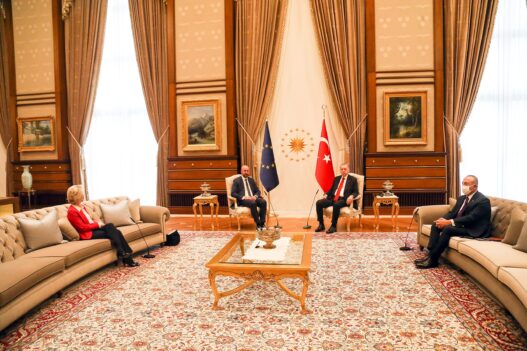
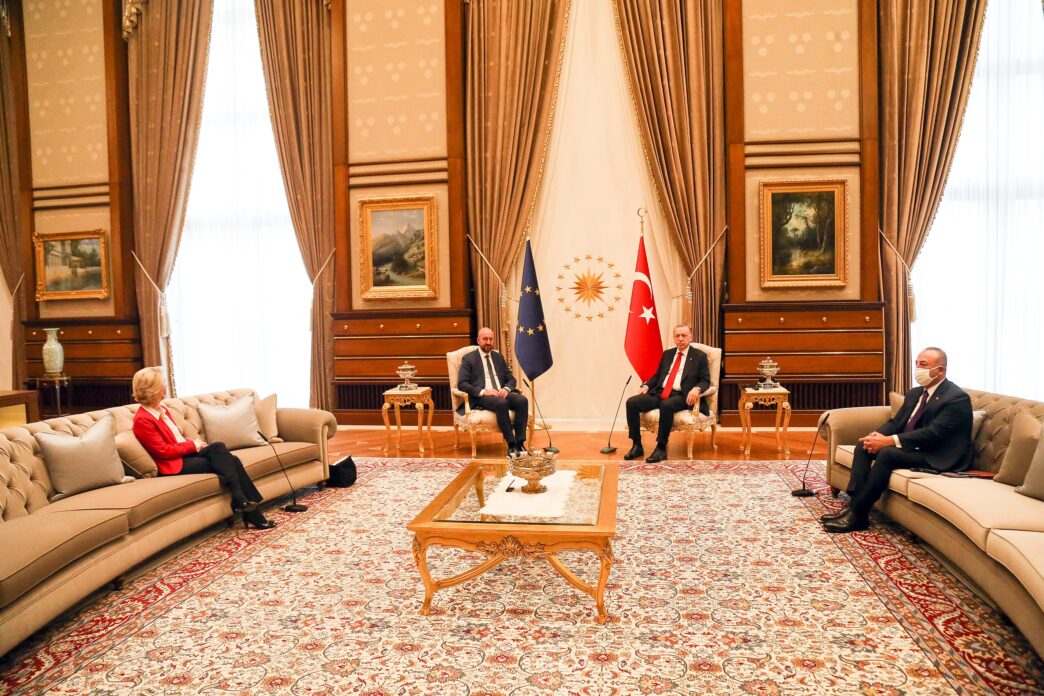
In fact, key member states in the EU, such as France, Austria, and Germany, heavily oppose Turkish membership because of internal factors such as enlargement fatigue and the rise of far-right ideologies, like Geert Wilder’s PVV in the Netherlands, and AfD in Germany. Likewise, in Türkiye, the strong support for EU membership has declined sharply. President Erdogan himself has repeatedly shown anti-EU rhetoric in his political agenda and has participated in many controversies, including Sofagate.
Could things change? Of course. However, this does not seem likely in the current political environment, keeping in mind Türkiye’s autocratic turn, democratic backsliding, and anti-EU rhetoric, combined with the 2016 Migration Deal between Türkiye and the EU. Any post-Erdogan democratic transition may reset relations between Türkiye and the EU, but major reforms would be required for the road to Brussels. For now, at least, Türkiye will remain a strategic partner and an uneasy neighbor.