






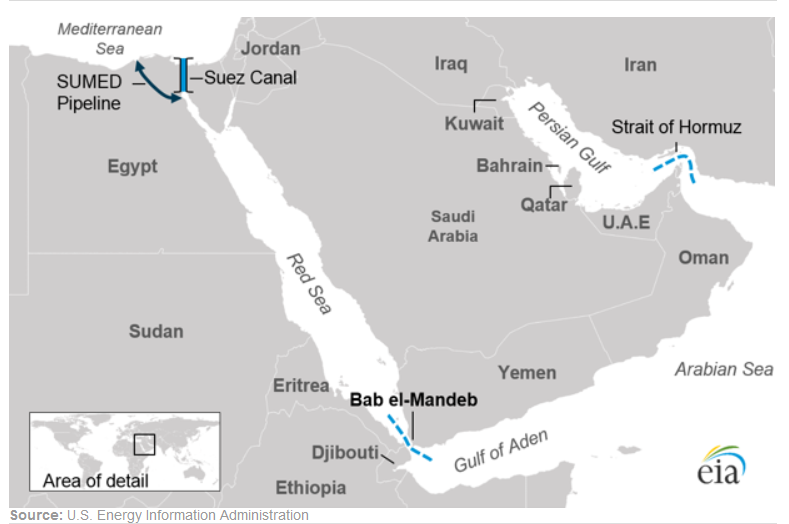
On Monday, September 14th, the Houthis took control of the Lesser and Greater Hanish Islands after the withdrawal of hundreds of government-allied forces of the internationally recognized Yemeni government. The group officially known as Ansar Allah captured the archipelago after taking Mokha and Perim Island inside the Bab el-Mandeb Strait while also waging an offensive further inland, particularly in the battleground province of Taiz. With the capture of the archipelago, the Houthis have strengthened their ability to threaten trade in the Bab el-Mandeb Strait, a significant chokepoint for international trade. Arabic for “Gate of Tears,” the Bab el-Mandeb Strait links the Gulf of Aden to the Red Sea and carries more than a tenth of the world’s trade. Ships travelling between Europe and the Indian Ocean via the Suez Canal must pass through Bab el-Mandeb. Previous Houthi attacks in the area forced many vessels to sail around Southern Africa instead, significantly increasing the time and expense of their journeys, according to the US Energy Information Administration.
The Houthis are an Iranian-backed Shia militia that came to power in 2014 after storming Sana’a and seizing the presidential palace later in 2015 as well as key military sites. These actions forced the Yemeni government into exile and sparked a brutal civil war that, until recently, had largely been halted by a UN Truce implemented in 2022 that created relative peace lasting beyond its expiration. The Houthis are a part of Tehran’s Axis of Resistance, a loose network of armed groups including Hezbollah in Lebanon, Hamas in Gaza and Shia militias in Iraq. In July this year, the Houthis allowed an Iranian plane to land in defiance of Saudi control of Yemeni airspace, which prompted the Saudis to retaliate by striking the airport. In response, the Houthis declared a blockade on Saudi Arabia targeting its oil trade. An estimated 150 civilians have been killed in the fighting since September 3rd, with more than 200 wounded. The UN estimates that over 90,000 people have been newly displaced across Yemen, according to data collected by the International Organization for Migration. As of now, the Houthis have stated that the Strait is open to everyone but Saudi Arabia, but how long that remains the case and how effective the Houthis are in distinguishing Saudi vessels remains to be seen. Saudi Arabia is an important US ally and the US has carried out airstrikes against the militia before. Saudi Arabia also recently suffered an attack attributed to an Iranian-backed Shia militia in Iraq on their East-West oil pipeline that has allowed it to circumvent the Strait of Hormuz. Between the blockade of the Strait of Hormuz and now in Bab el-Mandeb, as well as the attack on the pipeline, Saudi Arabia’s ability to export its oil has been severely impacted. The attacks from Houthis on Saudi shipping have created even more pressure on energy markets already strained by the Iran war and Russia-Ukraine war.
In response to the Houthis Red Sea coast offensive, Qatar has warned that closing another major shipping route while the Strait of Hormuz remains blocked would be “catastrophic” for global trade. Ibrahim bin Sultan Al Hashmi, Qatar’s director of media and communication in their Foreign Ministry, said on Tuesday that closing the Red Sea would worsen the damage caused by the Hormuz blockade. “The world is suffering enough with the closure of the Strait of Hormuz, so we cannot also afford to add the Bab al-Mandeb into that equation,” said Al Hashmi. Qatar wants international intervention in the form of diplomacy and negotiation to keep Bab el-Mandeb open.
Why this Matters for Europe
Europe is already struggling with disruptions to energy markets caused by various ongoing conflicts, and the closure of the Bab el-Mandeb Strait would only exacerbate these existing problems. As of September 15th, the price of oil per barrel was already $106.57 USD per barrel. Continued disruption of Saudi oil exports will likely continue to drive up the price of oil. In June, more than 7 million barrels of oil were passing through the Bab el-Mandeb strait per day, up from 4 million before the war in Iran. Saudi Arabia alone is responsible for transporting 4 million of these barrels from Yanbu. This goes to show how important Bab el-Mandeb has become to global energy flows. Europe is particularly exposed to other trade passing through the Bab el-Mandeb Strait as shown in an analysis of the 2021 incident with the Ever Given ship blocking the Suez Canal conducted by the New Zealand Foreign Affairs and Trade Ministry suggested Europe was the hardest hit economically. This means that a full blockade of the Bab el-Mandeb Strait could negatively impact European economies even more than the current closure of the Strait of Hormuz.
What to Watch Next
The response of other countries in the region and the US will have major implications for how this conflict unfolds. In August, the Mecca joint defence agreement was signed between Saudi Arabia, Turkey and Pakistan that declared that any attack against one country would be “regarded as an attack against them all.” Pakistani Prime Minister Shehbaz Sharif joined Saudi Arabia’s condemnation of a supposed drone attack on Mecca and said his country and the Saudis stand together “unwaveringly, shoulder to shoulder.” Despite this, both Pakistan and Turkey have said they had not received a request for support in response to the Houthi escalation. The US also seems unwilling to get involved in the conflict as they have done in the past, with Trump saying on Saturday that “The Houthis called us and they don’t want to fight with us.” While this could mean the conflict will not escalate in the short term, much remains to be seen. There is a chance the US changes its mind once the economic effects of the blockade are felt more concretely, and it remains to be seen whether the Houthis can effectively distinguish Saudi Arabian ships from other vessels traveling the Strait. How this conflict unfolds and whether the Houthis will decide to fully blockade the Strait will have significant impacts on European economies.
Sources
Atlas Institute, Euronews, Euronews, Fortune, New Zealand MFAT, PBS, The Guardian, United Nations, US Energy Information Administration