






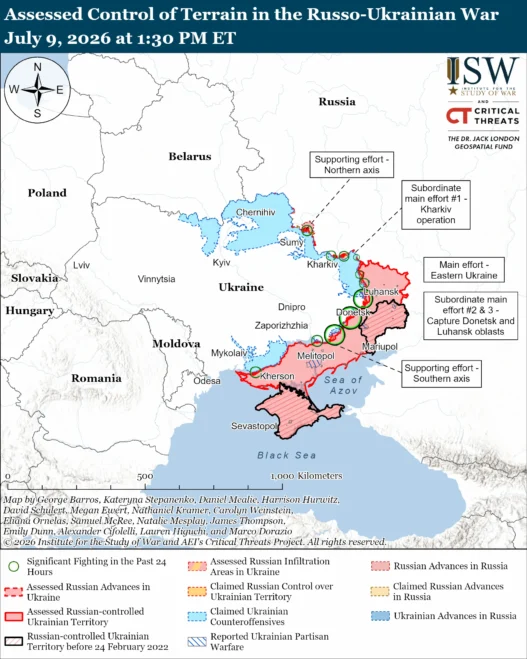
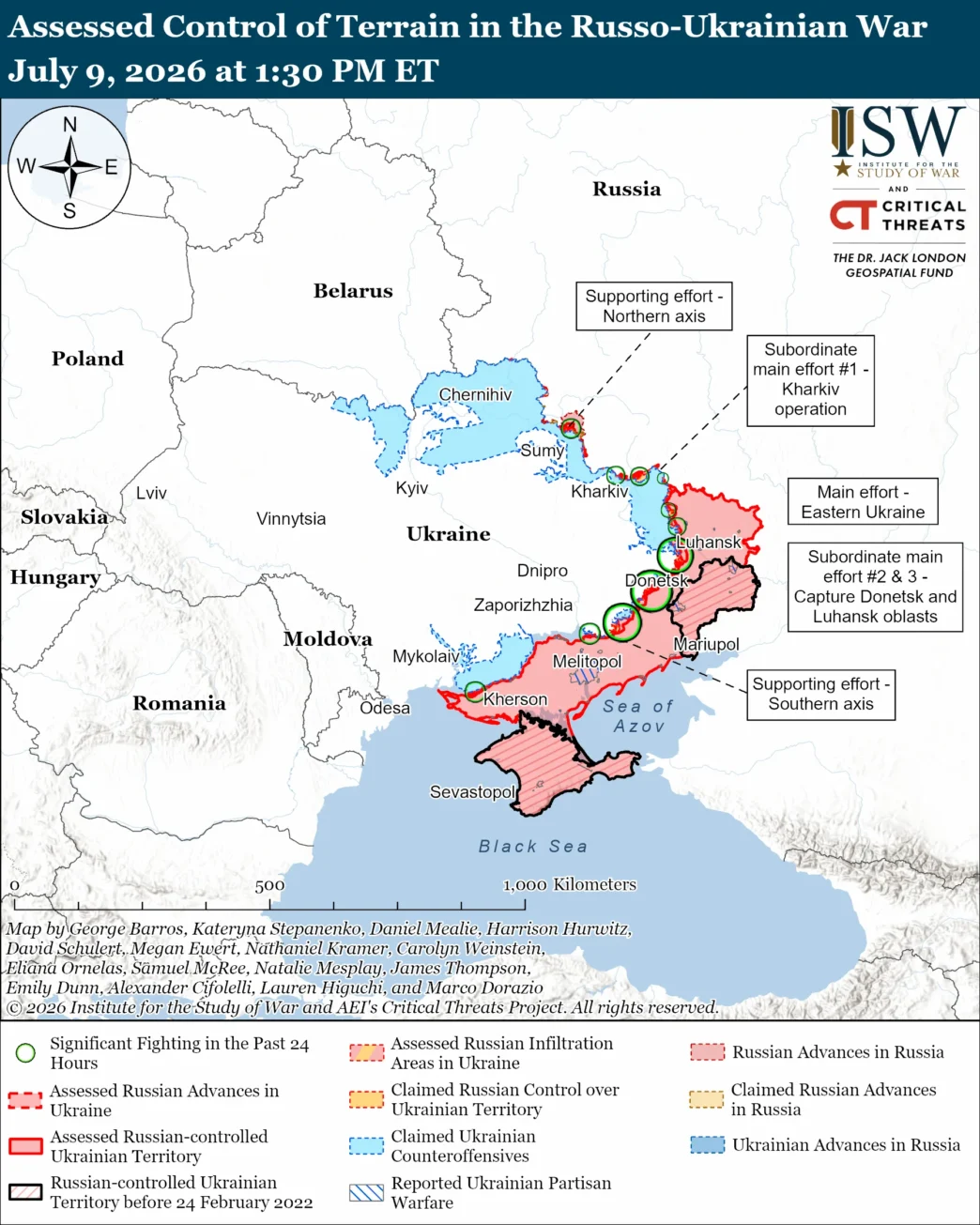
Recently, Putin claimed that Russian troops had “completely liberated” the long-fought-over eastern city of Kostiantynivka, despite Ukrainian forces still controlling parts of the city. He has also claimed that Russia has seized more than 3,000 square kilometres of Ukrainian territory this year. However, analysis of shifting front lines and Ukrainian counteroffensives between January and July 2026 by the Institute for the Study of War (ISW) estimates Russia’s net territorial gains at just 97 square kilometres.
Putin’s exaggerated claims of battlefield success are often reinforced by images of Russian infantry posing beside town squares or other prominent landmarks. These photographs are frequently taken during missions specifically intended to plant Russian flags regardless of whether the area had actually been taken, and as Ukrainian serviceman Andriy, who spent three years on the eastern front, explains “And then we kill them, and they never make it back.”
According to a senior Ukrainian military officer, Putin’s objectives with this disinformation campaign are clear. He is attempting to convince the Russian public that NATO’s support for Ukraine has transformed what was initially presented as a rapid “special military operation” into a full-scale war with NATO. This narrative was reinforced during Putin’s televised meeting with Chief of the General Staff Valery Gerasimov, who repeatedly referred to Ukraine’s “Western sponsors” to portray the conflict as a direct confrontation with NATO.
According to the ISW, Putin is constructing “a reality premised on a rejection of tactical and operational developments.” This propaganda campaign is intended to explain “why the war has to be scaled up, why this is happening, that this is a war already, and that they’re not at war with Ukraine, but with all of NATO.”
This messaging comes as Ukraine continues to conduct increasingly effective strikes against Russian military and economic targets in occupied territories and inside Russia, from the Baltic region to western Siberia. In particular, attacks on oil and gas infrastructure have contributed to fuel shortages, adding to Russia’s mounting economic difficulties.
The Kremlin also appears to be preparing the public for the possibility of a broader mobilization following the parliamentary elections scheduled for 18–20 September. Notably, Kremlin spokesman Dmitry Peskov used the term “war” the day after Putin’s remarks about Ukraine’s “Western sponsors.” This represents a significant rhetorical shift, as thousands of Russians have previously been fined, arrested, or imprisoned for referring to the conflict as a war rather than a “special military operation.”
As Volodymyr Fesenko, head of the Kyiv-based Penta think tank, observed: “As soon as Russia has problems on the frontline, as soon as it faces more military failures, like these days, as soon as there are more strikes on Russian territory, problems with Crimea, with the fuel crisis, it has to be justified, explained to their audience.”
Ukrainian drone strikes deep inside Russian territory have reportedly disabled roughly one-quarter of Russia’s oil refining capacity. The disruption has contributed to widespread fuel shortages, with motorists queuing at petrol stations while the government scrambles to redirect supplies, maintain price controls, and enforce export bans to limit domestic shortages. Russia has also reportedly introduced fuel rationing, limiting petrol sales to 20–30 litres per vehicle, while relaxing fuel quality regulations to permit lower-grade fuel onto the market. To alleviate shortages, Russia has increased fuel imports from neighbouring countries, including Belarus, as well as Asian suppliers. According to Reuters, industry sources estimate that India alone exported between 60,000 and 80,000 tonnes of petrol to Russia.
Military analysts argue that the Kremlin invested in the wrong weapons systems and that Western sanctions have constrained its ability to expand weapons production. Russia has prioritised manufacturing drones, primarily modified Shahed variants, and Iskander ballistic missiles, which provide valuable offensive capabilities but offer little protection for rear-area infrastructure.
According to researcher Nikolay Mitrokhin, Russia would have benefited from investing more heavily in mobile Pantsir air defence systems capable of intercepting Ukrainian medium- and long-range drones. Many of Russia’s other air defence systems were designed primarily to counter high-speed aircraft and Cold War-era missiles rather than large numbers of slow, low-flying drones. Mitrokhin believes Russia would require at least 6,000 Pantsir systems, along with trained crews and sufficient missile stocks, to establish a three-layer air defence network along the approximately 1,200-kilometre front line. As he stated, “But there are none, and none will appear in the nearest future.”
Ukraine’s growing ability to strike deep inside Russia while contesting territory along the front is reflected in changes on the battlefield. According to the Center for Strategic and International Studies (CSIS), Russia’s territorial control in Ukraine declined during the spring of 2026, with a net loss of approximately 400 square kilometres. CSIS attributes this to Ukraine’s increasingly effective campaign of short-, medium-, and long-range strikes against Russian military and economic targets, supported by AI-enabled systems. According to the report, these strikes have contributed to substantially increased Russian casualties, with the casualty ratio from increasing from roughly 2:1–3:1 in Ukraine’s favour to as high as 8:1. The campaign also likely contributed to Putins decision to scale back this year’s Victory Day military parade.
Sources:
Al Jazeera, Al Jazeera, Aljazeera, CSIS, ISW, ISW