









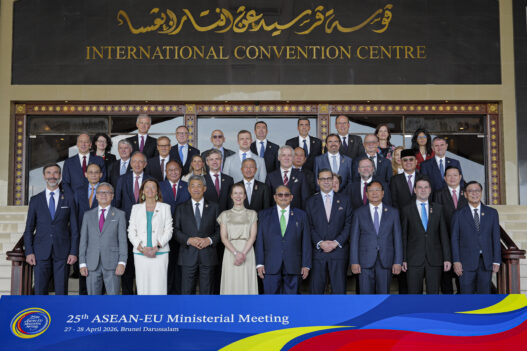
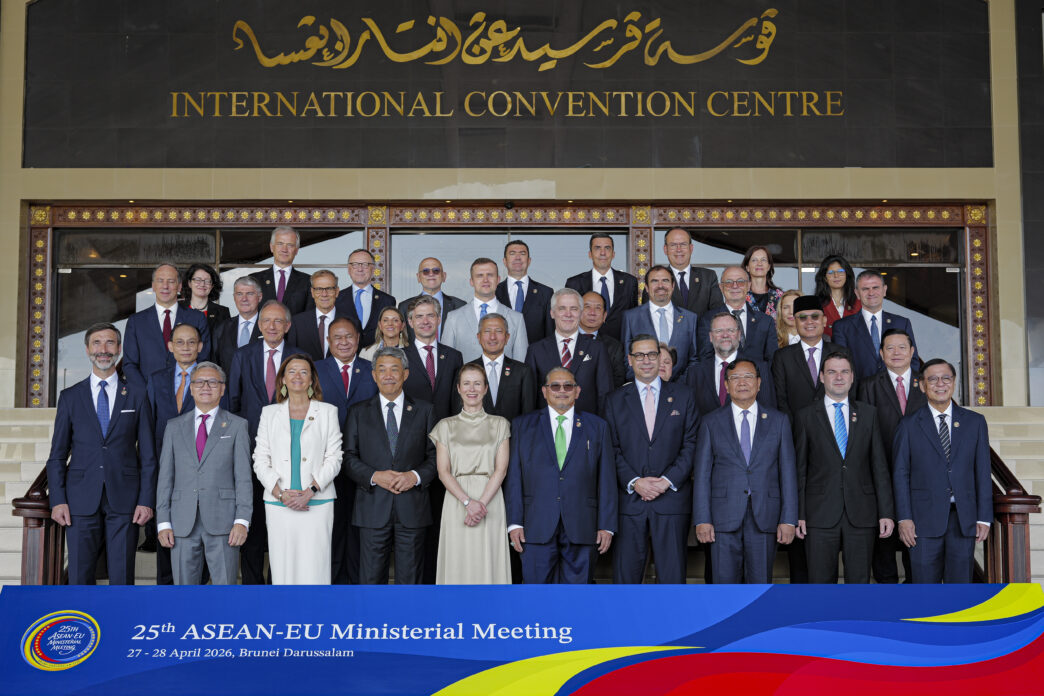
The European Union (EU) and the Association of Southeast Asian Nations (ASEAN) reaffirmed their Strategic Partnership during the 25th EU–ASEAN Ministerial Meeting held in Bandar Seri Begawan, Brunei Darussalam, on 28 April 2026. Marking nearly five decades of dialogue relations ahead of their 50th anniversary in 2027, both sides emphasized cooperation across a wide range of areas, including trade, digital connectivity, climate action, maritime security, disaster management, and sustainable development. Officials from both blocs reiterated their commitment to strengthening political and economic ties while supporting regional stability and a rules-based international order.
The ministerial meeting highlighted ongoing efforts to deepen economic integration between Europe and Southeast Asia. The EU remains ASEAN’s third-largest trading partner and one of its largest sources of foreign direct investment. Discussions focused on expanding trade and investment flows, enhancing digital cooperation, strengthening resilient supply chains, and advancing green transition initiatives. Both parties also welcomed progress in bilateral free trade negotiations between the EU and individual ASEAN member states, while reaffirming their longer-term ambition of establishing a region-to-region trade framework.
Security and geopolitical issues featured prominently in the discussions. The EU reiterated support for ASEAN Centrality and the ASEAN Outlook on the Indo-Pacific (AOIP), emphasizing the importance of ASEAN-led mechanisms in maintaining regional stability. At the same time, the EU expressed interest in expanding cooperation on maritime security, cybersecurity, counterterrorism, and crisis management throughout the Indo-Pacific region. Ministerial statements also addressed developments in the South China Sea, Myanmar, and broader regional security challenges, reaffirming commitments to international law and peaceful dispute resolution.
The meeting also underscored growing cooperation in emerging sectors. Digital governance, artificial intelligence, renewable energy, and critical supply-chain resilience have become increasingly important components of the EU–ASEAN agenda. Both sides emphasized the need to foster sustainable and inclusive economic growth while adapting to technological transformation and global economic uncertainty. These priorities reflect a broader shift in the partnership away from a purely economic focus toward a more comprehensive strategic relationship.
Despite the positive momentum, challenges remain. Trade negotiations continue to face obstacles related to regulatory standards, sustainability requirements, and market access concerns. Several ASEAN states have also expressed reservations regarding certain European regulations, including environmental and carbon-related measures, which some view as potential barriers to trade. Differences in political systems, development levels, and strategic priorities further complicate efforts to deepen integration across all areas of cooperation.
Commentary and opinion by the author:
The most interesting aspect of contemporary EU–ASEAN relations is not trade, investment, or even digital cooperation. It is the EU’s attempt to simultaneously support ASEAN Centrality while expanding its own geopolitical footprint in the Indo-Pacific. This balancing act has become one of the defining features of Europe’s engagement with Southeast Asia.
On paper, the EU consistently emphasizes support for ASEAN-led mechanisms and the ASEAN Outlook on the Indo-Pacific. European officials regularly describe ASEAN as the cornerstone of regional architecture and stress that regional challenges should be addressed through inclusive, multilateral frameworks. Such rhetoric is unsurprising. ASEAN Centrality remains a politically sensitive principle for Southeast Asian states, many of which are wary of external powers dominating regional affairs. Publicly embracing ASEAN’s leadership therefore helps the EU distinguish itself from more confrontational approaches associated with major-power competition.
Yet the EU is no longer content to remain solely an economic actor in Asia. Through its Indo-Pacific Strategy, expanding maritime deployments, security dialogues, defence partnerships, and supply-chain initiatives, Brussels is increasingly positioning itself as a geopolitical stakeholder in the region. Cooperation with countries such as India, Japan, South Korea, and ASEAN members demonstrates that Europe seeks a more active role in shaping the Indo-Pacific security environment. The challenge is that the more influential the EU becomes, the more difficult it may be to maintain the perception that it is merely supporting ASEAN-led structures rather than pursuing its own strategic interests.
This does not necessarily represent a contradiction. ASEAN itself welcomes external engagement that contributes to regional stability and economic development. However, the EU will need to carefully calibrate its actions to avoid appearing as another external actor attempting to shape regional dynamics according to its own priorities. The success of the EU–ASEAN Strategic Partnership may therefore depend less on new agreements or funding commitments and more on whether Brussels can convince Southeast Asian partners that a stronger European presence complements (rather than competes with) ASEAN Centrality. As Europe seeks a larger role in the Indo-Pacific, maintaining that distinction will become increasingly important.
Sources: European Union External Action, ASEAN, European Commission, European Parliament, European Council, Friends of Europe, IGES, Carnegie Endowment, Philippine Institute for Development Studies, Emerging Europe




Thank you for this insighful analysis