









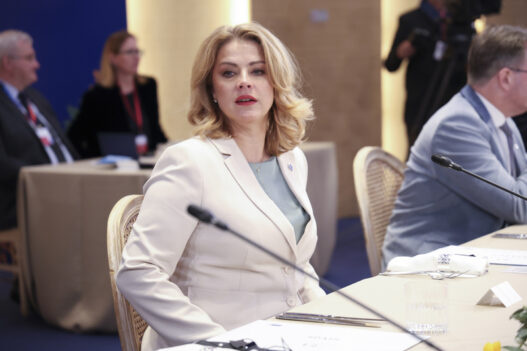
The resignation of Prime Minister Evika Siliņa marks a significant moment in Baltic politics. It reflects the wider geopolitical pressures facing countries on NATO’s eastern flank since the start of the war in Ukraine.
The immediate trigger for the collapse of the Latvian coalition government was a dispute over the handling of suspected Ukrainian drones that entered Latvian territory from Russia, raising concerns about national security preparedness and military coordination. The incursion included at least two drones into Latvian airspace on 7 May. Latvia and Ukraine believed that the drones were intended to target Russia, but their signals had been jammed, leading them into Latvia. There were no casualties or injuries.
The political crisis intensified after Siliņa dismissed her Defence Minister, Andris Spruds, over the response to the drone incidents, a move that angered coalition partners and ultimately led to the withdrawal of support from the ‚The Progressives‘ party. Without a parliamentary majority, the government collapsed less than five months before national elections, creating uncertainty about the country’s political direction amid heightened regional tensions. Siliņa said in a televised statement:
I am resigning, but I am not giving up.
She wrote further on X:
At present, political jealousy and narrow party interests have taken precedence over responsibility. Seeing a strong and professional candidate for the post of Minister of Defence, political talkers chose not a solution, but a crisis.
‚The Progressives’ on the other hand accuse Siliņa of using Sprud as a scapegoat for her own wider failings as Prime Minister.
Evika Siliņa was appointed Latvia’s prime minister in September 2023, heading a three-party coalition government. A centre-coalition led by Evika Siliņa’s ‚New Unity party‘, which included a mix of pro-European liberal and centrist parties, among them the left-leaning ‚The Progressives‘ and the agrarian-centrist ‚Union of Greens and Farmers‘. The coalition was broadly pro-EU, pro-NATO, and strongly supportive of Ukraine.
Under Latvia’s constitution, President Edgars Rinkēvičs is responsible for selecting a new head of government, with parliamentary support, and is set to meet all parliamentary parties on Friday, 15 May. With national elections already scheduled for October, the government’s collapse appears to have effectively launched the election campaign early.
Contextualisation by the author:
Beyond domestic politics, the crisis illustrates the growing pressure on frontline EU and NATO states, such as Latvia, along with the other two Baltic countries, Lithuania and Estonia, which feel increasingly nervous about potential Russian aggression and are therefore strengthening defence capabilities while managing complex security risks linked to the war in Ukraine. Latvia has been a strong supporter of Ukraine and has prioritised defence spending and regional security cooperation under Siliņa’s leadership. The collapse of the coalition, therefore, comes at a sensitive moment for both Latvia and the wider Baltic region, as European governments continue adapting to an increasingly unstable security environment.
Sources: Helsinki Times, BBC and DW.
Further Source: The Guardian