









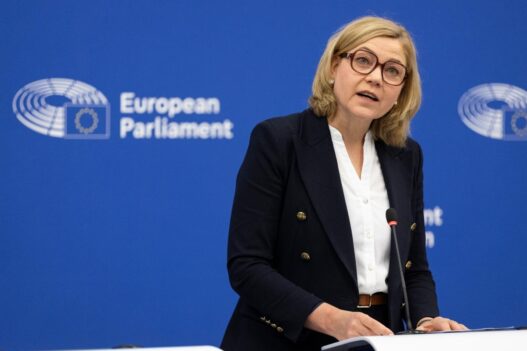
On 18 November 2025, French MP Laure Miller introduced a bill aimed at protecting minors from the risks associated with social media. The proposal includes a ban on social media use for children under 15, a “digital curfew” for teenagers, and restrictions on smartphone use in schools. The ambitious initiative immediately raised a key question: can such policies be effectively designed and enforced at the national level?
The reality is that social media platforms operate at a scale that transcends national and even European borders. Yet given the scope of their influence, there is a growing need for a comprehensive protective framework capable of addressing their societal effects. Miller herself acknowledged the limits of national action against social media, describing platform regulation as a competence inherent to the European Union. Accordingly, the European Union has emerged as a central regulatory actor, notably through the Digital Services Act (DSA).
Social media’s tension between operation and regulation highlights three challenges. First, a scaling problem: national regulations struggle to address transnational platforms. Second, a regulatory constraint: EU member states must operate within an already dense European legal framework. Third, a competitiveness issue: Europe regulates a digital ecosystem largely dominated by non-European actors, raising questions about its capacity to shape and drive the market.
Taken together, these challenges suggest that protecting children online is not merely a matter of adopting stricter rules. Rather, it requires an understanding of the mechanisms through which the European Union can act, as well as the limits of its current approach. 
Why Regulate? The Political and Legal Impetus
The urgency behind Laure Miller’s proposal reflects growing concern about the impact of social media on young users. Adopted by the French National Assembly in January 2026 under an accelerated procedure, the bill was designed to enter into force rapidly. Yet, such a rapid trajectory also illustrates the constraints of multi-level governance.
In a February 2026 interview, Miller argued that, while the Digital Services Act provides an ambitious framework, its implementation remains insufficient in practice. At the same time, recent European Commission guidelines (July 2025) clarified that Member States may introduce certain protective measures, such as age limits within the DSA framework, provided they remain compatible with EU law. This legal ambiguity quickly became apparent when the French Conseil d’État raised concerns about the bill’s compatibility with fundamental rights, including freedom of expression and access to information, as well as its proportionality. These objections forced a substantial revision of the text, but the problem of online protection of minors remained.
The Evidence Base: Between Public Health Concerns and Scientific Debate
Calls for regulation are grounded in a growing body of research focused on the relationship between social media use and adolescent well-being. A 2025 policy brief by the European Commission’s Joint Research Centre, based on PISA 2022 data, shows that 96% of 15-year-olds use social media, with 37% spending more than three hours per day online. High levels of reported anxiety and depression are observed among heavy users, especially among girls.
These findings point to a correlation between intensive social media use and mental health vulnerabilities. Neurobiological research suggests that adolescents may be particularly sensitive to such environments, as ongoing brain development affects impulse control, emotional regulation, and susceptibility to social feedback.
However, the causal relationship remains debated. While authors such as Jonathan Haidt argue that smartphones and social media are a primary driver of rising mental health issues among teenagers, other studies, such as recent reviews published in Nature, warn against oversimplifying the topic, emphasizing the complexity of underlying factors.
Beyond this debate, one element of social media use is increasingly well documented: the role of platform design. Recommender systems optimized for engagement can amplify emotionally charged or harmful content. Investigations into platforms such as TikTok have shown how algorithmic systems can rapidly expose young users to problematic content, including material related to body image and eating disorders. These dynamics are not incidental but rather reflect structural features of attention-driven business models.
In this sense, it is not only about how much time adolescents spend online, but also about how digital environments are designed and how these designs interact with existing vulnerabilities.
From Public Health to Geopolitics: Social Media as a Strategic Vulnerability
Concerns about the mental health effects of social media also raise broader political questions. If digital platforms shape information exposure, social interactions, and perceptions of public debate, they become more than private communication tools. Instead, they can be used to influence public debates, creating a form of structural vulnerability. Users, particularly younger ones, are exposed not only to advertisements but also to potential forms of political influence and manipulation. In this context, social media can be understood as a tool of what some analysts describe as “cognitive warfare”: the strategic attempt to influence perceptions, beliefs, and behaviors at scale. Recent controversies illustrate such concerns. Allegations surrounding the use of TikTok in electoral contexts, or the visible political positioning of social media platform owners such as Elon Musk, have raised questions about the role of digital platforms in democratic processes. While direct causal effects are difficult to establish, research suggests that social media contributes to individual perceptions of societal polarization, even when the underlying opinions may be less divided. The perception of fragmentation alone can itself be politically consequential. By shaping how individuals interpret the public sphere, platforms may create vulnerable conditions that can be instrumentalized by domestic or foreign actors. Children and adolescents, as particularly exposed users, become a critical point of entry in this broader geopolitical landscape. From this perspective, the regulation of social media is not only a matter of individual protection, but also of democratic resilience.
Scaling Up: What the European Union Can (and Cannot) Do
If national regulatory initiatives tend to quickly run into legal and practical limits, it is due in part to the fact that the European Union has already positioned itself as the central regulator of digital platforms. Over the past decade, it has built a dense framework aimed at structuring the online environment, with the protection of minors as an explicit objective.
The cornerstone of this approach is the Digital Services Act (DSA), adopted in 2022. Rather than regulating individual pieces of content, the DSA targets systemic risks. Platforms are required to assess and mitigate risks linked to their services, including those affecting minors’ mental health and well-being. The regulation also restricts targeted advertising to known underage users and mandates greater transparency, notably by granting researchers access to platform data.
The DSA framework has been complemented by non-binding Commission guidelines published in July 2025. These outline concrete measures that platforms are expected to implement, such as private accounts by default for minors, limits on addictive design features (like autoplay or streaks), and stronger safeguards around recommender systems. While these guidelines may not carry the force of law, they do shape expectations and enforcement priorities that national law enforcement agencies can enact.
Other policy instruments also contribute to this regulatory architecture, most notably the General Data Protection Regulation (GDPR), which has become a benchmark for European digital regulation. In the field of child protection, the GDPR establishes rules governing children’s consent to data processing, while allowing Member States some flexibility in determining the applicable age threshold. This approach reveals the EU’s broader regulatory philosophy. Rather than banning platforms outright or imposing sweeping restrictions on access, European regulation primarily seeks to shape the conditions under which digital services operate. The objective is more to constrain harmful practices and encourage safer digital environments than to prohibit social media.
Recent attempts seeking to ban teenagers from social media illustrate both the political pressure on national governments to act and the limits of prohibition-based strategies. Such measures risk ineffectiveness through circumvention, while also potentially deepening tensions between public authorities and younger users. Moreover, the problems associated with social media are not limited to minors alone. Issues related to addictive design, disinformation, online harassment, or unhealthy behavioural patterns affect adults as well, suggesting that the challenge is ultimately broader than child protection alone. The central question, therefore, is not simply whether young people should access social media, but how online environments can be made safer by design for all users.
The Limits of Regulation: Structural Constraints and Policy Trade-offs
Most major social media platforms operating in Europe are developed and controlled by non-European companies. Despite calls and attempts to create a European digital ecosystem with its own social media, these initiatives struggle to emerge. This creates an asymmetry: while the EU can impose rules, it has limited influence over the design choices and business models that shape these platforms. Regulation reacts to existing technologies, rather than adopting a proactive capacity to define alternative models, creating an issue of external dependency.
Second, the EU operates within a regulatory asymmetry. Platforms innovate rapidly by continuously adapting their features and algorithms. By contrast, regulation is inherently slower, constrained by legislative processes and legal safeguards. Even when rules such as the DSA are in place, their enforcement remains complex and resource-intensive, raising questions about their real-world impact.
Third, there exists a social and behavioural constraint. Restrictive measures such as age bans or usage limits may lead to circumvention, especially among teenagers. Workarounds, alternative platforms, or informal access can undermine regulatory objectives, sometimes exposing users to even less controlled environments. It also creates the risk of having a less informed youth, who then might be less prepared to understand the complexity of current events. There is thus a policy dilemma. Overly strict rules risk being ineffective or counterproductive. At the same time, insufficient intervention leaves existing harms unaddressed.
Finally, these challenges are compounded by the need to respect the EU’s commitment to fundamental rights. Any measure restricting access to online services must be proportionate and compatible with freedoms such as expression and access to information. This constraint, highlighted by the French Conseil d’État, limits the scope of national and European interventions alike.
In this context, regulation alone appears insufficient. While it can reduce certain risks, it cannot fully resolve the tensions between protection, innovation, and freedom that define the digital environment.
Beyond Regulation: Europe’s Digital Strategy
The debate triggered by Laure Miller’s bill goes beyond the question of protecting children from social media. It reveals a broader challenge for European digital governance.
Over the past years, the European Union has developed one of the most advanced regulatory frameworks in the world. Through instruments like the Digital Services Act and the GDPR, it has sought to make online platforms more accountable and safer, particularly for vulnerable younger users. Yet its approach remains fundamentally reactive: it regulates risks without fully shaping the systems that produce them.
This creates a structural tension. Europe acts as a regulator of a digital ecosystem largely designed and implemented elsewhere. As a result, the EU can constrain harmful practices, but struggles to redefine the underlying dynamics of attention, engagement, and data exploitation that drive platform behaviour.
Protecting minors online, therefore, raises a deeper question: can the EU move from regulating digital markets to actively shaping them? This would require not only stricter enforcement of existing regulations, but also an investment in alternative infrastructures, support for European innovation, and a clearer vision of what a “European” digital environment should look like.
In that sense, the issue is not simply whether or not children should be allowed on social media. It is whether Europe can assert meaningful control over the digital public sphere in which they are growing up.