








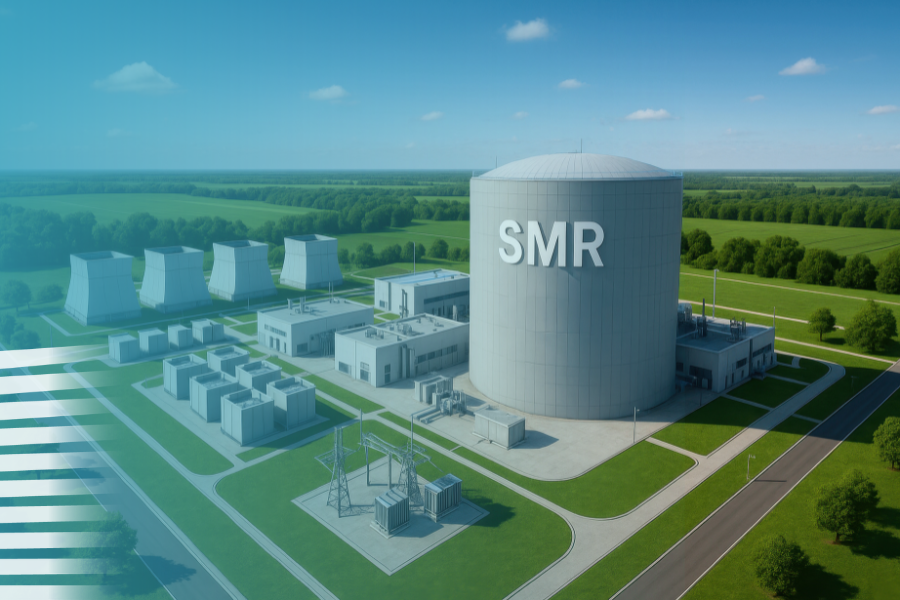
On 10 March 2026, the European Commission presented a new strategy to accelerate the development and deployment of Small Modular Reactors (SMRs). The plan aims to bring the first operational SMRs in Europe online by the early 2030s, with the goals of enhancing energy security, supporting climate objectives, and strengthening industrial competitiveness.
What are Small Modular Reactors?
SMRs are compact new generation nuclear reactors that typically produce up to 300 MW(e) of electricity per module—much smaller than conventional nuclear plants, which often exceed 1,000 MW. Their key feature is modularity, allowing components to be manufactured off-site and assembled on-site. This approach can potentially reduce construction time, costs, and financial risks.
SMRs can also complement renewable energy systems by providing stable, low-carbon electricity and heat for industrial processes and district heating applications. Several countries—including the United States, Canada, the United Kingdom, South Korea, Russia, and China—are actively developing SMR designs. Some projects are already connected to the grid or under construction, highlighting the technology’s growing global momentum.
The European Strategy
The EU’s strategy, structured around nine key actions, aims to build the industrial and regulatory foundations needed to develop a competitive European SMR supply chain. A central pillar is the European Industrial Alliance on SMRs, which brings together industry, research institutions, and public authorities to coordinate and select early demonstration projects.
Beyond energy production, the initiative reflects a broader industrial ambition: ensuring that Europe remains competitive in a sector where the United States, Russia, and China are moving rapidly. The strategy also stresses the need for coordinated action among member states to meet the target of deploying the first SMRs in the early 2030s.
Opportunities and Challenges
Nuclear energy remains a politically sensitive issue in Europe, and the debate around SMRs reflects this complexity. According to the International Atomic Energy Agency (IAEA), SMRs offer several potential advantages, including enhanced safety features resulting from simplified and modern designs, modular construction that enables factory fabrication and faster on-site assembly, and the ability to supply low-carbon electricity and heat to regions with limited grid capacity or to industrial sites requiring dedicated energy.
Their smaller scale may also make them suitable for remote areas and for integration with renewable energy systems, supporting a more flexible and resilient energy mix.
However, significant challenges remain. Most SMR designs are still under development, and the economic benefits of serial production will materialise only if a sufficiently large market emerges. Public acceptance may also pose a challenge, particularly in EU countries with limited or no nuclear experience or with strong anti-nuclear sentiment. In addition, regulatory harmonisation, licensing procedures, and cost-related concerns add further layers of complexity as Europe considers SMR deployment in the 2030s.
Sources:
- https://www.oecd.org/content/dam/oecd/en/publications/reports/2021/04/small-modular-reactors_c7224a6a/18fbb76c-en.pdf
- https://www.iaea.org/newscenter/news/what-are-small-modular-reactors-smrs?utm_
- https://energy.ec.europa.eu/topics/nuclear-energy/small-modular-reactors/small-modular-reactors-explained_en?utm_
- https://energy.ec.europa.eu/news/commission-unveils-strategy-bring-europes-first-smrs-online-early-2030s-2026-03-10_en
- https://eur-lex.europa.eu/legal-content/EN/TXT/?uri=CELEX%3A52026DC0117&qid=1773310096275
- https://ec.europa.eu/eurostat/statistics-explained/index.php?title=Nuclear_energy_statistics
- https://single-market-economy.ec.europa.eu/industry/industrial-alliances/european-industrial-alliance-small-modular-reactors_en#who-can-join-the-alliance-and-how