









Table of Contents
A concise weekly digest offering sharp insights into Europe’s role on the global stage and the forces shaping politics, society, and policy within the continent. Europe in the World tracks the Union’s external influence, strategic choices, and international challenges, while Inside Europe distils the key developments driving internal dynamics across member states.
Europe in the World
Photo by Dominik Lückmann on Unsplash
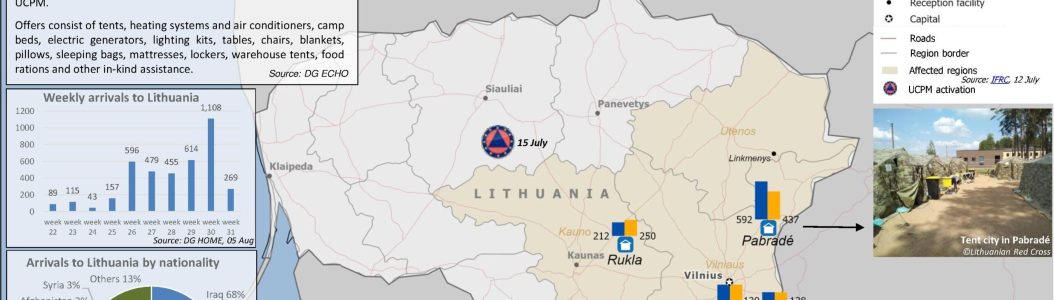
- CC BY 4.0 / © Photo by ERCC (Lithuania - Migrant Influx EU Civil Protection Mechanism response, 5 August 2021.)
Europe Tests International Law on Migrant Instrumentalisation
- Maximilian Schlenker
The European Union has submitted observations in Lithuania’s case against Belarus before the International Court of Justice. The dispute asks whether a treaty created to combat migrant smuggling can cover state-organised migration pressure used for geopolitical ends.
A border crisis reaches The Hague
On July 20th, 2026, the European Union furnished observations to the International Court of Justice in proceedings brought by Lithuania against Belarus. The EU participates as an international organisation.
Lithuania opened the case in May 2025. Its application alleges that Belarusian authorities organised and supported the movement of migrants towards the Lithuanian border from 2021 onwards. Lithuania claims that Belarus facilitated travel into the country, transported people towards the frontier and assisted irregular crossings into an EU Member State.
Lithuania describes the operation as migrant smuggling on a large scale, and accuses Belarus of breaching the United Nations (UN) Smuggling of Migrants Protocol. The case now places a European security dispute before the UN’s principal judicial organ.
The legal question extends beyond the events at the border. The Protocol targets the facilitation of irregular entry for financial or another material benefit. Lithuania is asking the Court to apply that framework to an operation allegedly directed by a state and designed to exert political pressure on the European Union.
Instrumentalisation and smuggling
For context, let’s take a look at the terms used in this case. Migrant instrumentalisation describes the use of migration flows to pressure or destabilise another state. Migrant smuggling means procuring illegal entry in order to obtain, directly or indirectly, a financial or another material benefit. The concepts may overlap, though they rest on different legal foundations.
The legal gap
This distinction sits at the centre of the case. Lithuania’s application describes an organised system involving travel routes into Belarus, transport towards the border and assistance with irregular crossings. Some individuals and companies allegedly received payments for their role in the operation.
These details resemble the conduct covered by the Smuggling of Migrants Protocol. But the wider strategy presents a harder question. Lithuania argues that Belarus used migration to retaliate against European sanctions and place pressure on the European Union. Political leverage differs from the financial or material gain that shaped the Protocol’s original focus.
The Court may have to decide how these two levels fit together. It could examine the benefits received by individual actors, the role of Belarusian state bodies and the political purpose of the operation as parts of a single system. The answer will show how far an existing criminal-law treaty can reach when a state adopts methods usually associated with private smuggling networks.
Why this matters for Europe
The case could give international legal weight to a concept already embedded in the EU’s migration framework. A ruling in Lithuania’s favour would strengthen Europe’s claim that state-organised migration pressure can trigger international responsibility. At the same time, European responses must preserve access to asylum, non-refoulement and protection against collective expulsion. Europe faces a dual task. It must confront the state directing the movement while protecting the people caught within it.
Info boxes provided by Laksmitha Anindyanari:
Non-refoulement is a principle of international refugee and human rights law that prohibits states from returning or transferring people to a country where they face a serious risk of persecution, torture, or other serious harm. It is a fundamental protection for refugees and asylum seekers and means that governments must consider the risks individuals may face before removing them from their territory.
Collective expulsion refers to the removal of a group of people from a country without individually examining the circumstances of each person’s case. International human rights law generally prohibits collective expulsions because authorities must assess each individual’s situation before removing them, particularly where people may face persecution or other serious harm upon return. This principle is intended to prevent governments from summarily removing groups of migrants or asylum seekers without due process.
What comes next
The proceedings before the ICJ are at an early stage. The Court will first address procedural and jurisdictional questions before reaching the merits. Its eventual ruling may expand the reach of the UN Smuggling Protocol or expose the need for a more specific international framework.
Sources
- https://www.icj-cij.org/index.php/node/206457
- https://www.icj-cij.org/case/200
- https://icj-cij.org/sites/default/files/case-related/200/200-20250519-app-01-00-en.pdf
- https://www.unodc.org/documents/middleeastandnorthafrica/smuggling-migrants/SoM_Protocol_English.pdf
- https://www.unodc.org/documents/human-trafficking/Migrant-Smuggling/Issue-Papers/UNODC_Issue_Paper_The_Profit_Element_in_the_Smuggling_of_Migrants_Protocol.pdf
- https://fra.europa.eu/en/publication/2025/countering-instrumentalisation-of-migrants
- https://www.europeanpapers.eu/system/files/pdf_version/EP_EF_2023_I_010_Mirko_Forti_00648.pdf
- https://eur-lex.europa.eu/legal-content/EN/TXT/PDF/?uri=OJ:L_202401359
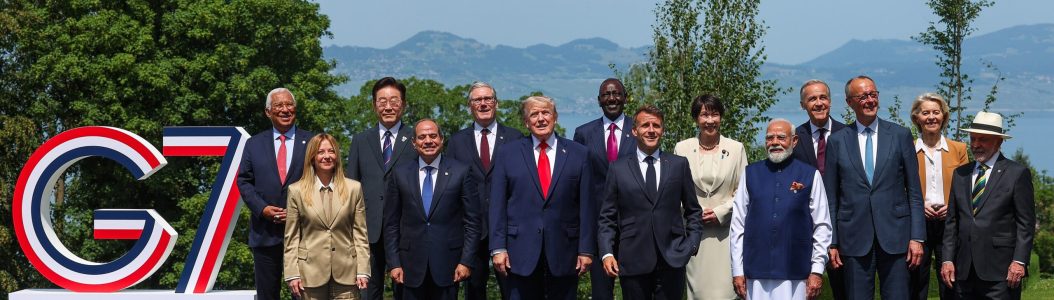
- <a href="https://www.data.gov.in/sites/default/files/Gazette_Notification_OGDL.pdf" © Photo by Ministry of External Affairs (India) (World leaders on family photo at the 52nd G7 Summit in Évian, France.)
G7 Evian: Unity on Display, Strategic Autonomy Tested for the European Union
- Chloé BAMBERGER
Key takeaways
The Evian G7 summit (15–17 June 2026) produced nine thematic joint declarations covering geopolitical crises (Ukraine, the Middle East, Lebanon), macroeconomic imbalances, digital and AI governance, critical minerals, health, and illicit trafficking. Leaders projected strong political unity, notably through reinforced military and economic support for Ukraine and a shared commitment to freedom of navigation in the Strait of Hormuz, while avoiding open public disagreements between Washington and its European partners. For the European Union (EU), the summit both reinforced its profile as a regulatory power (AI, migration, anti-trafficking) and highlighted persistent vulnerabilities, notably its dependence on Chinese markets and technologies and its exposure to increasingly protectionist US trade and industrial policies.
A united front masking strategic constraints
The EU was represented by the Presidents of the European Council and the European Commission, alongside France (host), Germany and Italy. Although European actors formed a majority around the table, they remained politically and economically constrained by US leverage over security guarantees, market access and technology ecosystems.
Under the French presidency, the agenda focused on macroeconomic imbalances, resilient supply chains—particularly for critical minerals—and AI governance. This approach sought to balance US calls for a tougher stance on China with the EU’s interest in preserving export markets and investment flows. Media analyses nevertheless pointed to managed tensions over trade, energy, automotive policies and the green transition. France’s decision to remove climate from the core joint declarations to avoid direct confrontation with Washington has been widely interpreted as a revealing compromise for European climate leadership.
Strategic signals for the European Union
The decision to adopt multiple thematic declarations instead of a single communiqué reflects an effort to project operational unity despite deeper divisions over trade and China. While the emphasis on macroeconomic coordination and the IMF places the EU within a familiar multilateral framework, it does little to address Europe’s limited strategic autonomy in the face of persistent US industrial and trade protectionism.
The focus on critical minerals, AI and illicit trafficking further consolidates the EU’s role as a regulatory power, while exposing a transatlantic divide. US policymakers often view European regulation both as a constraint on innovation and as a geo-economic instrument. This matters for partners such as Japan and Canada, which see the EU as both a regulatory benchmark and a key market, while remaining concerned about diverging transatlantic standards.
Most significantly, the removal of climate from the summit’s central agenda sends a challenging signal for the EU’s Green Deal diplomacy. It suggests that the Union will increasingly rely on other forums—such as internal EU processes, the UN climate regime and the G20—to advance its climate agenda.
The Evian G7 therefore matters less for the formal outcomes and more for what it reveals: an EU that remains central to Western coalition‑building on Ukraine and economic governance, but whose room for manoeuvre on trade, China and climate continues to be shaped by US preferences and Europe’s own structural dependencies.
Sources
Author:
Chloé BAMBERGER
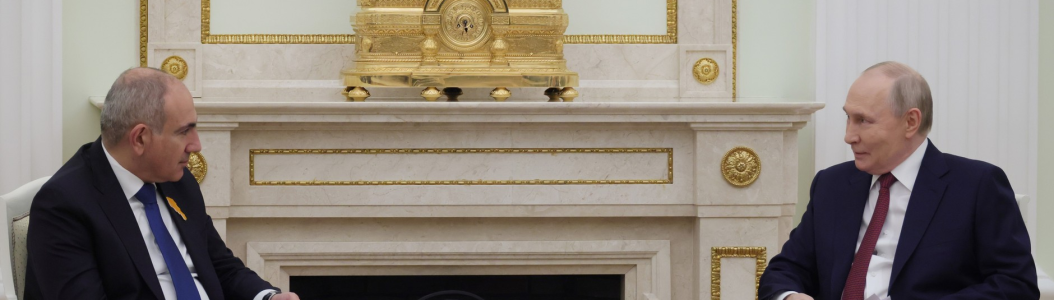
- CC BY 4.0 © Photo by kremlin.ru (Vladimir Putin and Nikol Pashinyan, April 2026.)
EU Welcomes Armenia’s Pro-Europe Election Results, but Can It Offer an Alternative to Russian Trade?
- Lena Sahakyan
Armenia’s most recent parliamentary elections reaffirmed the ruling party’s mandate and, with it, the country’s European course. Brussels, of course, welcomed the result, and the EU Commission President Ursula von der Leyen praised “a democratic Armenia that is drawing ever closer to Europe.” Yet, many Armenians find themselves anxious as to how Moscow will respond to the country’s growing distance from Russia.
“Armenia can count on us,” von der Leyen concluded in a statement on her X account. The country could indeed count on Europe, particularly in establishing new trade ties following Russia’s “strategic” ban on several Armenian products ahead of the key elections. In the past couple of weeks, Russia, Armenia’s largest export market, has banned several products from entering the local market. From alcoholic beverages that stopped “meeting mandatory requirements” to berries and vegetables flagged with an “increased number of violations,” this echoes Russia’s repeated warnings to Armenia regarding the consequences of its warmer ties with the EU.
Moscow Responds to Armenia’s European Aspirations
On June 10th, the Russian Foreign Minister Sergei Lavrov reminded Armenian authorities that the country cannot “sit on two chairs.” Accusing Western powers of interfering with Armenia’s elections, Lavrov highlighted that Armenia has to urgently decide whether it remains part of the post-Soviet military alliance, the Collective Security Treaty Organization (CSTO), and the Eurasian Economic Union (EEU) or moves ahead with the EU. He stressed that Russia respects the Armenian people’s right to decide through a referendum but wants clarity on Yerevan’s long-term direction, noting that such a choice would have major economic and regulatory consequences.
Tensions over Armenia’s European aspirations surfaced last year when the Armenian parliament approved a bill on European integration. Moscow responded by warning Yerevan that closer alignment with Europe could affect existing economic arrangements, including energy agreements. Armenian officials sought to reassure Russia, with the Foreign Ministry emphasizing that Moscow remains a reliable partner with which Armenia shares extensive ties.
Following the parliamentary elections, Prime Minister Nikol Pashinyan downplayed suggestions of a drift with Russia, stating that relations between the two countries are based on mutual respect and institutional cooperation. He told reporters that he did not see any real tension in ties between Yerevan and Moscow despite Armenia’s ongoing efforts to deepen relations with the European Union.
Does Europe Offer an Alternative?
European leaders welcomed the election results and reaffirmed their support for Armenia’s democratic strengthening. French President Emmanuel Macron expressed support for strengthening Armenia’s rapprochement with Europe. The EU Council shared a Statement by the High Representative reassuring the EU’s steadfast commitment to deepening the partnership with Armenia.
“We look forward to continuing our close cooperation with the future government and parliament of Armenia, to implement their comprehensive reform agenda, promote regional peace, economic growth and connectivity, with a view to strengthening Armenia’s sovereignty, resilience, democracy and prosperity.”
Labeling Russia’s sudden import barriers as “economic coercion,” Ursula von der Leyen announced the preparation of an EU support package for Armenia, including financial assistance worth over 50 million euro to ease trade for agricultural producers.
The EU Commission president also noted, that the EU has already organized practical support for affected sectors, such as flowers, including a shipment of 10,000 flowers to Latvia.
“We will also keep connecting our businesses, following up on the commitments taken at our recent Summit in Yerevan.” concluded von der Leyen.
While Armenian authorities face the challenge of finding alternative markets for local producers to mitigate the foreseeable impact of Russia’s export bans, European leaders welcome and praise the election results. This support will need to be reflected in sustainable trade alternatives, rather than primarily emergency responses such as the recent action plans.
Sources: European Council press release, European Commission press corner, OC Media, The Moscow Times, ArmenPress, Congratulatory Telegram,
Author: Lena Sahakyan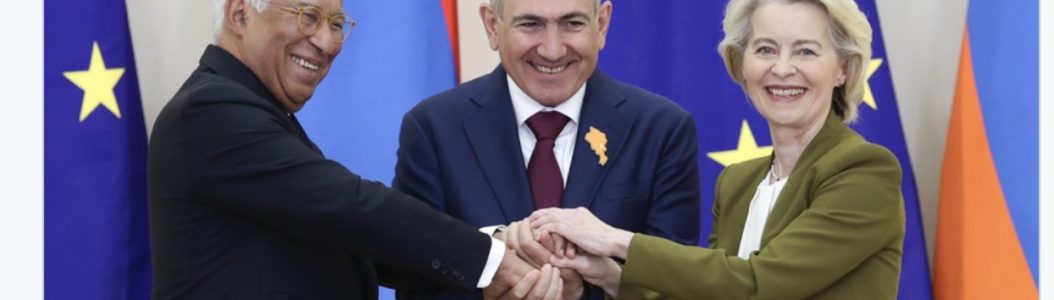
- © European Council, 2026, photo by Alexandros MICHAILIDIS (EU-Armenia summit, Joint press conference, 05.05.2026.)
A pause to examine Armenia’s path toward EU membership after the EPC summit
- Lena Sahakyan
On May 4, Armenia hosted the eighth European Political Community summit in its capital, Yerevan, which EU Council President António Costa called a “historic opportunity” to bring the country closer to the European Union.
The summit, held in the South Caucasus for the first time, was co-chaired by António Costa and the Armenian Prime Minister Nikol Pashinyan. Costa framed the meeting not only as a diplomatic milestone for Armenia, but also as part of a broader reassessment of European security architecture.
Leaders discussed economic security, democratic resilience, regional connectivity, and Europe’s evolving geopolitical challenges. In his remarks in Yerevan, Costa emphasized the growing need for what he called a “360-degree vision” of Europe’s security.
In the current geopolitical context, it is increasingly clear that our continent needs a 360º degree vision for its security. Meeting here, in Armenia, in the South Caucasus, so close to the Middle East – it is a stark reminder that war in Europe’s neighbourhood has a direct impact on our common security, our energy supply and our economy.
For Armenia, the summit came during a period of significant geopolitical transition. In recent years, the country has sought to diversify its foreign policy partnerships amid deteriorating security conditions in the region and growing dissatisfaction with Russia’s security commitments.
Located at the crossroads of Europe and Asia, Armenia has faced increasing security challenges following the 2020 Nagorno-Karabakh war, the following blockade of Nagorno-Karabakh, and Azerbaijan’s 2023 military offensive that led to the displacement of the region’s Armenian population. Against this backdrop, Armenian authorities viewed closer ties with the European Union as a means of strengthening political and economic resilience.
How far has Armenia’s path to the EU progressed?
Armenia’s relations with the EU have developed since its independence in 1991. However, the prospect of an eventual EU membership has only gained increased political traction in recent years.
The shift accelerated following Armenia’s ratification of the Comprehensive and Enhanced Partnership Agreement with the EU, which entered into force in 2021 and has since then established frameworks for cooperation in government reforms, trade and democratic institutions.
In March 2024, the European Parliament adopted a resolution stating that Armenia could apply for EU membership in the future, provided it satisfies the Copenhagen criteria, the political and economic conditions required of candidate states. Several months later, in September 2024, the Armenian government launched a petition initiative calling for a referendum on whether the country should pursue EU membership. Prime Minister Nikol Pashinyan later confirmed that initiating the EU accession process had become part of Armenia’s political agenda.
Still, Armenia remains far from formal accession talks. Unlike candidate countries such as Ukraine, Moldova, or Georgia, Armenia has not submitted an official application for membership and continues to balance its European ambitions with existing regional and economic dependencies, including its membership in the Russian-led Eurasian Economic Union.
At the same time, cooperation between Armenia and the EU has visibly intensified. Brussels has expanded political dialogue with Yerevan, deployed a civilian monitoring mission on Armenia’s border with Azerbaijan, and increased financial assistance aimed at democratic reforms and economic development in the country.
The EPC summit in Yerevan did not bring immediate changes to Armenia’s status within the European Union. However, by placing Armenia at the center of a major European diplomatic gathering, it underscored how the country’s relationship with Europe is becoming an increasingly important part of both regional politics and the EU’s broader strategy.
Whether Armenia will solidify its interest in beginning the path towards EU membership still remains a distant prospect. However, it is clear that what was once a largely symbolic path is now at the forefront of the country’s ruling party agenda. At the same time, the country’s parliamentary elections scheduled for June 7, and its subsequent political developments, will play a key role in shaping these ambitions.
Sources: European Council, Press release by António Costa, European Parliament Resolution May 13, Eastern Partnership CSF.
Author: Lena Sahakyan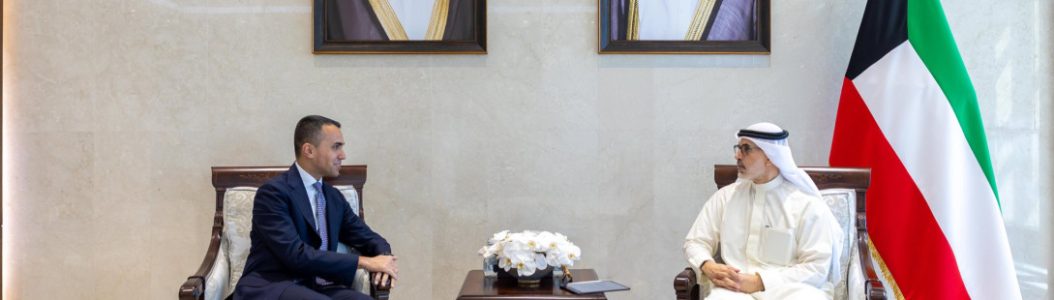
- © European Union, 2026, photo by EU (EU Special Representative for the Gulf, Luigi Di Maio, visits Kuwait amid rising tensions, 31.03.2026).
From the Gulf to Asia: How the EU Is Expanding Its Security Network
- Sebastian Dodd
The EU has called for an agreement modelled on the Black Sea Grain Initiative to help reopen the Strait of Hormuz amid the Iran conflict, EU Special Representative for the Gulf Region Luigi Di Maio told Euronews. “After the beginning of the war in Ukraine, we managed, as an international community, to strike a deal between Russia and Ukraine to ensure humanitarian corridors in the Black Sea. We have to do the same with the Strait of Hormuz. We have to guarantee freedom of navigation in the international waters of the Strait of Hormuz,” he said. Di Maio added that EU High Representative Kaja Kallas had spoken with UN Secretary-General António Guterres to advance this diplomatic initiative.
The EU’s representative to the Gulf Cooperation Council is currently undertaking a broad regional tour as the EU-GCC strategic partnership gains momentum. Since the outbreak of the U.S.-Iran war, Europe has moved quickly to support Gulf states, including by providing equipment for self defense and condemning Iran’s attacks across the region. Ukraine has also become increasingly active in the Gulf, offering counter-drone expertise to regional partners in exchange for air defense support as Kyiv seeks to deepen its security ties in the Middle East. Ukrainian President Volodymyr Zelenskyy recently met with Syrian interim President Ahmad al-Sharaa following a visit to Turkey, resulting in a pledge to expand bilateral security cooperation. The EU has expressed support for Ukraine’s efforts to build these partnerships.
Regarding ongoing U.S.-Iran peace talks, Di Maio said the EU supports the “Islamabad initiative” and seeks “a structured solution to this conflict.” He also noted that, over the past year, the EU and Gulf states have been working to deepen their strategic partnership. The war in Iran, however, has transformed this effort into an even greater opportunity to deepen security and defense cooperation.
The Middle East is not the only region where Europe has been strengthening ties. Earlier this year, the EU and India signed a free trade agreement alongside a Security and Defence Partnership, while several European states have also concluded bilateral agreements with New Delhi. Relations between Japan and the EU have likewise reached unprecedented levels, evolving from a primarily trade-based relationship into a broad strategic partnership. This transformation was anchored by the 2019 Strategic Partnership Agreement and Economic Partnership Agreement, which together created one of the world’s largest economic areas.
More recently, in 2024, the EU and Japan launched the EU-Japan Security and Defence Partnership, one of the first such agreements between the EU and an Asia-Pacific country. The pact formalized deeper military and intelligence cooperation. In the economic sphere, Japan and Europe are also working to strengthen supply-chain resilience, secure access to critical technologies and raw materials, and coordinate international standards to reduce vulnerability to external shocks and economic coercion. In late 2024, the EU also signed a Security and Defence Partnership with South Korea.
These developments come at a pivotal moment for Japan. Tokyo’s foreign policy is focused on stabilizing East Asia, deterring China, and preserving freedom of navigation in the South China Sea, objectives that have traditionally depended on sustained U.S. engagement. However, the U.S. redeployment of military assets from the Pacific to support operations in Iran has raised concerns in both Japan and South Korea about Washington’s long-term commitment to the region. President Donald Trump’s recent decision to redeploy missiles from South Korea to the Middle East has further heightened these anxieties. As a result, Japan has continued to strengthen ties with Europe, viewing closer cooperation as a means of bolstering deterrence against China and drawing greater international attention to Indo-Pacific security.
Overall, Europe is steadily expanding and deepening its network of partnerships in pursuit of greater strategic autonomy. In many ways, this mirrors the United States’ post-World War II strategy of building a broad alliance system to project power and shape the international order. Whether Europe ultimately follows a similar trajectory will depend on the continued development of its military capabilities and the resilience of these emerging partnerships.
Sources:
EEAS, EEAS, EU Commission, Euronews, Euronews, Euronews, Japan Ministry of Foreign Affairs
Author: Sebastian Dodd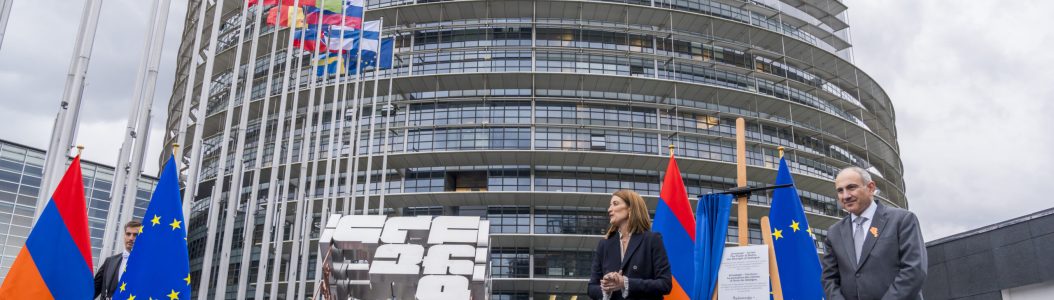
- © European Parliament, 2026. photo by Daina LE LARDIC (METSOLA, EP President and PASHINYAN, Armenian Prime Minister, inaugurate the sculpture 'Armatagir — Script: The Power of Roots, the Strength of Dialogue ', 11.3.2026.)
The 8th European Political Community Summit in Yerevan: challenges and prospects
- Chloé BAMBERGER
The eighth summit of the European Political Community (EPC) will convene in Yerevan on 4 May 2026, followed by the first-ever EU-Armenia Summit on 5 May. This consecutive hosting of both summits represents an exceptional and historic political signal of pan-European solidarity with Armenia, an EU candidate country since March 2025.
The EPC: origins and strategic objectives
Created in October 2022 at the initiative of French President Emmanuel Macron in response to Russia’s aggression against Ukraine, the EPC brings together over 40 European leaders to foster “strategic intimacy” and strengthen cooperation on continental challenges including security, stability and prosperity. The platform explicitly distinguishes itself from the EU enlargement policy, instead aiming to stabilise European borders and rebuild relations with countries such as the United Kingdom, Turkey and Ukraine. Priority areas include energy, critical infrastructure, cybersecurity, migration and regional cooperation.
The EPC operates without a permanent secretariat, dedicated budget or staff, with each summit organised by the host country supported by a limited French taskforce established in January 2023. This deliberate informality constitutes both its strength and weakness: it enables frank exchanges between leaders without the constraint of binding final declarations, but raises questions about transparency, accountability and capacity to deliver tangible results.
Summit agenda: beyond the Armenian dimension
While Armenia’s hosting holds particular significance, the Yerevan summit will address broader European challenges under the theme “Building the Future: Unity and Stability in Europe”. According to the Finnish government, small group discussions will focus on three priority areas:
- strengthening democratic resilience;
- responding to hybrid threats;
- and advancing connectivity policy and reinforcing economic security in the context of the green transition.
Armenian Prime Minister Nikol Pashinyan indicated in October 2025 that connectivity will constitute a key topic, emphasising mutual interest in implementing the Middle Corridor and ensuring unimpeded connectivity of goods, energy and fibre-optic cables between Europe, the South Caucasus and Central Asia. As Armenia will host COP17 on Biodiversity in 2027, the summit may also serve as a platform to discuss the green transition agenda with outcomes subsequently brought to the global arena.
Finland has highlighted that strengthening Europe-wide support for Ukraine remains an important priority at this summit, as at previous meetings. Previous EPC summits have consistently focused on strengthening Ukraine, disinformation and electoral manipulation, tackling traditional and hybrid threats, economic security and migration.
The Armenian context: geopolitical stakes
For the first time, the EPC convenes in the South Caucasus, a region peripheral to the European continent but crucial for energy security and stability. The summit occurs at a critical juncture: five weeks before Armenian legislative elections on 7 June 2026, whose integrity is threatened by systematic Russian hybrid operations. The European Parliament adopted a resolution on 30 April 2026 expressing concern over disinformation campaigns, cyberattacks and mobilisation of local proxies orchestrated by Moscow to influence the ballot.
The consecutive organisation of both summits in Yerevan reflects the EU’s commitment to supporting Armenia’s peace, reform and resilience agenda against multifaceted Russian pressures. This deployment occurs in a delicate regional context marked by the Armenian-Azerbaijani normalisation process and tense relations with Moscow following Pashinyan’s pro-European positioning.
Expected deliverables and institutional consolidation
The European Parliament explicitly calls on European and Armenian leaders to use this opportunity to develop “ambitious and concrete deliverables”. Identified priorities include strengthening connectivity in energy, transport and digital infrastructure, and supporting peace, security and prosperity in the South Caucasus.
The EU-Armenia Strategic Partnership Agenda adopted in December 2025 covers democracy, judicial reform, human rights and anti-corruption. The EU Resilience and Growth Plan, endowed with €270 million, constitutes the central financial instrument of this reinforced partnership. The Armenian-Azerbaijani normalisation process represents another major challenge, with multimodal connectivity projects across Armenian territory linking continental Azerbaijan to its Nakhchivan exclave, in strict respect of Armenian sovereignty and territorial integrity.
The double summit in Yerevan offers an opportunity to strengthen the EPC’s institutional visibility by demonstrating its capacity to address concrete security challenges beyond general discussions. The traditional absence of binding final communiqués within the EPC framework could be counterbalanced by results formalised during the bilateral EU-Armenia summit on 5 May, bringing together the European Council President, the Commission President and the High Representative for Foreign Affairs. The EPC’s capacity to move from family photo stage to genuine foreign policy instrument remains conditional on its ability to produce measurable results beyond declarations of intent.
Sources
- European Parliament, “Joint Motion for a Resolution on supporting democratic resilience in Armenia” (28 April 2026)
- European Parliament, “Motion for a Resolution on supporting democratic resilience in Armenia” (24 April 2026)
- European Parliament, “Outcome of the European Political Community and European Council meeting” (October 2022)
- Government of Finland, “Prime Minister Orpo to represent Finland at European Political Community Summit in Yerevan” (28 April 2026)
- Government of Armenia, “Address by Prime Minister Nikol Pashinyan at the 8th European Political Community Summit announcement” (1 October 2025)
- Institut Jacques Delors, “A European Political Community for a geopolitical era” (September 2025)
- ISS European Union, “A stage without a script? How can the European Political Community live up to its ambition” (May 2025)
- Delors Centre, “European Political Community: From family photo to strategic forum” (October 2022)
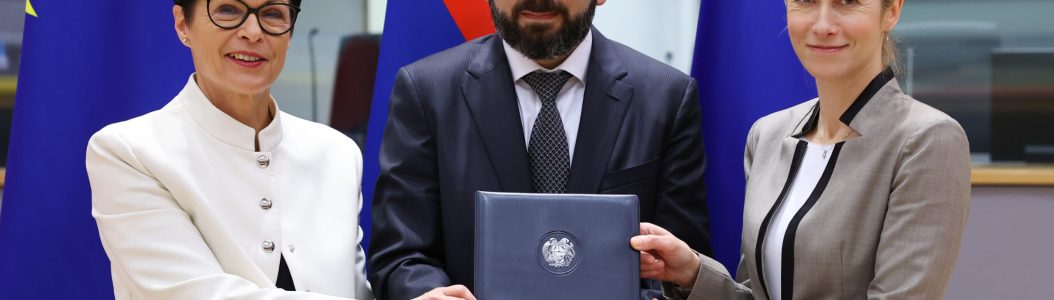
- © European Council, 2026, photo by Frederic GARRIDO-RAMIREZ (EU-Armenia Partnership Council - December 2025, Presentation of signed Strategic Agenda.)
First EU-Armenia Summit: Yerevan Anchors Its Western Realignment
- Chloé BAMBERGER
Summary
On 5 May 2026, Yerevan hosts the first EU-Armenia Summit, bringing together António Costa (European Council), Ursula von der Leyen (European Commission) and Nikol Pashinyan (Armenian Prime Minister). The day before, the city hosts the 8th Summit of the European Political Community, lending the sequence an unprecedented diplomatic density that makes Yerevan the focal point of two overlapping European agendas.
The official agenda covers connectivity (energy, transport, digital), peace and security in the South Caucasus, global challenges, the visa liberalisation dialogue — an action plan presented in November 2025 — and the EU accession pathway.
The EU attends with a clear strategic objective: to consolidate its role as Armenia’s primary external partner and anchor a reform-oriented Armenia as a node of stability in a South Caucasus where Russian influence is receding. The summit endorses a trajectory of progressive integration and marks the EU’s entry as a security actor into a region it had not previously penetrated.
Contextualisation
The rapprochement has accelerated since autumn 2023, when the fall of Nagorno-Karabakh exposed the limits of Armenia’s Russian security guarantee. The CSTO — the Russian-led collective defence alliance — failed to intervene both when Armenian territory came under attack in 2020 and again in 2023, shattering Yerevan’s confidence in Moscow and opening a strategic window for the EU.
In March 2025, the Armenian Parliament adopted a law formally launching the EU accession process, promulgated on 4 April by President Khachaturyan. On 2 December 2025, the Partnership Council adopted the EU-Armenia Strategic Agenda, covering security, defence, and hybrid resilience.
The Resilience and Growth Plan (€270 million, 2024–2027), the EUMA civilian mission (mandate extended to February 2027), and two tranches of the European Peace Facility (€30 million cumulative) illustrate deepening ties.
On the regional peace front, Pashinyan and Aliyev initialled a 17-article agreement in August 2025 and launched the TRIPP corridor, per the EPRS briefing of October 2025. Final signature remains contingent on Azerbaijan’s demand to amend the Armenian Constitution.
Strategic drivers of EU Engagement
As Armenia’s largest donor since independence, the EU has sustained the relationship through the CEPA (in force since 2021), which committed Yerevan to reforms on democracy, rule of law, anti-corruption, and the judiciary. The Resilience and Growth Plan (€270 million, 2024–2027) and Global Gateway investments expected to reach €2.5 billion confirm the partnership’s scale. The December 2025 Strategic Agenda set more ambitious joint priorities on economic development, security, and resilience; the EU presence creates durable leverage.
Strategically, the EU seeks to anchor a westward-leaning Armenia as a stability node in the South Caucasus — a region where Russia is receding and where EU economic, institutional, and security presence creates durable leverage. The summit is equally a test of EU credibility: proof that the Union can deliver in its neighbourhood after years of limited security engagement in the region.
Analysis
A Structural Realignment
The summit consecrates the convergence of three dynamics.
- Russia’s erasure as a security guarantor created a security vacuum that Pashinyan deliberately seized. Yerevan then built a European legitimacy file through reforms, commitment to regional peace, and alignment with democratic values.
- Pashinyan’s address to the European Parliament on 11 March 2026 (“either the EU will accept us, or it will not”) signals a trajectory lock-in rather than a mere declaration.
- The Washington–Yerevan sequence validated this approach, reducing its diplomatic cost.
Signals in institutional language
The choice of Yerevan as venue signals symbolic recognition of a partner in transition. The inclusion of the accession pathway on the official agenda — without a timetable — replicates the mechanism used with Moldova and Ukraine in 2022–2023.
The PPC’s call for a CSDP mission ahead of the June 2026 elections confirms that Armenian democratic stability is now a European interest. Crucially, the EUPM Armenia — adopted 21 April, with an initial two-year mandate — is a second CSDP mission alongside EUMA, marking an escalation in EU security engagement depth. Where EUMA observes and reports on the ground, EUPM Armenia operates at the strategic advisory level targeting hybrid threats, FIMI, cyberattacks, and illicit financial flows. This dual-mission architecture is unprecedented for a non-candidate Eastern Partnership country. Moscow, still an economic lever through the EAEU, is exerting growing pressure and threatening trade measures if alignment continues.
Sources
- Final Statement of the 5th EU-Armenia PPC, 19 March 2026
- Joint press release Commissioner Kos / Deputy PM Grigoryan, 19 March 2026
- Pashinyan’s address to the European Parliament, 11 March 2026
- New Union Post, summit announcement, 27 March 2026
- EPRS, Armenia and Azerbaijan: Lasting peace in sight?, October 2025
- SpecialEurasia, Armenia Foreign Policy Dilemma, 9 April 2026
- New Eastern Europe, Armenia’s pivot to the EU, July 2025
- News.am, “Historic EU-Armenia summit: One of key topics to be situation in South Caucasus”, 28 April 2026
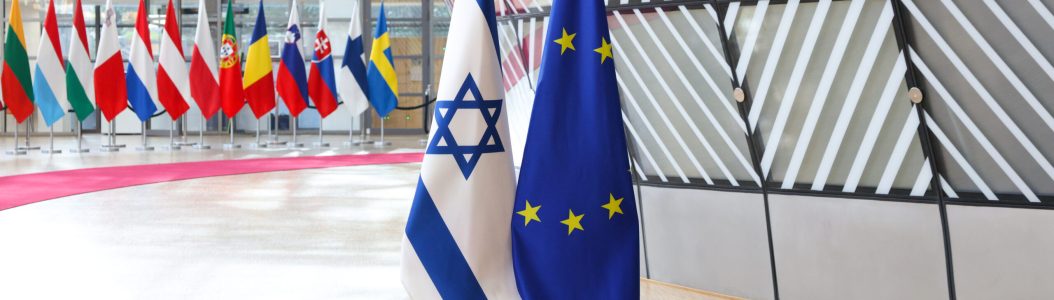
- © European Council, 2026, photo by Alexandros MICHAILIDIS (Flags as part of event considering EU-third countries relations, 09/04/2026.)
Why the EU did not suspend the EU–Israel Association Agreement
- Chloé BAMBERGER
Summary
By spring 2026, the European Union had not suspended the EU–Israel Association Agreement, despite an official review concluding that there were “indications” Israel had breached Article 2, which makes respect for human rights and democratic principles an essential element of the agreement. The core reason is not the absence of legal or political grounds, but the lack of a sufficient majority in the Council for the most far‑reaching options, and in particular the absence of unanimity required for full suspension.
Since May 2025, institutional dynamics have significantly intensified. On 20 May 2025, High Representative Kaja Kallas announced the launch of an Article 2 review; the findings, presented to the Foreign Affairs Council on 23 June 2025, concluded there were indications that Israel was in breach of its human‑rights obligations. In September 2025, following her State of the Union address, Commission President Ursula von der Leyen proposed a package including partial suspension of trade concessions under the agreement, sanctions on Hamas, and targeted measures against extremist ministers and violent settlers. The European Parliament, in its 11 September 2025 resolution on “Gaza at breaking point”, called for the immediate suspension of the agreement and, as a first step, of preferential trade access.
Institutional context and key actors
The Association Agreement is the legal backbone of EU–Israel relations, with Article 2 enshrining human rights and democracy as “essential elements”. A serious violation can justify proportionate measures, but full suspension requires a unanimous Council decision, a high political threshold in a deeply divisive file.
Kaja Kallas, as High Representative/Vice‑President, was the procedural catalyst, securing a “strong majority” for launching the Article 2 review and presenting its conclusions to ministers. The von der Leyen Commission then moved from monitoring to proposing a graduated response: first a partial suspension of Israel’s participation in Horizon Europe, then suspension of trade‑related provisions and targeted sanctions. The European Parliament consistently pushed for immediate suspension or at least suspension of the trade pillar, stressing that the Commission’s own review had confirmed indications of breach.
Most Member States supported opening the review, but the Council never converged on full suspension. Politically, several governments considered the agreement a key legal basis for engagement and humanitarian leverage, and thus favoured incremental, reversible measures.
Why the Council blocked – and what this reveals
Three factors explain the Council’s inaction.
- First, unanimity: full suspension “can only be decided by the Council acting unanimously”, and this condition has not been met.
- Second, strategy: the agreement is seen as a necessary framework for “frank and principled dialogue” and for securing humanitarian steps on the ground.
- Third, design: by advancing partial measures (Horizon Europe, trade concessions, targeted sanctions), the Commission implicitly acknowledged that support for a total suspension was lacking, and opted for a modular response more likely to pass in the Council.
This has triggered three main lines of criticism:
- inconsistency between legal findings and political follow‑through;
- institutional fragmentation between Parliament, Commission and Council;
- and a slow, incremental pace that risks eroding the credibility of Article 2 conditionality.
For future action, the case points to the need for a clearer, more transparent mechanism for activating human‑rights clauses, better use of partial measures under non‑unanimity decision rules, and stronger upstream involvement of the European Parliament in monitoring “essential elements” clauses.
Sources
Amnesty International
Euractiv
European Commission – Press release (trade concessions / sanctions)
European Parliament – Motion for a resolution (9 September 2025)
Inside Europe
© Thomas Lohmann on Unsplash
- © Photo by Mark König /Unsplash/(Flag of Sweden.)
What Sweden’s Election Could Change
- Tizian Stocker
Sweden’s election is too close to call. But the biggest change may not be the country’s strategic direction – it could be who gets to shape it.
Sweden votes on Sunday, 13 September, in an election that could end four years of centre-right government under Prime Minister Ulf Kristersson – or return him to office with a substantially different balance of power on the right. The latest Novus voter barometer puts the opposition parties at 50.7 per cent and the parties behind the Tidö Agreement at 48.1 per cent. The difference is within the poll’s margin of error.
Info Box:
The Tidö Agreement (Tidöavtalet) is a political cooperation agreement concluded in October 2022 between Sweden’s Moderate Party, Christian Democrats, Liberals and Sweden Democrats following the 2022 parliamentary election. It covers the 2022-2026 parliamentary term.
Behind that close race lies a larger story. Sweden has changed considerably since its last parliamentary election. It has joined NATO, increased defence spending, maintained strong support for Ukraine and adopted a much more restrictive approach to migration. Sunday’s vote could change the government without reversing many of these shifts. What it could change considerably is who holds political power – particularly if the Sweden Democrats move from supporting a government to joining one.
A Race Too Close to Call
Sweden’s 349-seat Riksdag is elected through proportional representation. Parties normally need at least four per cent of the national vote to participate in seat allocation, making smaller parties’ performance potentially decisive.
For much of the campaign, that put the Liberals at the centre of the electoral arithmetic. But their position has changed rapidly. The 9 September Novus poll puts them at 5.8 per cent, comfortably above the threshold and sharply higher than earlier in the campaign. According to Novus, the party has mainly gained voters from elsewhere within the Tidö bloc.
At the same time, another shift has taken place. The Sweden Democrats are now polling statistically significantly ahead of Kristersson’s Moderates, according to Novus. That matters because a victory for the governing bloc could leave the prime minister more dependent on a strengthened Sweden Democrats than during the past four years.
The opposition has its own coalition problem. Magdalena Andersson’s Social Democrats lead the alternative bloc, but forming a stable government would require cooperation among parties with significant differences over taxation, economic policy and the role of the state. Winning the election and forming a workable government may therefore be two different tasks.
The Sweden Democrats Want In
Info Box:
The Sweden Democrats (Sverigedemokraterna, SD) are a Swedish nationalist and socially conservative political party. They entered the Swedish parliament in 2010 and became the second-largest party in the 2022 election. Since 2022, they have supported Ulf Kristersson’s government without formally joining it, based on cooperation under the Tidö Agreement. The party is particularly known for its restrictive positions on migration and integration.
Since 2022, the Sweden Democrats have occupied an unusual position. Under the Tidö Agreement, they have supported Kristersson’s government and gained considerable influence over migration and criminal justice without holding cabinet positions. That arrangement may now be reaching its limit. Jimmie Åkesson, the party chairman, wants his party to participate directly in government, while Kristersson has opened the door to governing with the Sweden Democrats after the election. As Reuters reported, this would represent the first time the party entered a Swedish government.
The implications extend beyond Stockholm. The Sweden Democrats no longer advocate Swedish withdrawal from the EU, but favour a more intergovernmental Europe, less power for EU institutions and stronger national sovereignty. A formal place in cabinet would therefore give the party a new level of influence over Sweden’s European policy.
This makes Sunday’s election more than a contest between Kristersson and Andersson. It is also a test of how far the Sweden Democrats’ transformation from political outsiders to potential governing party can go.
The Left-Right Divide Has Shifted
Yet the election also demonstrates how Sweden’s traditional political divisions have blurred. Migration is the clearest example. The Social Democrats have moved towards a significantly more restrictive approach, meaning a centre-left victory would not simply restore Sweden’s previous liberal migration policy. Crime and integration have similarly pushed political debate towards positions once associated primarily with the right.
Nicholas Aylott, Associate Professor of Political Science at Södertörn University in Stockholm, told European Relations that this makes the composition of the next government more uncertain than the direction of some of its policies:
“The campaign has been dominated by what Swedes call the ‘government question’ – that is, the possible combinations of parties that might form a majority, and a government based on that majority, in light of the election result.” – Nicholas Aylott
Aylott argues that this question is particularly important for the Sweden Democrats’ future role. But he expects considerable policy continuity regardless of which parties eventually take office:
“I don’t expect the next government, whichever parties form it, to deviate much from the course that the incumbent right-wing majority has set in key policy areas, including migration and law-and-order.” – Nicholas Aylott
Sharper differences remain on welfare, taxation, and economic policy. They also remain over European integration. An ECFR analysis argues that an Andersson-led government would probably pursue a more proactive European policy, while much of Sweden’s fundamental security orientation would remain intact.
That distinction is central to understanding the election. A change of government could matter substantially without producing a complete policy reversal.
Security May Change Less
Foreign and security policy offers the strongest example of continuity. Sweden’s NATO membership, support for Ukraine and stronger defence enjoy broad backing across the political mainstream. Neither a Kristersson nor an Andersson government is likely to reverse Sweden’s strategic response to Russia’s invasion of Ukraine.
Russia nevertheless remains part of the election environment. In August, Sweden’s Security Service (Säpo) announced that it had disrupted an operation directed by Russia’s SVR foreign intelligence service. Säpo said the operation sought information about Swedish decision-making and could facilitate influence activities intended to polarise society and discredit Sweden, NATO and the EU. But Swedish authorities make an important distinction between Russian hostile activity and a coordinated campaign against Sunday’s election. The Swedish Psychological Defence Agency says Russia remains the principal threat when it comes to foreign malign information influence, while its current assessment is that Sweden and the election are not currently priority targets.
“Russia is preoccupied with other countries, and Sweden has a sufficiently high resilience.” – Ola Svenonius
Ola Svenonius’s assessment captures the distinction: Sweden faces a persistent Russian threat, but foreign interference has not become the defining dividing line of the election.
Why This Matters for Europe
Sweden is a different European actor from the country that voted four years ago. NATO membership has increased its importance to Baltic and northern European security, while support for Ukraine and higher defence spending have tied Swedish security more closely to its European partners. Sunday’s election is unlikely to undo that transformation. Instead, its European significance lies in who gets to shape Sweden’s position within that new strategic reality.
An Andersson-led government could make Sweden more active in European cooperation while maintaining its security commitments. A renewed Kristersson government could give the Sweden Democrats unprecedented executive influence, strengthening a more sovereignty-focused voice within Sweden’s European policy.
The election therefore offers both continuity and change: broad agreement over the security threats facing Sweden, but a much sharper contest over how the country should govern itself and exercise influence in Europe.
What to Watch Next
Polls close at 20:00 on Sunday. The Swedish Election Authority will then begin reporting preliminary results, but the political consequences may take considerably longer to become clear.
First, watch the balance between the two blocs and whether the Liberals stay safely above four per cent. Then watch the balance within the right: a strong Sweden Democrats result combined with weaker Moderates would strengthen Åkesson’s hand in negotiations. If the Tidö bloc prevails, the central question will be whether the Sweden Democrats enter government for the first time. If Andersson’s bloc wins, attention will instead turn to whether she can construct a stable parliamentary majority from parties with competing economic priorities.
Sweden may know who won the election on Sunday night. Who really gained power could be a more complicated question.
Sources
- Swedish Election Authority (Valmyndigheten) – Distribution of seats. Accessed 11 September 2026.
- Novus – Väljarbarometern, 9 September 2026. 9 September 2026.
- Swedish Security Service (Säpo) – Russian intelligence operation thwarted. 10 August 2026.
- European Council on Foreign Relations (ECFR) – After Tidö: What a centre-left Sweden would change for Europe. 3 September 2026.
- Reuters – Swedish PM Kristersson seeks new term, backing partnership with far right. 11 September 2026.
- EUobserver – Swedish election ‘not a priority’ for Moscow interference, but still a target for troll farms and disinformation. 8 September 2026.
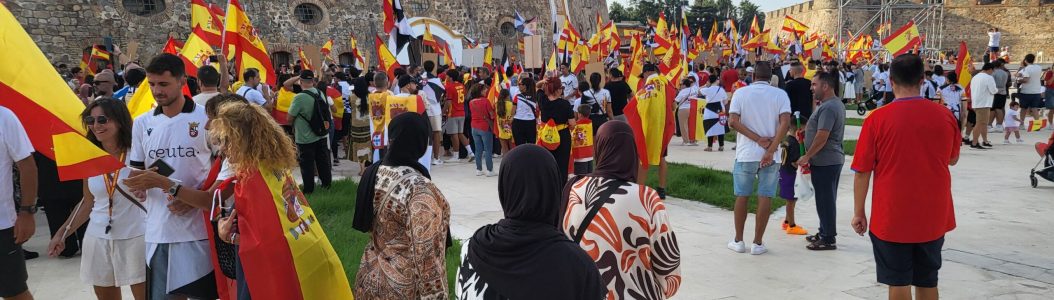
- CC BY-SA 4.0/ © Photo by Xemenendura (People protesting against migrants in Ceuta who arrived at the end of July 2026. September 2, 2026.)
Ceuta One Month Later – What the Aftermath Reveals About EU Migration Policy
- Clara Laurentia Hanitzsch
About a month after tens of thousands of migrants arrived in the Spanish exclave of Ceuta, the immediate border crisis has largely subsided. 90% of those who arrived returned to Morocco within a short period. While the initial wave of excitement around Ceuta has subsided, the situation on the ground remains unclear, meaning many seeking refuge face precarious living conditions. At the same time, analysts describe Ceuta as the first major stress test for the reformed Common European Asylum System (CEAS).
Sources: The Guardian, The Loop, Human Rights Watch
Info box:
The Common European Asylum System (CEAS) is the European Union’s framework for managing asylum and international protection across its member states. It sets common rules for how people seeking protection are registered, screened, assessed and accommodated, as well as how asylum applications and returns are handled. The system is intended to ensure that asylum seekers receive consistent standards of protection across the EU while helping member states manage migration at the EU’s external borders.
1. Current Situation on the Ground
At the end of July, tens of thousands of people, predominantly from Morocco, entered Ceuta in a very short period. Many crossed by swimming or entering through coastal sections of the border. Several dozen people seeking refuge died along the way. Ceuta has a population of only around 85.000; at times, the scale of the initial influx was therefore almost comparable to the city’s population. According to the Spanish government, the vast majority returned to Morocco within the first few days. By late August/early September, however, official estimates suggested that around 5.000 people remained in the exclave, while local aid organisations even reported figures of about 10.000 people. Those remaining include Moroccan nationals as well as people from countries such as Sudan, Somalia, Syria, Chad and Yemen, alongside numerous unaccompanied minors, many of whom expressed their wish to apply for asylum. This fact is particularly relevant because it means that there is no legally homogeneous group in Ceuta. Potential asylum seekers, minors and people not entitled to protection must be subject to different procedures.
The causes of the exceptional influx remain politically contested. Explanations include smuggling networks, misinformation about Spain’s migration policies (like the large-scale regularisation program), and the possible temporary inaction of Moroccan security forces to put pressure on Spain and the EU. So far, however, no conclusive evidence shows that the Moroccan government deliberately orchestrated the border crossings.
Sources: Euronews, Human Rights Watch, Verfassungsblog, The Guardian
2. Humanitarian Situation
The exodus of 10,000 migrants and the unpredictability of the situation meant that many people lost their lives whilst attempting to reach the mainland. Whilst some drowned on the way, others were crushed whilst trying to climb a border barrier. At the same time, there are also reports of Spanish security forces and residents of Ceuta using violence against arriving asylum-seekers.
Whilst the Spanish government speaks of the voluntary return of many people, the Moroccan Association for Human Rights (AMDH) has reported violent ‘mass pushbacks’ by the Spanish security forces, without assessing the individual protection needs of those arriving.
Sources: Human Rights Watch, The Loop
While the immediate pressure at the border has eased, the humanitarian situation in Ceuta remains critical. Reception facilities struggle to accommodate the thousands of people who remain in the exclave. In mid-August, Human Rights Watch reported that more than 1,000 men and boys were living in makeshift shelters at Trampolín beach, while thousands more were sleeping on streets, in industrial areas or in the hills surrounding the city. Hundreds of women and girls were housed in improvised outdoor facilities or on the streets. Access to sanitation and other basic services has remained inadequate, forcing people to use parks, remote areas, and the sea. Despite the expansion of emergency accommodation and the distribution of thousands of meals by authorities and local organisations, people tell journalists that they returned empty-handed from food distributions for several days in a row.
Sources: Human Rights Watch, Le Monde
Thousands of people have been in the streets in a legal vacuum, exposed to sexual violence and without adequate shelter, food, or sanitation for almost three weeks.
Human Rights Watch
Women, children and unaccompanied minors face particular risks. Two improvised shelters were set up for women and young girls who had been raped and sexually abused in their home countries or recently on the streets of Ceuta, since the number of sexual violations has risen sharply in the 4 weeks since the mass crossing. Especially unaccompanied minors (2,168, according to figures from the Spanish Ministry of the Interior) are struggling to find shelters, food and support. Temporary facilities in schools and other public buildings have further demonstrated the strain on the exclave’s limited infrastructure. As a small exclave, Ceuta has only limited ‘surge capacity’ in structural terms; an exceptional influx of people can therefore trigger a long-term humanitarian crisis, even if most leave again quickly.
Sources: Deutsche Welle, La Vanguardia, Human Rights Watch
Non-governmental organisations have expressed great outrage at the situation in Ceuta and are calling for the rights of migrants not to be overlooked amidst this challenging situation. While Spain further tries to accelerate the returns to Morocco, Human Rights Watch and Amnesty International demand that Spanish authorities should provide access to the asylum system since many of the migrants would like to apply for it. Furthermore, they reported no evidence that all adults had undergone systematic individual assessments. This is particularly relevant for people from countries such as Sudan, Somalia or Syria, as well as individuals with specific protection needs. Some Moroccan women told HRW that they had fled domestic violence (in some cases with their children). This is particularly relevant because Morocco’s general classification as a ‘safe country of origin’ does not automatically rule out individual grounds for protection.
Sources: Amnesty International, Human Rights Watch
As things stand, Madrid appears to be aiming to create additional capacity in Ceuta rather than transferring larger numbers to the Spanish mainland – “The Guardian” interprets this as an attempt to avoid backlash in domestic and European politics.
The large number of people arriving in Ceuta and the circumstances of crossings must not distract from the fact that under international law, the principle of non-refoulement is absolute and collective expulsions are prohibited in all cases.
Amnesty International
Under the new EU rules, screening, health and safety checks and a preliminary vulnerability assessment should already have been carried out. Many residents and local organisations assisted; but at the same time, HRW has documented growing insecurity, increasing social strain and fears of xenophobia and violence.
Sources: Amnesty International, The Guardian, Le Monde, Human Rights Watch
3. Political Situation in the EU
The Ceuta crisis quickly developed into a broader political dispute within the EU. While Spain called for European solidarity in managing pressure at an EU external border, several member states focused instead on preventing secondary movements from Spain. Italy, Germany, Greece and other countries pushed for tougher measures, while Spain’s migration and regularisation policies came under criticism for allegedly creating a “pull factor”. However, the causal link between Spain’s regularisation policy and the arrivals in Ceuta remains contested, not least because newly arrived migrants are not eligible for the scheme.
Within Spain, Sánchez faced fierce attacks from the conservative and right-wing populist opposition over his handling of the situation with Morocco and Ceuta. Relations remain strained, however: on 21 August, Spain summoned the Moroccan ambassador after Moroccan ministers had once again asserted claims to sovereignty over Ceuta and Melilla.
Sources: Euronews, The Italian Government, Verfassungsblog, The Guardian
Info box:
Secondary movement refers to asylum seekers or migrants moving from one EU member state to another after initially arriving in or being registered in the EU. In EU migration policy, the term often describes people moving onward to seek protection or settle in another member state rather than remaining in the country responsible for their asylum procedure.
The most immediate consequence has been renewed pressure on the Schengen system. Italy introduced temporary controls on air and sea connections from Spain, prompting Spain to impose reciprocal controls. Both countries subsequently extended these measures. Denmark and Finland went further by calling for Spain’s temporary suspension from Schengen, while a broader group of member states advocated stronger measures to prevent secondary movements. The crisis at the EU’s external border has therefore translated into restrictions at internal European borders.
Rather than demonstrating confidence in the resilience of the EU’s migration and asylum framework in the face of migratory challenges, Ceuta is being used to push for emergency measures in response to migration being used to exert political pressure.
Helena Hahn
Sources: Euronews, European Policy Centre
At the same time, Ceuta has strengthened calls for a more restrictive EU migration policy. Member states have found greater common ground on accelerating returns, strengthening cooperation with third countries and combating smuggling networks than on relocating migrants within the EU. Several governments, including Germany, Austria, Denmark, Greece and the Netherlands, are also exploring establishing “return hubs” outside the EU. However, significant legal questions regarding responsibility, detention and access to legal remedies remain unresolved.
Sources: Euronews
Info box:
Return hubs are proposed facilities, potentially located outside the EU, where people who are required to leave the EU could be transferred and held. At the same time, arrangements are made for their return to their country of origin or another destination. The concept is intended to make deportation procedures more efficient, but has raised concerns about detention conditions, legal safeguards and access to remedies.
The political response therefore reveals a continuing divide over responsibility and solidarity. Whereas Spain frames Ceuta as a common European challenge requiring support for a member state at the external border, other governments have primarily emphasised Spain’s responsibility to control onward movement. Euronews therefore describes migration as one of the key issues likely to cause conflict this autumn; a wider debate is scheduled for the European Council in October.
Rather than generating a new moment of European solidarity, the crisis has led to weakened solidarity between member states, hasty deportations and the disregard for human rights.
Sources: Euronews, European Policy Centre, The Loop
The question remains: if, immediately after a system of compulsory solidarity comes into force, Member States are the first to close their national borders, what does that mean for the reform?
4. Ceuta and CEAS
In recent weeks, many analysts have described the Ceuta crisis as the first major stress test for the reformed Common European Asylum System (CEAS) since the Pact on Migration and Asylum became fully applicable in June 2026. The new framework was designed to improve the EU’s capacity to handle sudden pressure at its external borders through faster screening and border procedures, more efficient returns, and a permanent solidarity mechanism between member states. Ceuta therefore provides an early indication of how these mechanisms function when confronted with an exceptionally large number of arrivals within a very short period.
Sources: European Policy Centre, The Loop
A first challenge concerns screening and border procedures. Under the reformed CEAS, people arriving irregularly at the EU’s external border should undergo registration, identity, security, and health checks, as well as a preliminary assessment of vulnerabilities, before being directed to the appropriate asylum or return procedure. Yet Human Rights Watch reported in August that many people in Ceuta still lacked clear information about how to apply for asylum and that systematic individual procedures were not evident for all adults. According to the Verfassungsblog, the reform introduces more tools. However, it still accepts a system in which large numbers of people can, in effect, be detained at the external border without any realistic prospect of continuing their journey.
Sources: Human Rights Watch, Verfassungsblog, The Loop
Ceuta also illustrates the tension between faster border procedures and fundamental-rights safeguards. One objective of the reform is to process asylum claims and returns more rapidly at the external border. However, rapid returns to Morocco after initial crossings raised concerns about whether authorities sufficiently assessed individual protection needs. This is particularly relevant for third-country nationals and vulnerable individuals who may have grounds for international protection.
Sources: Human Rights Watch, Amnesty International
Migrants are not passive instruments of state strategy, but people who move for reasons that a focus on border control alone can never address
ECPR
A second major test concerns European solidarity. The Pact introduced a permanent solidarity mechanism under which member states can contribute through relocation, financial assistance or operational support to countries facing migratory pressure. However, the political response to Ceuta has demonstrated the limits of this principle in practice. Rather than focusing primarily on relocation, several member states responded by tightening internal border controls and demanding stronger measures against secondary movements. Moreover, relocation mechanisms apply primarily to people within the asylum system, limiting their relevance for many Moroccan nationals expected to be returned.
Sources: European Policy Centre, Euronews, Verfassungsblog, the Italian Government
Ultimately, the GEAS reform was introduced primarily to make frontline states such as Spain more resilient in the face of exceptional migratory pressure.
However, what the Ceuta case has fundamentally demonstrated about the CEAS is:
- That it ultimately still depends on resources, capacity and staffing whether unexpected waves of migrant women can be managed without risking legal breaches, human rights violations or placing an excessive burden on the local population.
- The Pact can organise solidarity in legal terms; however, it has not resolved the political conflict over who should actually take in migrants. And as soon as concrete responsibilities are at stake, many Member States once again retreat into national isolation. And as long as intra-European solidarity remains politically difficult, the incentive to shift migration management to third countries or ‘return hubs’ increases, although the legal framework for this is highly controversial.
- External border crises can directly jeopardise internal freedom of movement as soon as states fear secondary migration. Ceuta thus illustrates the close link between external border management and Schengen
- Human rights: The operational logic of the new system – rapid screening, border procedures, swift return – comes into conflict, particularly during an exceptional influx, with individual assessment, special protection for vulnerable persons and humane reception conditions. Several local and international organisations have documented this conflict in Ceuta precisely.
Sources: European Policy Centre, Human Rights Watch, Euronews, Verfassungsblog, The Loop
Info boxes provided by Laksmitha Anindyanari.
For further updates on the topic, check the quick brief by ERA here
Author: Clara Laurentia Hanitzsch
- CC BY 4.0/ © Photo by Ministry of Culture of Ukraine (Dormition Cathedral of the Kyiv Pechersk Lavra in Kyiv, Ukraine on fire following the Russian attack on 15 June 2026.)
What Ukraine Is Fighting to Preserve
- Tizian Stocker
Millions of books have been destroyed, and hundreds of cultural sites have been damaged. But Ukraine’s struggle to preserve its culture reaches beyond what Russian strikes can physically destroy.
Just days before Ukrainian children returned to school, another part of the country’s cultural infrastructure went up in flames. A Russian strike on the logistics centre of Ukrainian publisher Ranok in August destroyed around eight million books, according to Ukraine’s Ministry of Culture. More than 620,000 were school textbooks. The ministry says Russian attacks destroyed more than 10 million books during the summer of 2026 alone. BBC News puts the recent total at around 12 million.
The losses illustrate a dimension of Russia’s war that extends beyond territory and military infrastructure. Libraries, museums, churches, archives, publishing houses and schools carry language, history and collective memory. Their destruction raises a broader question: what happens to a country’s identity when the institutions preserving it become part of a war?
More Than Buildings
As of 29 July, UNESCO had independently verified damage to 545 cultural sites since Russia launched its full-scale invasion in February 2022. They include 43 museums, 22 libraries, five archives, 156 religious sites and 281 buildings of historical or artistic importance. Among them is the Kyiv-Pechersk Lavra, one of Ukraine’s most important religious and cultural landmarks and a UNESCO World Heritage Site. Russian strikes in June damaged several structures within the historic complex.
During a visit to Ukraine in August, UNESCO Director-General Khaled El-Enany described what the site represents:
“For nearly a millennium, this site has carried the faith, memory and cultural identity of generations.”
- Khaled El-Enany, UNESCO Director-General
The consequences extend beyond internationally recognised monuments. Local libraries, printing facilities and archives determine whether books remain available, historical records survive, and Ukrainian cultural life can continue during wartime. For schools, that impact is immediate. Figures published by the Ukrainian parliament’s education committee show that recent attacks destroyed hundreds of thousands of textbooks intended for the new academic year. Authorities and publishers must replace them while the war continues.
Identity Under Occupation
Physical destruction is only one part of the picture. UN human rights monitors have documented changes to education, language and cultural expression in Russian-occupied areas of Ukraine. Russian curricula have replaced Ukrainian ones in schools, while occupation authorities have promoted Russian language, history and state narratives.
The UN has also documented pressure on teachers and parents to accept the Russian education system. These changes have been accompanied by patriotic and military education centred on Russian state identity. For some families, education has become a reason to leave. One Ukrainian father, whose family fled the Russian-occupied part of the Kherson region in 2025, told UN human rights monitors:
“Our children do not want to study in Russian language. We had to leave.”
- Ukrainian father interviewed by UN human rights monitors
According to his testimony, occupation authorities had also threatened to remove the children from the family. This distinction matters. Damage caused by a missile or drone does not by itself establish an intention to destroy a national culture. Policies governing language, schooling and public life raise a different set of questions because they directly influence how identity can be expressed and passed to the next generation. UN High Commissioner for Human Rights Volker Türk warned that Russian actions had “ruptured the social fabric of communities”, pointing to consequences that could persist long after individual towns or territories change hands.
Ukraine describes these developments as part of a broader attempt to suppress its national identity. Foreign Minister Andrii Sybiha made that connection following the recent attacks on publishing infrastructure, arguing that the destruction targets Ukrainian language, memory and history. Russia rejects that interpretation. In comments reported by BBC News, the Russian embassy in London accused Ukraine itself of damaging cultural heritage through the removal of monuments and renaming of streets. It also claimed that some cultural facilities had been used to conceal military activities.
These claims do not change the independently verified scale of damage to Ukrainian cultural sites. They do, however, demonstrate how history and cultural identity have themselves become part of the political conflict surrounding the war.
Europe Moves to Protect Culture
Europe’s response increasingly treats cultural preservation as part of Ukraine’s resilience and recovery. EU support has included emergency equipment for cultural heritage sites, digital documentation of museum collections and training for Ukrainian professionals responsible for protecting endangered objects. In June 2026, the EU also provided €2 million through UNESCO to help safeguard Ukraine’s documentary heritage and improve digital access to collections. The European Commission said in 2025 that it had mobilised more than €50 million for Ukraine’s cultural and creative sectors since the beginning of the full-scale invasion, including more than €11.5 million for cultural heritage. The Team Europe Initiative for Cultural Heritage in Ukraine brings together the European Commission, EU Member States and Ukrainian partners. Its work ranges from emergency protection and training to longer-term recovery and reconstruction.
Info box provided by Laksmitha Anindyanari:
Documentary heritage refers to recorded materials that preserve the knowledge, history and cultural memory of a community or society. It includes materials such as manuscripts, books, archival records, photographs, films, sound recordings and other documents with lasting cultural or historical value. Protecting documentary heritage helps ensure that information and collective memories remain accessible for future generations, particularly when cultural institutions are threatened by conflict or disaster.
Culture is therefore moving beyond emergency assistance into a wider European policy question: what should be restored, what needs to be digitally preserved, and how can Ukrainian cultural institutions remain resilient during and after the war?
Why This Matters for Europe
Ukraine demonstrates why cultural heritage cannot be separated from security. A missile can destroy a printing press or museum in seconds. The consequences last much longer: fewer books, missing archives, damaged religious sites and communities losing places through which their history was preserved. Education makes that connection even more significant. Language, curricula and historical narratives influence how future generations understand the country to which they belong. Policies affecting them in occupied territories therefore reach beyond cultural administration into questions of political identity.
For Europe, protecting Ukrainian culture is consequently about more than reconstructing monuments. Ukraine is an EU candidate country whose cultural heritage forms part of Europe’s wider historical landscape. Supporting its preservation also reinforces the principle that military occupation should not determine which language, history or identity a population is allowed to maintain. The struggle over Ukraine’s future is therefore being fought not only over territory. It is also being fought over what can be remembered, taught and passed on.
What to Watch Next
The immediate challenge is replacing books and educational materials destroyed before the new school year while protecting cultural institutions from further attacks. In the longer term, reconstruction will require difficult choices. Ukraine and its European partners will have to determine how damaged heritage should be restored, how collections and archives can be digitally protected and how cultural institutions in formerly occupied territories can be rebuilt. UNESCO verification and UN human rights monitoring will remain important in distinguishing documented cultural destruction from broader political claims about intent – and in preserving evidence for potential future accountability.
Sources
- UNESCO – Damaged cultural sites in Ukraine verified by UNESCO. Updated 29 July 2026. Original source. Accessed 31 August 2026.
- UN Human Rights Office / Human Rights Monitoring Mission in Ukraine – Reporting on human rights, education and cultural identity in Russian-occupied Ukraine. Original source. Accessed 31 August 2026.
- Ministry of Culture of Ukraine – Reporting on attacks against Ukrainian publishers and the destruction of books. 28 August 2026. Original source. Accessed 31 August 2026.
- European Commission – Support for Ukraine’s cultural and creative sectors and cultural heritage. Original source. Accessed 31 August 2026.
- BBC News – Russian strikes destroy 12 million books ahead of Ukraine’s first week back at school. August 2026. Article. Accessed 31 August 2026.
AI Transparency Note: Artificial intelligence was used to support research, source comparison and the structuring of this briefing. Editorial decisions, source selection and the final assessment remain subject to human review.
Author: Tizian Stocker
- CC BY 4.0/ © Photo by National Police of Ukraine (Mobile fire team of Rapid Operational Response Unit of Ukrainian police, which shoots Russian drones in Kherson region, 26 June 2024.)
What Kherson Is Teaching Europe
- Tizian Stocker
Kherson lies only a few kilometres from Russian positions on the other side of the Dnipro River. That proximity has turned the southern Ukrainian city into one of the clearest examples of how cheap, precise drones are changing both warfare and civilian life.
When Le Monde visited the city in June, explosions could be heard as often as every five minutes. Streets were being covered with anti-drone nets, while soldiers armed with shotguns provided a last line of defence. Around 60,000 of Kherson’s roughly 300,000 pre-war residents were estimated to remain in the city or travel regularly between Kherson and safer areas.
The threat has continued to grow. In July, the UN Human Rights Monitoring Mission in Ukraine recorded 34 civilians killed and 424 injured in Kherson. Across Ukraine, short-range drones killed 111 civilians and injured 710 that month, the highest monthly toll from such weapons since Russia launched its full-scale invasion in February 2022.
Sources: Le Monde | UN Human Rights Monitoring Mission in Ukraine
When the Front Reaches Daily Life
Short-range drones differ from many traditional battlefield weapons because their operators can observe potential targets through onboard cameras. First-person-view (FPV) drones can carry explosives, travel at high speeds and operate kilometres away from their controllers. Their relatively low cost has contributed to their rapid proliferation on both sides of the frontline.
Info boxes provided by Laksmitha Anindyanari:
FPV (First-Person-View) drones are remotely operated drones equipped with cameras that transmit live video to the operator, allowing them to see and control the drone from its perspective. In warfare, FPV drones are often modified to carry explosives and can be used to precisely strike targets while being operated from a distance. Their relatively low cost and manoeuvrability have made them widely used in the Russia-Ukraine war.
For civilians, this has changed the nature of danger. UN investigators have documented drones striking people travelling by bus, walking, cycling, driving civilian vehicles and providing humanitarian or medical assistance. Between February 2022 and April 2025, short-range drone attacks killed at least 395 civilians and injured 2,635. The vast majority, 89 per cent, resulted from Russian attacks in Ukrainian-controlled territory; 11 per cent of the casualties were documented in Russian-occupied Ukrainian territory.
The consequences extend beyond casualties. Fear of drones restricts movement and access to food and healthcare, while humanitarian organisations, medical personnel and municipal workers have had to limit some activities. Older people and people with disabilities are particularly vulnerable because many remain in frontline communities and have fewer options to relocate. Kherson illustrates this transformation particularly starkly. Yaroslav Shanko, head of the city’s military administration, told Le Monde that around 2,000 Russian drones were being directed against the city each week.
Ukrainian officials and residents have used the expression “human safari” to describe alleged deliberate attacks on civilians.
The phrase represents a Ukrainian description rather than an independently established Russian military policy. However, UN findings independently document extensive civilian harm caused by short-range Russian drone attacks and incidents in which civilians appeared to have been deliberately targeted.
Sources: UN Human Rights Monitoring Mission in Ukraine | Le Monde
Cameras Change the Legal Question
The ability of drone operators to see potential targets also raises important questions under international humanitarian law. Parties to a conflict must distinguish between civilians and combatants regardless of the weapons they use.
Info boxes provided by Laksmitha Anindyanari:
The principle of distinction is a fundamental rule of international humanitarian law requiring parties to an armed conflict to distinguish between civilians and combatants, as well as civilian objects and military objectives. Attacks may only be directed against legitimate military targets, and deliberately targeting civilians or civilian objects is prohibited. The principle applies regardless of the weapons or technologies used in warfare, including drones.
The UN notes that onboard cameras should, in principle, give operators greater ability to distinguish civilians from military targets. Yet investigators documented incidents in which operators appeared to have intentionally attacked civilians or civilian objects. Deliberately targeting civilians, if established, constitutes a war crime.
“Each of these attacks must be investigated,” Danielle Bell, head of the UN Human Rights Monitoring Mission in Ukraine, said when presenting its findings.
The mission called for those responsible for intentionally targeting civilians and humanitarian personnel to be held accountable. UN monitors have also verified civilian casualties from short-range drones in occupied Ukrainian territory. Independent verification remains more difficult because publicly available information from occupied territory is increasingly limited.
Source: UN Human Rights Monitoring Mission in Ukraine
Europe Turns Experience Into Policy
What is happening in Kherson increasingly matters beyond Ukraine. European policymakers are treating the conflict’s rapid technological development as a lesson for the continent’s own defence. In June, the European Council called for faster work on drones and counter-drone systems, early warning and air defence. EU leaders also stressed the need to draw on Ukraine’s experience with emerging technologies and strengthen cooperation between European and Ukrainian defence industries.
Info boxes provided by Laksmitha Anindyanari:
Counter-drone systems are technologies and equipment designed to detect, track, identify, disrupt, or destroy hostile drones. They can include radar and other sensors for detecting drones, electronic systems that interfere with their communications or navigation, and physical interceptors that disable or destroy them. These systems are increasingly important as inexpensive drones become more common in modern warfare and pose growing threats to military forces and civilian infrastructure.
That cooperation is becoming institutionalised. On 17 July, the European Commission launched the EU-Ukraine Drone Alliance. The alliance brings together companies, start-ups, researchers, armed forces and other users, with 18 EU-based and Ukrainian companies selected as its founding members.
The alliance is therefore more than another channel of military support for Kyiv. The Commission explicitly presents cooperation with Ukraine as a way to provide battlefield capabilities while strengthening Europe’s own defence readiness and industrial capacity. Its founding members are expected to meet in Brussels in September.
Sources: European Commission | European Council
Why This Matters for Europe
Kherson demonstrates how rapidly relatively inexpensive technology can change the relationship between military operations and civilian protection. Drones that once supplemented other weapons can now influence whether people near the frontline can safely use roads, public transport, hospitals, or humanitarian services.
For Europe, the lesson is both humanitarian and strategic. International humanitarian law requires civilians to remain protected regardless of technological change. At the same time, European governments increasingly face the question of how to protect their own populations, infrastructure, and armed forces against large numbers of comparatively cheap drones.
Ukraine is consequently becoming both a defence partner and an important source of operational knowledge for Europe. The EU-Ukraine Drone Alliance illustrates how lessons developed under wartime pressure are already entering European defence and industrial policy. Kherson’s experience therefore reaches beyond the Dnipro. The city provides a glimpse of a form of warfare that Europe is now preparing to defend itself against.
What to Watch Next
The first meeting of the EU-Ukraine Drone Alliance’s 18 founding members is expected in Brussels in September. Its progress will provide an early indication of how quickly political commitments can translate into joint European-Ukrainian production and effective counter-drone capabilities.
Further UN monitoring will also show whether the sharp rise in civilian casualties from short-range drones continues, and whether investigations and accountability mechanisms can keep pace with a technology that is evolving rapidly.
Sources
- UN Human Rights Monitoring Mission in Ukraine — Protection of Civilians in Armed Conflict, July 2026. Published 12 August 2026. Original source. Accessed 24 August 2026.
- UN Human Rights Monitoring Mission in Ukraine — Short-range drone attacks killed 395 civilians, injured 2,635 between February 2022 and April 2025. Original source. Accessed 24 August 2026.
- European Commission — Commission launches EU-Ukraine Drone Alliance to boost drone and counter-drone technology. Published 17 July 2026. Original source. Accessed 24 August 2026.
- European Council — European Council conclusions on Ukraine and European defence and security. Published 18 June 2026. Original source. Accessed 24 August 2026.
- Le Monde — “It’s pure terror against civilians”: In Ukraine, Kherson’s residents live under the constant threat of Russian drones. Published 24 June 2026. Article. Accessed 24 August 2026.
AI Transparency Note: Artificial intelligence was used to support research, source comparison and the structuring of this briefing. Editorial decisions, source selection and the final assessment remain subject to human review.
Author: Tizian Stocker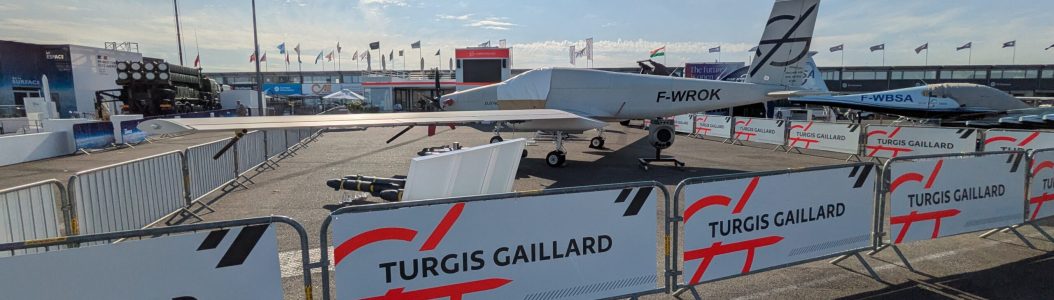
- CC BY 4.0 / © Photo by Artvill (The Aarok drone from Turgis and Gaillard Groupe at the 2025 Paris Air Show, 20 June 2025.)
France Turns to Automotive Industry to Expand Domestic Drone Production
- Sebastian Dodd
Executive Summary
France is working to build a domestic drone-production industrial base through partnerships between defense firms and its automotive manufacturing sector. These efforts demonstrate the response Europe is making to the growing recognition of drones’ importance to security.
Like much of Europe and the wider world, France is drawing lessons from the Russia-Ukraine war about the importance of drones for the future of security. In an effort to bolster domestic drone production, France has enlisted its automotive manufacturing industry to produce drones and is moving toward industrial-scale production as partnerships between automakers, automotive suppliers, and defense firms take shape. Since the beginning of 2026, at least six defense-industry partnerships involving the automotive sector have been announced. The government of French President Emmanuel Macron seeks to combine the scale, automation, and cost discipline of France’s automotive sector with drone production, which is increasingly viewed as essential to future military capabilities.
This approach is consistent with the broader prioritization of drones across Europe at both the multilateral and national levels. The projects currently underway indicate that France is developing an industrial base potentially capable of producing tens of thousands of drones annually, a scale that would be difficult for defense start-ups to achieve independently. The objective is to enable France to produce drones rapidly and scale up production if required. France currently lacks substantial domestic drone-production capacity, and a July report by the French Senate’s defense committee found that the country’s existing stock of a few thousand drones was “insufficient to achieve a critical mass.”
To address this capability gap, France has been encouraging partnerships between defense firms and its automotive manufacturing sector. Forvia, a major French automotive technology supplier, recently unveiled a partnership with a European defense company specializing in AI-powered counter-drone systems with plans to have an initial production of around 500 interceptor drones per month and an objective of increasing capacity to 1,000 per month. Renault, which is already working with Turgis and Gaillard to develop a long-range drone, also announced a partnership with Thales on June 16 to industrialize production of the Toutatis drone, with a target of up to 1,000 units per month from 2027.
This is the second defense partnership between the two companies, which are also working together on a military vehicle. The focus of the new partnership is loitering munitions, drones that hover over a target area before striking. Loitering munitions have played a major role in the Russia-Ukraine war. Thales currently produces around 100 Toutatis drones per year, but its partnership with Renault is expected to increase output by replacing 3D printing with large-scale plastic injection molding and adapting the drone’s design for higher-volume production. These changes include a 20 percent reduction in parts and 40 percent reduction in the fasteners.
Info box provided by Laksmitha Anindyanari:
Loitering munitions are weapons that combine the features of a drone and a missile. They can fly over or “loiter” around a target area for a period of time, allowing operators to identify and select a target before the weapon strikes it and is destroyed. Unlike conventional drones, which can often return after completing a mission, loitering munitions are designed as one-way weapons and have played a significant role in the Russia-Ukraine war.
Renault’s Chorus program with Turgis and Gaillard to develop long-range drones is expected to produce a first demonstrator by the end of the year, with projected production of 600 units per month at Renault’s Le Mans plant thereafter. Renault is also working with Belgian group John Cockerill on a ground drone. While Renault stresses that automotive manufacturing remains its core business, it also stated in February that it had been asked by France’s Ministry of the Armed Forces to strengthen the defense sector.
French drone manufacturer Delair also partnered with German automotive supplier Schaeffler in June to establish a production line capable of producing approximately 100 drones per day by November. If all these plans come to fruition, it has been estimated that the various collaborations could eventually provide France with capacity for up to 60,000 drones annually, significantly exceeding its current production capabilities.
While these plans would substantially increase domestic drone production in France, even producing 60,000 units annually would fall far short of what could be required in a high-intensity conflict similar to the Russia-Ukraine war. Ukraine currently produces an estimated 10 million drones per year and aims to produce 20 million annually. Ukraine has more than 160 companies producing FPV drones, alongside a broader ecosystem of manufacturers producing other unmanned systems, and is reportedly producing more drones than the Ukrainian military can purchase, prompting the government to cautiously allow manufacturers to export excess production.
While increasing drone production is difficult in itself, the greater challenge is creating the capacity to rapidly scale production without building stockpiles that could quickly become obsolete. This problem can be seen with how the US excalibur artillery stopped being used in Ukraine after Russian jamming reduced their hit rate from 55% in January 2023 to 6% by August. Hence, a major obstacle is finding the right balance between procurement and production, a difficult line to maintain given the long-term demand that defense firms typically require to incentivize investment in production capacity.
Impact on Europe
These developments in France are significant for Europe because France is one of the EU’s major military powers. Closing gaps in the domestic production of critical weapon systems, such as drones, will be essential to future European security. If France’s cooperation between automakers and drone manufacturers succeeds, it could also provide a template for other European countries to follow as Europe seeks greater strategic autonomy amid a reduced US security role. How the next decade unfolds will be crucial to determining Europe’s security in the future as this securitization effort and others play out across Europe.
Info box provided by Laksmitha Anindyanari:
Strategic autonomy refers to a country or region’s ability to make and implement decisions about its security and other strategic interests without being overly dependent on external powers. In Europe, the term commonly refers to strengthening the EU’s capacity to defend itself and develop critical capabilities, including military equipment and technology, while reducing reliance on partners such as the United States. It does not necessarily mean acting independently of allies, but having enough capabilities to act when necessary.
What to Look For
- Renault-Turgis and Gaillard drone demonstration: Whether the first demonstrator is delivered by the end of 2026 as expected.
- French drone production rates: Whether the announced production targets are reached in 2027.
- European manufacturing partnerships: Whether similar partnerships between automotive manufacturers and defense-technology companies emerge elsewhere in Europe.
AI Disclaimer: This briefing was edited and fact checked with the assistance of AI.
Sources: Breaking Defense, Defense News, Euro-Security, National Security and Defense Council of Ukraine, Kyiv Post Reuters, Renault Group.
Author: Sebastian Dodd
- CC BY-SA 4.0/ © Photo by Юрий Д.К. (Moscow. The Kremlin in Spring, taken on 29 March 2026.)
EU Tightens Sanctions on Russia’s War Machine
- Sebastian Dodd
Executive Summary
After being approved on July 23, the EU’s 21st sanctions package against Russia for its war of aggression against Ukraine entered into force on July 24. The package includes 218 designations, 170 entities and 48 individuals, making it the largest sanctions round in four years and bringing the total number of designations to nearly 3,000. This new package adds to the existing sanctions regime against Russia with a focus on combatting Russia’s methods of circumventing sanctions.
In regards to the EUs latest sanction package, EU foreign policy chief Kaja Kallas stated, “More than 50 military-industrial entities are included, (as well as) key actors involved in the production of Russia’s long-range drones,” arguing that Russia will negotiate an end to its illegal war and stop killing civilians only if it is pressured to do so. The package targets 56 military-industrial entities and individuals, with a particular focus on those involved in the production of long-range drones and communications networks. Experts argue that these measures could improve Ukraine’s battlefield efforts while strengthening Europe’s future security. The latest sanctions also continue the EU’s efforts to target suppliers of dual-use goods and technologies in third countries, including China and India, as these technologies are frequently found in Russian weapons such as missiles, drones, and tanks.
Info box provided by Laksmitha Anindyanari:
Sanctions are utilized by the EU to increase the economic and military costs of Russia’s war against Ukraine and limit its ability to sustain the conflict. By restricting access to international finance, energy revenues, advanced technologies and military-related goods, while targeting actors that help Russia circumvent these restrictions, the EU aims to weaken Russia’s capacity to wage war. The ultimate goal is to create incentives for Russia to negotiate by making continued warfare increasingly costly and strengthening Ukraine’s position in negotiations for a ceasefire and lasting peace.
The attention of EU officials and experts has focused in particular on two relatively new measures targeting Russia’s military capabilities. The first is that more than 30 designations target the manufacturing and supply network of Russia’s long-range Garpiya drones. Ukrainian civilians and civilian infrastructure have suffered immensely from Russian bombardment, particularly long-range drone attacks. As a senior EU official explained, “What we’ve done is we’ve focused on one category of long-range drones, Garpiyas, and we’ve mapped out effectively the entire manufacturing and supply network … In a single blow, we are targeting it today with over 30 designations.”
The second is that the package also targets Rassvet, a low-Earth-orbit satellite system produced by the Russian aerospace company Bureau 1440 and hailed by Russian media as a potential future counterpart to Starlink. The company launched 16 satellites in March 2026 and aims to have 250 in orbit by 2027. When Russia previously lost access to Starlink in February of this year, it had “very significant implications on their battlefield performance,” according to Bruegel Senior Fellow Jacob Funk Kirkegaard, making the denial of Russia’s ability to develop its own comparable capability an important EU priority as it seeks to pressure Moscow toward negotiations. Denying such capabilities is also in the EU’s own interests. As Kirkegaard put it, “As the EU or Europe more broadly prepares for a world in which we have to deter Russia on our own for the long run, denying Russia their military capabilities in the next three, four, 10 years from now is very important for our own security.”
Since one of the EU’s stated aims of the sanctions is to pressure Russia into negotiating an end to the conflict, the EU must continue updating its sanctions regime to keep pace with Russian efforts to circumvent existing restrictions. As Kallas stated, “With each round of sanctions, we squeeze Russia’s economy and its capacity to prolong its illegal war. Our 21st package includes the highest number of listings in four years. We’re hitting over a hundred banks and crypto operators, 40+ vessels in Russia’s shadow fleet, and several oil refineries in Russia and Belarus. More than 50 military-industrial entities are included, key actors involved in the production of Russia’s long-range drones. Russia will only negotiate to end its illegal war and stop killing civilians if it is pressured to do so. Sanctions add to this pressure.”
Info box provided by Laksmitha Anindyanari:
The shadow fleet refers to a network of vessels and related companies used to help Russia transport and sell oil while evading international sanctions and the G7 oil price cap. These vessels often operate through opaque ownership structures, use alternative shipping routes or change their registration and flags to make their links to Russia less visible. The EU targets the shadow fleet because it allows Russia to continue generating energy revenues that can help finance its war against Ukraine.
For the first time, the EU is introducing the possibility of a full third-country ban on crypto-asset services as a deterrent to countries hosting platforms that assist Russia in evading sanctions. This new instrument allows the EU to prohibit transactions between EU operators and crypto-asset providers used by Russia.
Energy also remains a major focus of the package. The new sanctions pause the automatic adjustment of the oil price cap mechanism until July 15, 2027, helping ensure that Russian profits from oil sales remain constrained. The Russian shadow fleet was targeted again by extending existing rules to cover vessels supporting the fleet, including those providing bunkering and other services. Another 41 vessels were sanctioned, on top of the previously sanctioned 632 vessels. Non-EU tankers that form part of the shadow fleet and circumvent the oil price cap mechanism, support Russia’s energy sector in other ways, transport military equipment for Russia, or transport stolen Ukrainian grain have also been targeted. Among the eight entities designated in relation to the shadow fleet ecosystem, a crewing agency has been included for the first time.
Info box provided by Laksmitha Anindyanari:
The oil price cap mechanism is a policy designed as a sanction instrument to limit Russia’s earnings from oil exports without completely removing Russian oil from global markets. Under the mechanism, companies in participating countries can provide services such as shipping, insurance and financing for Russian seaborne oil only when it is sold at or below a set price. This allows Russian oil to continue reaching global buyers while reducing the revenue Russia can earn from its exports, limiting funds available to support its war against Ukraine.
Why this matters for Europe
Overall, through this package the Council is continuing to seek ways to strengthen the sanctions regime against Russia by targeting the various methods Moscow has developed to circumvent existing restrictions. This is important because a common criticism of sanctions as a tool for changing state behaviour is that targeted states can adapt to restrictions over time. Recent evidence suggests that the Russian economy is struggling under the combined strain of the war and sanctions, as casualties continue to mount and Ukraine has regained some initiative on the battlefield. Continuing to compound Russia’s economic difficulties could therefore contribute to creating greater incentives for Moscow to negotiate. At a minimum, constraining Russia’s ability to produce and acquire important military capabilities will benefit Ukraine on the battlefield while strengthening European security by limiting Russia’s future military capacity.
What to Watch Next
- The response of countries affected by the new sanctions targeting domestic companies helping Russia circumvent restrictions, particularly China.
- The impact on Russian supply chains important for the production of various military assets, particularly the Garpiya drones.
- Information on the economic situation of Russia going forward.
- Whether Russia is pressured to come to the negotiating table.
Disclaimer: AI-powered language models were used selectively as tools to structure the research and formulate the text. The Research, selection and evaluation of sources, as well as the content analysis, assessments and conclusions, were conducted independently.
Sources Euronews, European Council, Reuters
Author: Sebastian Dodd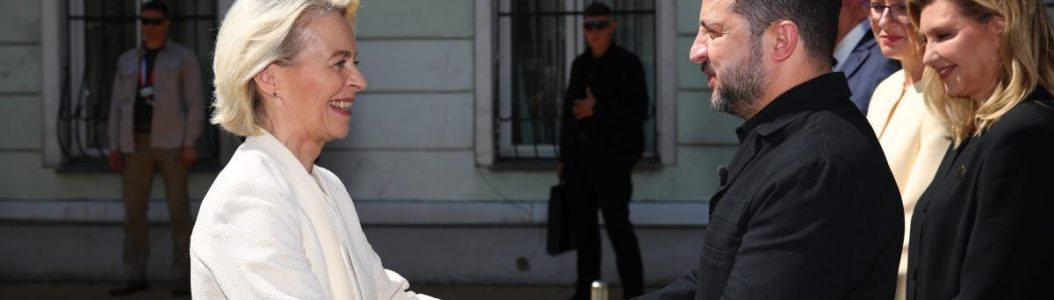
- © Photo by Christophe Licoppe European Commission (Visit of Ursula von der Leyen, President of the European Commission, to Ukraine, 15/07/2026.)
EU and Ukraine Join Forces to Build Europe’s Drone Defence Industry
- Sebastian Dodd
The EU-Ukraine Drone Alliance was officially launched on July 17 during the third EU-Ukraine Defence Industry Forum in Kyiv following the announcement of the Drone Deal on July 15. The goal of the alliance is to accelerate the development of a European ecosystem for drone and counter-drone technology. As the EU works to develop strategic autonomy, Ukraine is an ideal partner for strengthening its drone capabilities and defence industry. The alliance is part of broader EU efforts to enhance European defence capabilities in this area.
The initiative brings together drone manufacturers, technology companies, start-ups, research organisations, and military end users from the EU and Ukraine on a single industrial platform. Its objective is to establish joint ventures between Ukrainian and European companies, with a focus on accelerating the development and production of next-generation drones and counter-drone systems. In relation to the Drone Deal underpinning the Alliance, President Ursula von der Leyen stated, “Our defence industrial partnership integrates Ukraine’s defence economy the same way we integrate our markets: By removing barriers and aligning our standards as quickly as possible – from defence procurement to the protection of intellectual property. Allowing for a closer cooperation of our defence industries and joint ventures. Together, we are harnessing our shared industrial strength for our common security.”
The EU Drone Alliance was first announced by von der Leyen in her 2025 State of the European Union address and is a key deliverable of the Joint Communication Preserving Peace – Defence Readiness Roadmap 2030.
The new partnership creates a single EU-Ukraine framework for developing a strong drone industry that builds on the nine existing bilateral drone agreements between Ukraine and EU Member States, three of which were recently signed following the NATO Summit in Ankara. The framework includes plans to rapidly scale up the production and deployment of battle-proven capabilities to counter drones and missiles, while providing long-term predictability to secure investment and expand defence industrial capacity in both Ukraine and the EU.
One priority highlighted in the cooperation is protecting against low- to medium-range drones and missiles and deploying battle-proven drone systems at scale. Part of the plan is to build systems that can be stocked outside Ukraine while providing both industrial bases with the stability needed to secure investment and expand production. This focus is understandable given the effectiveness of drones in both the Russia-Ukraine war and the US war with Iran, which demonstrates the need for such systems. Iskander ballistic missiles in particular have been among the main weapon systems used by Russia to inflict significant damage on Ukrainian targets, particularly when fired in large numbers to overwhelm Ukrainian air defences. Finding ways to mitigate the effectiveness of such weapons will therefore be crucial to European and Ukrainian defence. This priority can also be seen in plans to expand EU-Ukraine defence industrial cooperation to facilitate the joint production of anti-ballistic missiles by 2028, addressing critical air and defence capability gaps.
On July 16, the European Commission selected Quantum Systems as a founding member of the EU-Ukraine Drone Alliance in support of the initiative. The appointment reinforces Quantum Systems’ position as a leading force in the European drone industry and a flagship of European-Ukrainian industrial cooperation. Since the company began operations in Ukraine in 2022, it has expanded its local footprint by increasing manufacturing capacity, integrating Ukrainian suppliers and software expertise, and deepening industrial collaboration.
Quantum Systems co-founded the first European-Ukrainian joint venture with Quantum Frontline Industries (QFI), under the defence industry cooperation framework “Build with Ukraine.” It has also established multiple new joint ventures with Ukrainian industry partners, showcasing its expertise in cooperative military development.
A total of 18 companies are involved in the drone initiative, nine from the EU and nine from Ukraine. The EU side includes ORQA, the Croatian FPV specialist, alongside Indra Group, Fincantieri, WB Group, Destinus, Delair, RSI Europe, TERMA, and the recently selected Quantum Systems. The Ukrainian side includes Skyfall Industries, Greentech Harvest, Tencore, Deviro, Vyriy Industry, Athlon Avia, TAF Industries, UFORCE, and F-Drones. F-Drones, in particular, highlights the adaptability of Ukrainian defence companies. The company transitioned from a fully Chinese supply chain in 2023 to manufacturing its own flight controllers, speed controllers, and video transmission systems by 2025.
The European Commission also disbursed a further €1 billion to support Ukraine’s drone capabilities under the €90 billion Ukraine Support Loan. This was the second drone related payment in three weeks, following the Commission’s initial €3.9 billion payout on June 30, the first payment of a roughly €6 billion tranche dedicated to drone procurement. This funding comes on top of Commission forward funding of up to €10 billion, which is expected to draw on the remaining funds of the EU’s SAFE (Security Action for Europe) programme, a €150 billion common borrowing facility adopted in May 2025.
All of this demonstrates the EU’s commitment to improving its drone capabilities and strengthening its drone industry. However, it is important to note that the drone deal is currently a memorandum rather than a binding treaty. The actual Defence Industrial Pact, which will cover intellectual property issues and joint venture rules, still needs to be negotiated.
Sources:
DroneXL, European Security & Defence, European Union, European Union.
Author: Sebastian Dodd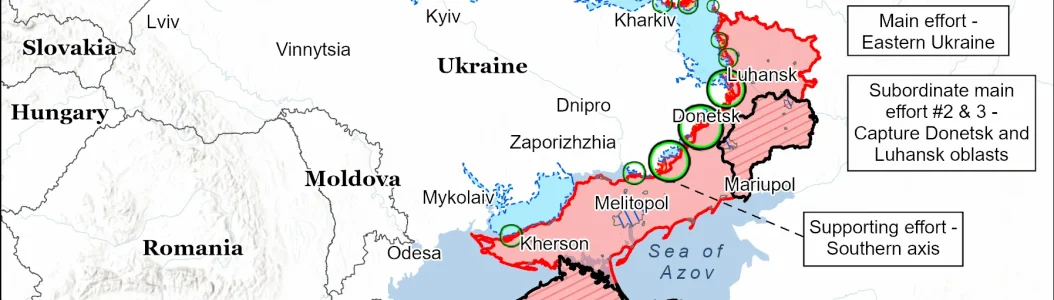
- PD © Photo by Institute for the Study of War and AEI's Critical Threats Project, 2026 (Assessed Control of Terrain in the Russo-Ukrainian War, July 9.)
Russia’s War Narrative Collides with Battlefield Reality
- Sebastian Dodd
Recently, Putin claimed that Russian troops had “completely liberated” the long-fought-over eastern city of Kostiantynivka, despite Ukrainian forces still controlling parts of the city. He has also claimed that Russia has seized more than 3,000 square kilometres of Ukrainian territory this year. However, analysis of shifting front lines and Ukrainian counteroffensives between January and July 2026 by the Institute for the Study of War (ISW) estimates Russia’s net territorial gains at just 97 square kilometres.
Putin’s exaggerated claims of battlefield success are often reinforced by images of Russian infantry posing beside town squares or other prominent landmarks. These photographs are frequently taken during missions specifically intended to plant Russian flags regardless of whether the area had actually been taken, and as Ukrainian serviceman Andriy, who spent three years on the eastern front, explains “And then we kill them, and they never make it back.”
According to a senior Ukrainian military officer, Putin’s objectives with this disinformation campaign are clear. He is attempting to convince the Russian public that NATO’s support for Ukraine has transformed what was initially presented as a rapid “special military operation” into a full-scale war with NATO. This narrative was reinforced during Putin’s televised meeting with Chief of the General Staff Valery Gerasimov, who repeatedly referred to Ukraine’s “Western sponsors” to portray the conflict as a direct confrontation with NATO.
According to the ISW, Putin is constructing “a reality premised on a rejection of tactical and operational developments.” This propaganda campaign is intended to explain “why the war has to be scaled up, why this is happening, that this is a war already, and that they’re not at war with Ukraine, but with all of NATO.”
This messaging comes as Ukraine continues to conduct increasingly effective strikes against Russian military and economic targets in occupied territories and inside Russia, from the Baltic region to western Siberia. In particular, attacks on oil and gas infrastructure have contributed to fuel shortages, adding to Russia’s mounting economic difficulties.
The Kremlin also appears to be preparing the public for the possibility of a broader mobilization following the parliamentary elections scheduled for 18–20 September. Notably, Kremlin spokesman Dmitry Peskov used the term “war” the day after Putin’s remarks about Ukraine’s “Western sponsors.” This represents a significant rhetorical shift, as thousands of Russians have previously been fined, arrested, or imprisoned for referring to the conflict as a war rather than a “special military operation.”
As Volodymyr Fesenko, head of the Kyiv-based Penta think tank, observed: “As soon as Russia has problems on the frontline, as soon as it faces more military failures, like these days, as soon as there are more strikes on Russian territory, problems with Crimea, with the fuel crisis, it has to be justified, explained to their audience.”
Ukrainian drone strikes deep inside Russian territory have reportedly disabled roughly one-quarter of Russia’s oil refining capacity. The disruption has contributed to widespread fuel shortages, with motorists queuing at petrol stations while the government scrambles to redirect supplies, maintain price controls, and enforce export bans to limit domestic shortages. Russia has also reportedly introduced fuel rationing, limiting petrol sales to 20–30 litres per vehicle, while relaxing fuel quality regulations to permit lower-grade fuel onto the market. To alleviate shortages, Russia has increased fuel imports from neighbouring countries, including Belarus, as well as Asian suppliers. According to Reuters, industry sources estimate that India alone exported between 60,000 and 80,000 tonnes of petrol to Russia.
Military analysts argue that the Kremlin invested in the wrong weapons systems and that Western sanctions have constrained its ability to expand weapons production. Russia has prioritised manufacturing drones, primarily modified Shahed variants, and Iskander ballistic missiles, which provide valuable offensive capabilities but offer little protection for rear-area infrastructure.
According to researcher Nikolay Mitrokhin, Russia would have benefited from investing more heavily in mobile Pantsir air defence systems capable of intercepting Ukrainian medium- and long-range drones. Many of Russia’s other air defence systems were designed primarily to counter high-speed aircraft and Cold War-era missiles rather than large numbers of slow, low-flying drones. Mitrokhin believes Russia would require at least 6,000 Pantsir systems, along with trained crews and sufficient missile stocks, to establish a three-layer air defence network along the approximately 1,200-kilometre front line. As he stated, “But there are none, and none will appear in the nearest future.”
Ukraine’s growing ability to strike deep inside Russia while contesting territory along the front is reflected in changes on the battlefield. According to the Center for Strategic and International Studies (CSIS), Russia’s territorial control in Ukraine declined during the spring of 2026, with a net loss of approximately 400 square kilometres. CSIS attributes this to Ukraine’s increasingly effective campaign of short-, medium-, and long-range strikes against Russian military and economic targets, supported by AI-enabled systems. According to the report, these strikes have contributed to substantially increased Russian casualties, with the casualty ratio from increasing from roughly 2:1–3:1 in Ukraine’s favour to as high as 8:1. The campaign also likely contributed to Putins decision to scale back this year’s Victory Day military parade.
Sources:
Al Jazeera, Al Jazeera, Aljazeera, CSIS, ISW, ISW
Author: Sebastian Dodd