






In January 2026, India’s External Affairs Minister S. Jaishankar participated in the first-ever India-Weimar Triangle meeting, reflective of India’s growing security engagement with the rest of Europe beyond France. The Weimar Triangle is an informal grouping of France, Germany, and Poland.
While India’s growing security relationship with the European Union (EU) and other EU member states is a significant development that will allow India to diversify its arms imports, France will remain India’s primary European security partner for the foreseeable future. Being the only EU member-state that is a resident power of the Indo-Pacific and part of the P5 enables Paris to project global security influence that the rest of the EU cannot.
History of India-France Relations
At the core, New Delhi and Paris share similar views on strategic autonomy and a suspicion of American unipolarity in the international system, given that these perceptions are rooted in India’s Nehruvian nonalignment and France’s Gaullist foreign policy worldview.
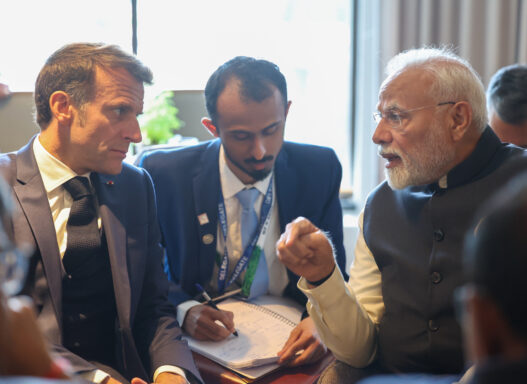
An important turning point came in 1998, when France was one of the few countries that did not sanction or condemn India’s nuclear weapons test, Pokhran II. Instead, France supported India, and the same year, President Jacques Chirac visited India, where the two countries signed a strategic partnership. 
Since then, France has been one of India’s most important strategic partners, and the two countries cooperate extensively in areas such as nuclear technology and maritime security in the Indo-Pacific. According to Aparna Pande, a senior fellow at the Hudson Institute, and C. Raja Mohan, a professor at O.P. Jindal Global University, France is described as India’s “new Russia” in the sense that it has replaced Russia’s importance in Indian foreign policy.
Importantly, as India seeks to reduce its reliance on Russian arms, it has looked toward France. For example, France became the second-largest arms exporter to India from 2019 to 2023, accounting for 33%. By contrast, the United States exported only 13% in the same period. One of the key reasons India prefers French arms over American arms is that France has been willing to share key technologies with India, whereas the United States imposes many technology-transfer restrictions.
India’s Expanding Security Relations Beyond France
In recent years, there has been growing security cooperation with Brussels and other European countries beyond France.
One reason greater security cooperation has been possible at the EU level is the growing European desire for strategic autonomy, driven by the perception that the United States is an unreliable ally. As James Crabtree wrote for the European Council on Foreign Relations, the emergence of a “geopolitical Europe” has led India to look at the European Union as a security actor, not just a trading bloc.
While France has long been a proponent of strategic autonomy, many other European countries are now embracing it as well. These include Germany, Poland, the Netherlands, and other historically pro-transatlantic countries. At the EU level, strategic autonomy is actively embraced, as when EU Commission President Ursula von der Leyen insisted that “we Europeans must defend ourselves and we must depend on ourselves” in a speech to the European Parliament in December 2025.
With growing demand for strategic autonomy, there is a push to increase investment in indigenous European defense to reduce reliance on the United States. By 2039, Germany is expected to spend 153 billion euros on defense, which is 3.5% of the country’s GDP. In 2025, Poland spent 4.7% of its GDP on defense, the highest level among NATO members. Europe’s defense sector has grown significantly in recent years, with its employment rate of 6.9% the highest recorded.
Consequently, the burgeoning European defense industrial base has facilitated greater security cooperation with India.
In June 2025, Italy’s Chamber of Deputies, its lower house of parliament, approved a military pact with India. If approved by the Senate, this pact could facilitate joint defense production between Rome and New Delhi. In the EU’s latest strategy on India, released in September 2025, the two sides aim to conclude a Security and Defense Partnership. If concluded, India could participate in common procurement in the Security Action for Europe (SAFE), alongside other Indo-Pacific powers such as South Korea and Japan.
Similarly, India and Germany are about to finalize an 8 billion USD submarine deal, India’s largest ever submarine deal. If reached, it would include, for the first time, technology transfer for submarine production.
As these examples illustrate, the rearmament of Europe as part of its push for greater strategic autonomy has opened the way for greater defense industrial cooperation between India and Europe beyond France.
What France has that the Rest of Europe does not
Despite growing security cooperation between India and the rest of Europe, France will remain India’s primary European security partner for the foreseeable future for two reasons.
One reason is that France is a permanent member of the United Nations Security Council (UNSC), known as the P5. What gives the P5 immense authority is their ability to veto anything in the UNSC, and Paris has used it to block Chinese efforts to raise the Kashmir issue at the UN. For example, in 2019, after the Chinese and Pakistanis allegedly called for a meeting to discuss Kashmir, France vetoed it. In 2020, the French once again vetoed China’s proposal to discuss Kashmir during a closed-door meeting of the UNSC. Thus, as long as China and Pakistan remain India’s primary geopolitical adversaries, India will continue to rely on France’s diplomatic cover at the UN. No other European country can offer this level of institutional leverage, making France’s P5 status an advantage India cannot find elsewhere in the European Union.
The second reason is that France is a resident power in the Indo-Pacific through its overseas territories known as France d’Outre-Mer. In the Indo-Pacific region, France’s territories include La Réunion, Mayotte, Nouvelle-Calédonie, and Polynésie Française. About 1.5 million French citizens live on these islands, which constitute about 90% of France’s exclusive economic zone. Since France has territories in the region, it views developments in the Indo-Pacific as directly linked to French national interests rather than as a distant region. By contrast, many other European countries don’t necessarily regard the Indo-Pacific as their pressing priority, even if the other member-states are concerned about China’s economic coercion.
As India navigates an uncertain international system, New Delhi’s expanding relations with Brussels are a crucial development as it seeks to diversify its foreign partners amid tensions with Washington. However, for the foreseeable future, France will remain India’s primary security partner due to Paris’ status as a member of the P5 and a resident power of the Indo-Pacific. Taken together, these structural realities mean that while India will have more options in defense procurement, it will not diminish France’s importance in Indian foreign policy.