










A Quiet Trade Move
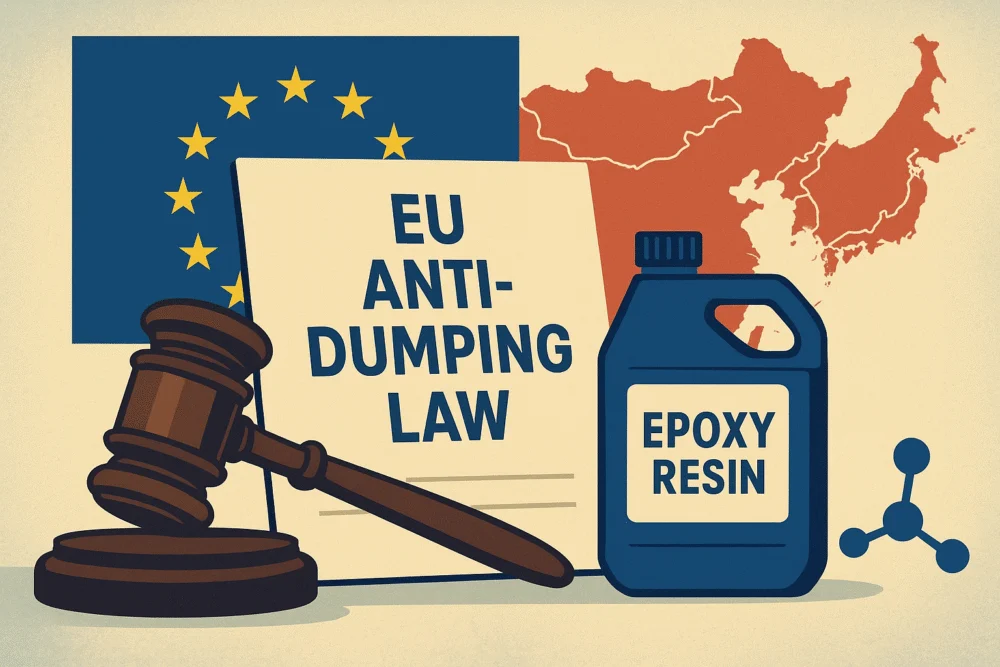
Few outside the chemical industry noticed when Brussels announced new anti-dumping duties on epoxy resins in July 2025, turning this unassuming issue into Europe’s latest trade confrontation with the asian chemical industry.
By targeting resin imports from China, Taiwan, and Thailand, the EU has pushed its defensive trade measures into the upstream materials industry. This confirms a long-awaited shift of the spotlight toward the raw/fundamental ingredients of modern manufacturing instead of end-user products.
Timeline: What happened?
The epoxy resin dispute began quietly on 1 July 2024, when the Commission launched an investigation into low-priced imports from China, Korea, Taiwan, and Thailand. The inquiry covered any product containing more than 35 percent epoxy resin by weight, whether solid, semi-solid, or liquid.
By February 2025, Brussels had seen enough to act. A provisional duty was introduced, signalling that the Commission believed European producers were being undercut. 
The final step came on 25 July 2025, when Regulation (EU) 2025/1505 imposed definitive duties on the three Asian exporters but cleared Korea of wrongdoing.
Under the EU’s previous “basic regulation” on anti-dumping (Regulation 2016/1036), such action is taken only when dumping, injury, and causation are all proven. The epoxy case ticked each box, completing the process from suspicion to enforcement in just a bit over a year.
What are epoxy resins, and what products fall under the regulation?
Epoxy resins, also known as epoxides or polyepoxides, are reactive polymers widely used as intermediates in various industrial formulations. They are primarily produced from epichlorohydrin (ECH) and + a di- or poly-hydroxyl (aliphatic or aromatic) molecule, like bisphenol A (BPA), or related compounds, and form a thermosetting network when combined with suitable curing agents. The resulting thermoset polymers demonstrate excellent chemical and solvent resistance, strong adhesion, low curing shrinkage, impact resistance, flexibility, and good electrical insulating properties, making them indispensable compounds for use in secondary products.
Under EU regulations, the product under investigation is defined as any material containing more than 35 percent epoxy resin by weight, regardless of its form or grade. This includes solid, semi-solid, and liquid variants, encompassing general-purpose, high-performance, and specialty formulations, and refers specifically to epoxides before curing, meaning the resins are still chemically reactive rather than combined with hardeners (curing agents).
Why are resins important?
Epoxy resins‘ key properties, such as strong adhesion, chemical and corrosion resistance, and electrical insulation, make them indispensable across multiple manufacturing chains, supplying sectors that together represent billions in annual turnover.
They serve a wide spectrum of products: industrial coatings, structural adhesives, electrical encapsulants, circuit boards, laminates, composite materials, and much more. These are critical for sectors such as construction, electronics, automotive manufacturing, and advanced materials production, or in other words, the core market within Europe’s specialty chemical industry.
For Europe’s specialty chemical producers, resin production sustains a network of upstream and downstream activities: feedstock processing, compounding, and formulation. Around 1,400 jobs are directly linked to the EU epoxy resin industry, but the indirect footprint extends far wider through dependent manufacturers in construction materials, automotive components, and the electrical industry.
Maintaining a viable domestic epoxy resin base supports not only employment but also technological know-how and supply security in an area where Asia dominates global capacity. In that sense, epoxy resins are strategic because of their role as enabling materials across Europe’s high-value manufacturing landscape.
What Is Dumping?
In trade law, “dumping” refers to the practice of exporting a product to another market at a price below its normal value, typically lower than the price charged in the producer’s home market or below the cost of production plus a reasonable profit margin. The European Union, like the World Trade Organization (WTO), treats such pricing as an unfair trade practice when it causes injury to the domestic industry.
The EU’s legal basis for addressing dumping is set out in Regulation (EU) 2016/1036f, which allows the Commission to impose anti-dumping duties if three conditions are met:
- Dumping is proven;
- Injury to the Union industry is established; and
- A causal link between the two is demonstrated.
In the epoxy resin case, the Commission determined that exporters from China, Taiwan, and Thailand had sold resins in the EU market at prices significantly below fair value, with calculated dumping margins that range from 17.3% to 33% for China, 10.8% to 11% for Taiwan, and 29.9% for Thailand.
Why Is Dumping Harmful to the EU?
Rarely does international trade operate on an even playing field. Factors that impact how industries develop, compete, and survive are hidden under alluring import prices and changing market patterns. The effects extend well beyond short-term price and impact Europe’s industrial resilience and competitiveness.
- Undercutting domestic producers
If foreign producers can sell at artificially low prices (due to subsidies, overcapacity, distortions), they can capture market share in the importing region by undercutting local producers. This often results in lost sales, shrinking margins, and factory closures among domestic firms. A clear example came in 2012–2013, when the EU and U.S. investigated Chinese solar panel exports and found they were sold below market value, harming local industries. The European Commission, citing €21 billion in Chinese imports in 2011, responded with provisional duties averaging about 47 percent.
2. Distorted competition
Dumping often reflects structural distortions in the exporter’s home market, such as subsidised energy or feedstock costs. These differences grant non-market advantages that EU producers cannot replicate under normal commercial conditions.
- Loss of technological and strategic autonomy
Europe’s specialty chemicals sector relies on continuous reinvestment and R&D to maintain product quality and innovation capacity. Prolonged price suppression discourages investment, leading to loss of know-how and increased dependency on external suppliers for critical intermediates.
- Ripple effects in downstream industries
Because epoxy resins are upstream inputs, collapse or weakening of domestic resin producers can raise risks (in cost, availability, innovation) for downstream industries (coatings, wind blades, composites). That, in turn, can affect Europe’s ambitions in clean-tech and advanced manufacturing.
- “Dump and exit” risk
Economic researchers warn that so called „predatory dumping“ may be used as a strategic tool to drive rivals out of the market, then later raise prices once competition has exited the market. So far however, no verified instance of such a strategy has been officially recorded.
In the epoxy resin case, the Commission concluded that such cumulative effects justified intervention to restore fair price competition. Anti-dumping duties were therefore deemed necessary not only to protect specific producers, but to preserve Europe’s capacity to produce essential chemical inputs within its own borders.
How Have East-Asian Exporters Responded?
The duties imposed by the European Commission have not gone unnoticed in East Asia. In China, trade authorities and business media reported on the measure, noting that exporters now face additional pressure in an already oversupplied global market. Analysts see the case as part of a broader shift in Europe’s trade-defence strategy, extending beyond finished goods into upstream chemical inputs such as epoxy resins.
Taiwan’s trade authorities likewise issued notices to affected producers, reflecting growing awareness of the EU’s tighter stance on industrial materials. In Thailand, the issue has drawn less public attention, but exporters are likely keeping a close eye on the developments as the EU remains an important downstream market for resins.
Across the region, the tone is one of cautious reassessment rather than confrontation. No formal challenges or retaliatory steps have been announced, yet the inclusion of multiple Asian economies in a single trade measure has pointed out the EU’s willingness to police regional value chains. For many suppliers, this is a reminder that market access to Europe increasingly depends not only on competitiveness but also on alignment with the evolving industrial and trade policies.
The next test will be whether East Asian exporters challenge the measure through the WTO’s dispute settlement process. This, in turn, may become a move that could elevate this case from a technical trade action to a wider question about how global chemical supply chains are going to be maintained going forward.
Consequences: Protection or Pressure?
A positive development in this regard is the growing recognition that responsibility does not lie with end users, but rather with manufacturers seeking the lowest possible input costs. At the same time, it is important to acknowledge that large companies operate within their own economic pressures, aiming to satisfy shareholders and maintain capital efficiency.
Building on this awareness, the EU has intervened to address these unfair practices and to protect epoxy and resin manufacturers from distorted global competition. In doing so, the Commission has acted appropriately to safeguard both citizens and domestic production. Yet, as with many trade-defense measures in intermediate sectors, the ripple effects inevitably reach far beyond the factory gates.
For Europe’s chemical industry, the duties may offer temporary relief. By curbing underpriced imports, they help stabilize margins, sustain employment, and create space for reinvestment in production capacity.
However, the same duties can also tighten the cost structure of Europe’s downstream industries. Coatings, adhesives, composite materials, electrical components, and much more will be affected by these changes. Many of these are critical products to sectors driving the energy and technology transitions: wind turbines, electric vehicles, and advanced electronics all rely on epoxy-based systems.
Higher resin input prices could therefore raise production costs for European manufacturers competing globally, potentially slowing investment or deployment in renewable and high-performance applications. What protects one layer of the value chain may thus strain another on a global scale, creating the fear of big global players cutting contracts with European firms.
The policy dilemma remains: How can Europe secure domestic upstream materials production without endangering the competitiveness of the industries that depend on it?
Brussels’ balancing act is likely to continue, implementing trade defenses to protect domestic capacity while closely monitoring their downstream effects. As reviews and appeals unfold, the outcome will ultimately reveal whether this approach reinforces Europe’s industrial backbone or introduces new points of strain and stress within it.