






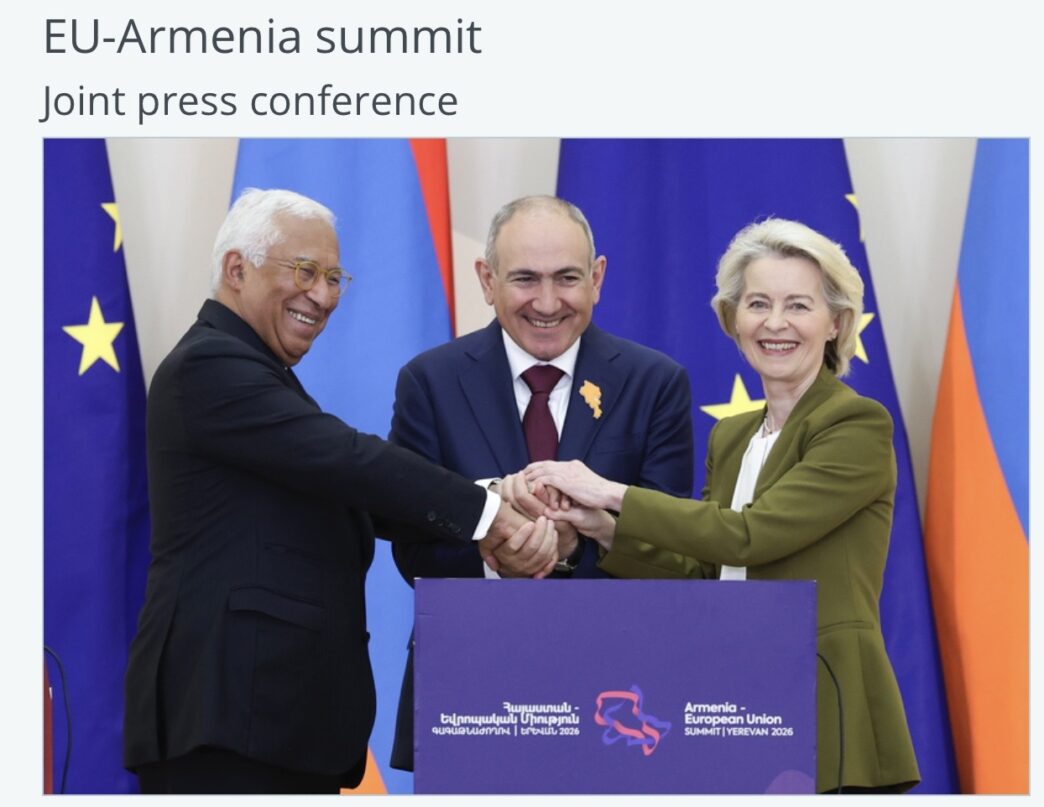
On May 4, Armenia hosted the eighth European Political Community summit in its capital, Yerevan, which EU Council President António Costa called a “historic opportunity” to bring the country closer to the European Union.
The summit, held in the South Caucasus for the first time, was co-chaired by António Costa and the Armenian Prime Minister Nikol Pashinyan. Costa framed the meeting not only as a diplomatic milestone for Armenia, but also as part of a broader reassessment of European security architecture.
Leaders discussed economic security, democratic resilience, regional connectivity, and Europe’s evolving geopolitical challenges. In his remarks in Yerevan, Costa emphasized the growing need for what he called a “360-degree vision” of Europe’s security.
In the current geopolitical context, it is increasingly clear that our continent needs a 360º degree vision for its security. Meeting here, in Armenia, in the South Caucasus, so close to the Middle East – it is a stark reminder that war in Europe’s neighbourhood has a direct impact on our common security, our energy supply and our economy.
For Armenia, the summit came during a period of significant geopolitical transition. In recent years, the country has sought to diversify its foreign policy partnerships amid deteriorating security conditions in the region and growing dissatisfaction with Russia’s security commitments.
Located at the crossroads of Europe and Asia, Armenia has faced increasing security challenges following the 2020 Nagorno-Karabakh war, the following blockade of Nagorno-Karabakh, and Azerbaijan’s 2023 military offensive that led to the displacement of the region’s Armenian population. Against this backdrop, Armenian authorities viewed closer ties with the European Union as a means of strengthening political and economic resilience.
How far has Armenia’s path to the EU progressed?
Armenia’s relations with the EU have developed since its independence in 1991. However, the prospect of an eventual EU membership has only gained increased political traction in recent years.
The shift accelerated following Armenia’s ratification of the Comprehensive and Enhanced Partnership Agreement with the EU, which entered into force in 2021 and has since then established frameworks for cooperation in government reforms, trade and democratic institutions.
In March 2024, the European Parliament adopted a resolution stating that Armenia could apply for EU membership in the future, provided it satisfies the Copenhagen criteria, the political and economic conditions required of candidate states. Several months later, in September 2024, the Armenian government launched a petition initiative calling for a referendum on whether the country should pursue EU membership. Prime Minister Nikol Pashinyan later confirmed that initiating the EU accession process had become part of Armenia’s political agenda.
Still, Armenia remains far from formal accession talks. Unlike candidate countries such as Ukraine, Moldova, or Georgia, Armenia has not submitted an official application for membership and continues to balance its European ambitions with existing regional and economic dependencies, including its membership in the Russian-led Eurasian Economic Union.
At the same time, cooperation between Armenia and the EU has visibly intensified. Brussels has expanded political dialogue with Yerevan, deployed a civilian monitoring mission on Armenia’s border with Azerbaijan, and increased financial assistance aimed at democratic reforms and economic development in the country.
The EPC summit in Yerevan did not bring immediate changes to Armenia’s status within the European Union. However, by placing Armenia at the center of a major European diplomatic gathering, it underscored how the country’s relationship with Europe is becoming an increasingly important part of both regional politics and the EU’s broader strategy.
Whether Armenia will solidify its interest in beginning the path towards EU membership still remains a distant prospect. However, it is clear that what was once a largely symbolic path is now at the forefront of the country’s ruling party agenda. At the same time, the country’s parliamentary elections scheduled for June 7, and its subsequent political developments, will play a key role in shaping these ambitions.
Sources: European Council, Press release by António Costa, European Parliament Resolution May 13, Eastern Partnership CSF.