






Balancing Resources and Rights: The EU’s Dilemma in Serbia’s Democracy Crisis
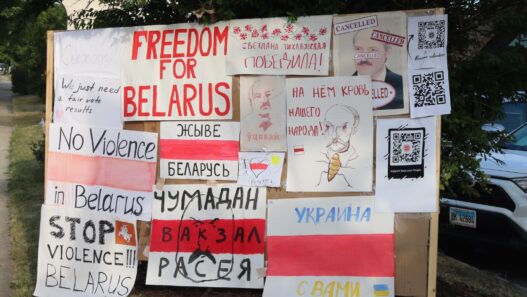
Serbia’s current student-led pro-democracy movement emerged in November 2024, after a newly renovated railway station canopy in Novi Sad collapsed, ultimately killing 16 people. What began as outrage over official negligence and corruption quickly grew into a nationwide wave of demonstrations against government repression, media control, and the erosion of democratic standards under President Aleksandar Vučić, who served as Slobodan Milošević’s1 Information minister in the late 1990s.
The protests have also been fueled by anger over plans to revive a controversial lithium mining project in the Jadar Valley, a project tied to the European Union’s green transition and its search for critical raw materials. Polling shows a solid majority of Serbs – often 60–75% – oppose the Jadar project, amid widespread fears it would damage the environment and threaten farmers’ livelihoods.
This has placed the EU in a difficult position. On one hand, it views Serbia as a key partner and candidate for membership, and lithium as vital to Europe’s strategic autonomy. Before being paused, the mine was previously slated to start production around 2027, with supporters claiming it could cover up to 90% of Europe’s current lithium demand – a figure many experts dispute, with other estimates putting its contribution closer to a fraction (for example, around 17% of projected EV battery needs). Without a reliable lithium supply, the EU’s plans for a large-scale rollout of electric vehicles and renewable energy storage could slow dramatically, threatening one of the EU’s most ambitious climate goals.
On the other hand, the Union faces growing criticism for disregarding human rights abuses and the suppression of dissent to preserve political stability and access to resources. Human rights groups have denounced the police violence used against demonstrators. At the same time, Serbian civil society accuses Brussels of sacrificing its principles for geopolitical convenience, failing to uphold central European values, such as the rule of law.
Vučić vowed to free the country “from terror and evil.”We will act faster, stronger”, he said. “We will not ask anyone abroad for help or permission.”
Serbia has remained a candidate for EU membership since 2012, but the accession process has been slow and difficult. Under Vučić, Serbia received significant European funds to transform the Country for EU membership. Still, it maintains good ties with Russia and China, pursuing these relations for its own economic benefits and balancing between the three geopolitical powers.
Freedom House has said that Vučić’s party, the ruling Serbian progressive party (SNS), has, over the years, “steadily eroded political rights and civil liberties, putting pressure on independent media, the political opposition, and civil society organisations.”
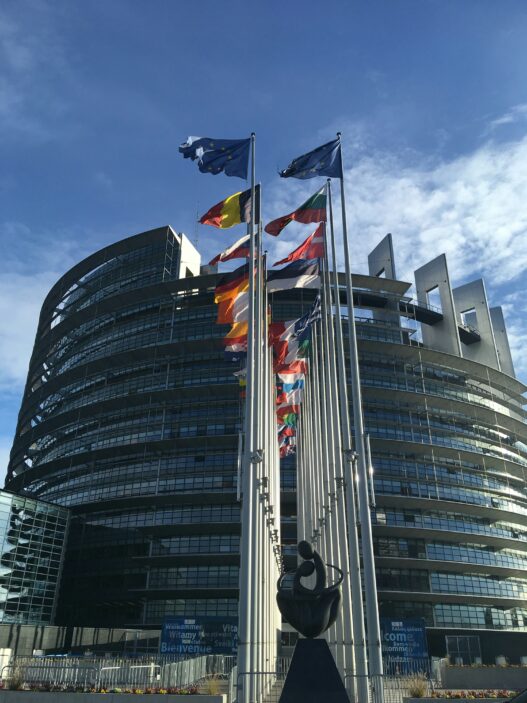
Experts and political analysts warn that the crisis represents a test for the EU’s democratic credibility: whether it can uphold its values of democracy, transparency, and the rule of law, even when they conflict with strategic or economic interests.
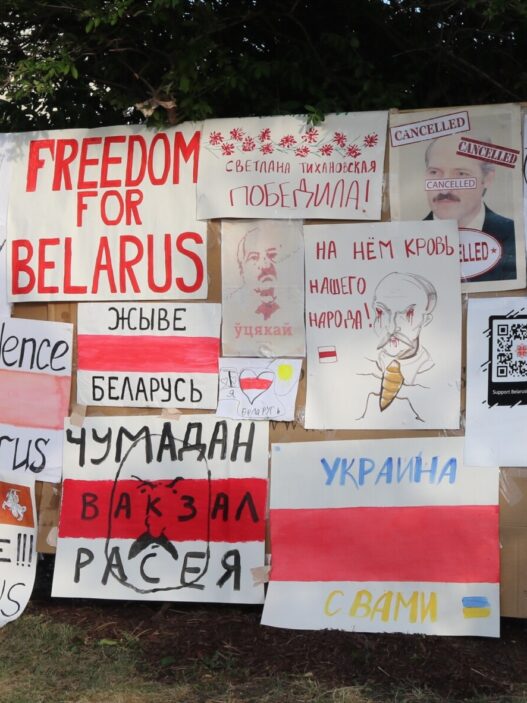
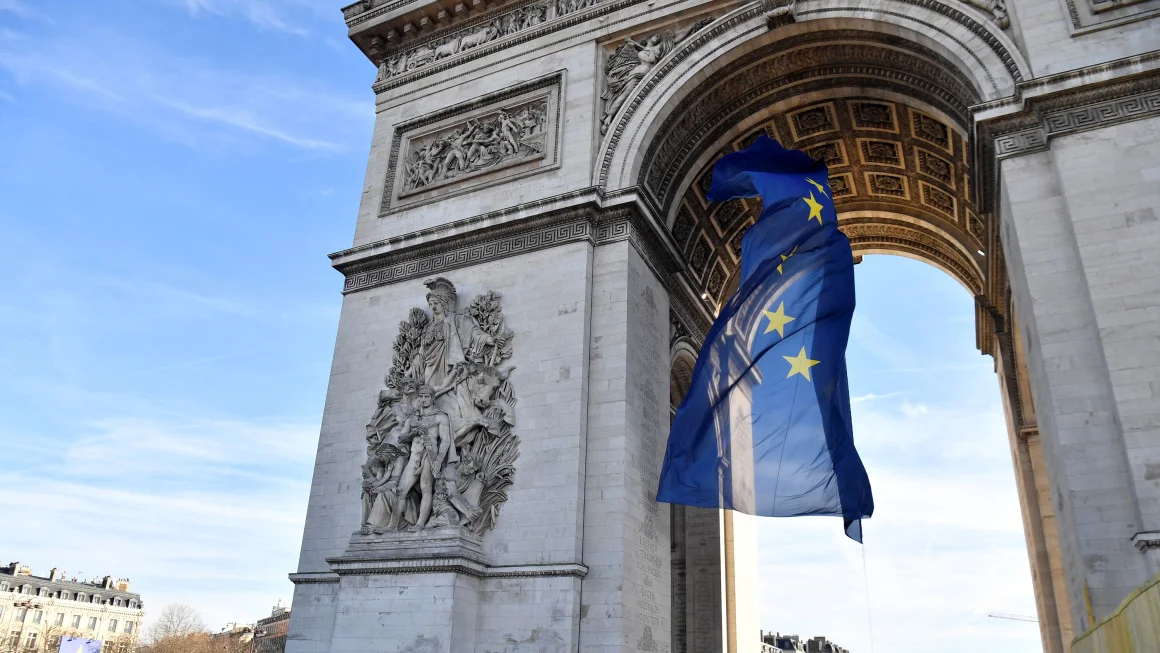
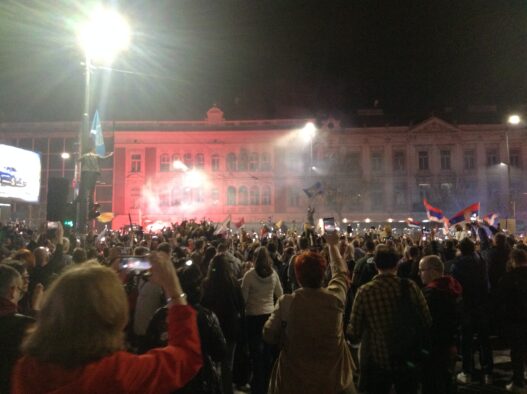
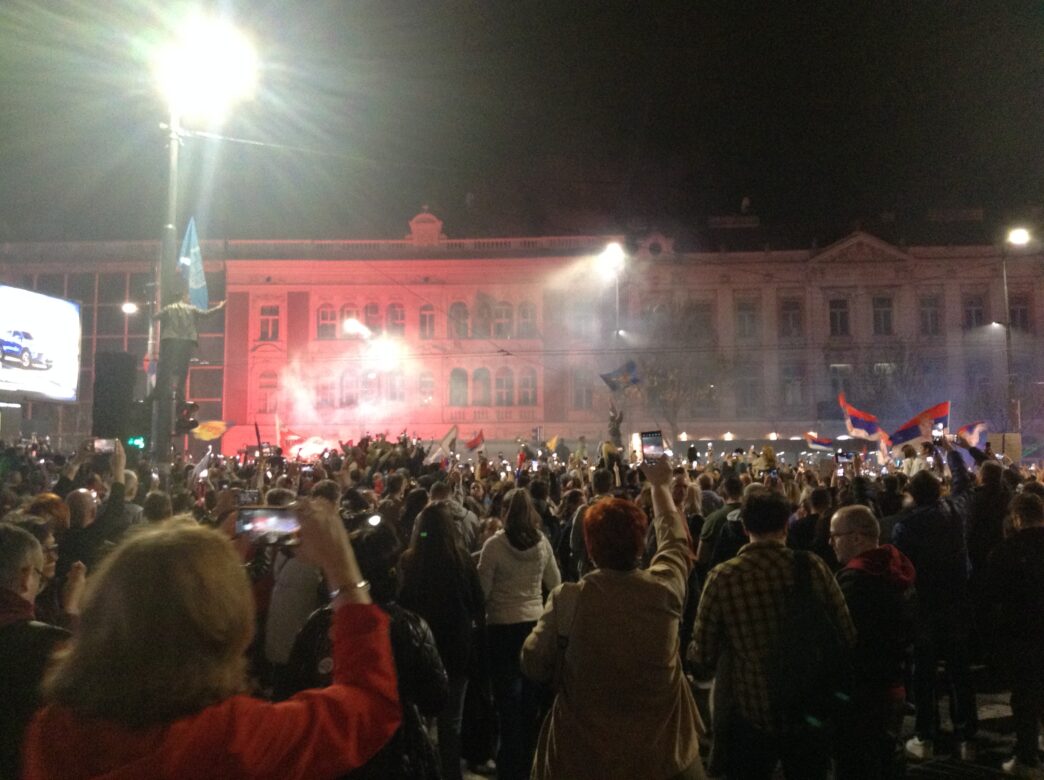
Suppose Brussels continues to prioritise short-term stability over democratic accountability, the EU risks losing moral authority in the Western Balkans and weakening public support for European integration among the very citizens who still believe in its ideals. Polls in Serbia show that support for the EU has significantly decreased, raising questions about the EU’s Enlargement process and Serbia’s place in it. This fact is evident in the protests, where people are showing Serbian flags and almost no EU flags.
In January this year, a public letter published on 5 February, a public letter from leading Serbian activists to the EU called on the EU to be more outspoken about the Serbian government, condemning its actions against protesters:
“The rule of this regime all these years would not have been possible without, unfortunately, a very ambivalent and inconsistent policy of the European Union towards Serbia”.
1 November marked the anniversary of the Novi Sad disaster. Given the actors’ stated intents, even if a million protesters took part, it is unlikely that Serbia’s government or the EU would reconsider their actions.
Sources and further details on the current democracy crisis in Serbia can be found in BISI, Euractiv and HBS.
- Slobodan Milošević was a Serbian and later Yugoslav politician who served as President of Serbia and then President of the Federal Republic of Yugoslavia from the late 1980s until 2000. He played a central role in the Yugoslav wars of the 1990s and was a key driver of nationalist conflict in Bosnia, Croatia, and Kosovo. After being overthrown in 2000, he was handed over to the UN war crimes tribunal in The Hague, where he was charged with genocide, crimes against humanity, and war crimes, and died in custody in 2006. ↩︎