








The expansion of the EU carries both advantages and disadvantages, which have been widely considered.
Advantages of higher integration include the support of geopolitical interests by bringing states geographically close to rivals under EU influence. This is the case, for instance, with Eastern European countries such as Ukraine, Georgia and Azerbaijan who are at a higher risk of attacks from Russia. Through integration, Eastern European countries can look for EU protection for the purpose of stronger defence and security. Simultaneously, the EU earns further influence over direct borders with Russia, placing more strategic pressure on rivals. Furthermore, the EU is the “world’s largest single market”, expanded through the previous Eastern Enlargement which provided economic advantages, such as increased trade. Lack of integration can lead to interested member states to look for economic arrangements with other competitors. It is, thus, widely argued that further integration results in further economic improvement and multiculturalism.
However, increasing the number of member states simultaneously increases the risk of internal incohesion, resulting from a higher number of different national interests colliding. As Hungary’s membership has demonstrated, e.g. by vetoing assistance to Ukraine, integrating member states who do not fully align with the EU acquis can undermine EU’s stability and efficiency. Furthermore, considering the existence of a current war between Russia and Ukraine and Russia’s expansionist efforts and tendencies in the region brings the risk of directly involving the EU and respective member states into active conflict.
To find a balanced response to this dilemma, Macron has proposed the solution of the EU organising into concentric circles. The 2023 Franco-German paper on the reform and enlargement of the EU explored differentiation, stating it “could lead to four tiers of European integration” – comprising of “inner circle (deep integration in areas like the eurozone and Schengen), the EU itself, a larger circle of Associate Members, involving participation in the single market and adherence to common principles, and finally the European Political Community (EPC), as an outer tier for political cooperation without having to be bound to EU law”. 
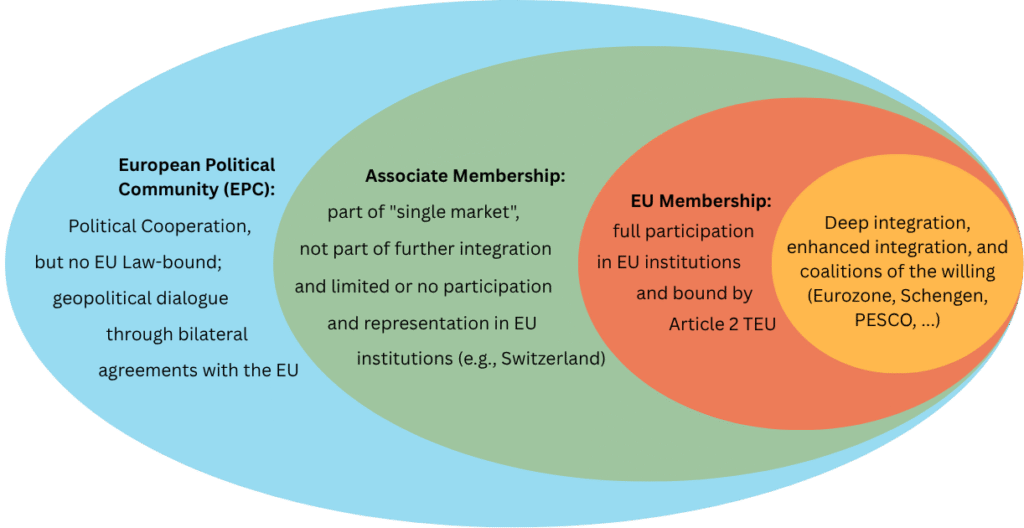
This strategy aims to facilitate the efficiency of decision-making and its implementation by relying on consensus within a smaller inner circle with less chances of disagreement/hindrance from uncooperative states. Such a proposal, thus, looks for a more efficient and cohesive decision-making whilst simultaneously allowing a degree of integration of other states.
Nevertheless, such separation can potentially deepen fractures in inter-circle relations, undermining the possibility of fostering peace and shared values in the region. Furthermore, the allocation of areas of influence, for instance socio-economic policy and foreign policy sectors per different circles could potentially hinder the intended efficiency of a concentric circle model. The fact different areas of policy (which could potentially be allocated to different circles) are interrelated as, e.g. economic policy directly influences foreign policy capacity, potentially undermines the idea of efficiency as different circles can still undermine one another indirectly. Thus, the implementation of a concentric circles model does not come without its limitations and possible counter effects.
Other institutional reforms for improved efficiency and institutional protection of the EU’s structures have been proposed. For instance, still within the 2023 Franco-German paper is the proposal of amendments to Article 7 of the Treaty on the European Union for the facilitation of the implementation of sanctions for member states carrying out “serious and persistent breach or risk of breach of EU values”. Such facilitation is proposed by amending the level of consensus required to apply sanctions – implementing “a majority of four-fifths at the European Council” in lieu of the existing “unanimity -1” rule. Supplementing a lower threshold for triggering sanctions is the recommendation of solidifying the response mechanisms through “automatic sanctions five years after a proposal to trigger the procedure” – hence, representing a strategy of ensuring defiant member states are unable to avoid penalisation based upon the Council’s inertia. Taken to the limit, repeated breaches and infractions can place the respective breaching member state’s membership at risk with reduced integration and influence in EU matters.
Thus, separating the EU into concentric circles or facilitating the sanctioning of breaching member states seems to be proposed upon the preconceived basis that breaching member states would be newer or geographically peripheral states. However, with the rise of far-right tendencies globally, founding EU member states are also at the risk of seeing their own governments become unaligned with the EU acqui. This is the case with Belgium, France, Germany, Italy, Luxembourg and the Netherlands. For instance, Belgium currently has a right-wing government, whilst the rise of Le Pen has also increased far-right tendencies in France. Germany’s far-right party (AfD) also grew, coming second in the 2025 elections. Italy has now had a right-wing government and Prime Minister since 2022. As for the Netherlands, it saw the implementation of “its first far-right government” following the 2024 elections. Only Luxembourg’s right-wing populist party (ADR) remained fourth in its most recent general elections (2023); though in 2024 European elections ADR successfully won “its first seat in the European Parliament”.
Italy specifically represents an adequate example of how the rise of far-right trends can hit the EU in its deepest core through its founding member states. Italy has seen far-right prime minister Georgia Meloni come into power and impacting LGBT+ rights by, for instance, not signing the “EU declaration on the World Day Against Homophobia” and applying stricter control over journalists. Prior to her election, Meloni criticised the EU and claimed Italy should leave the Union. From an European perspective, many have since compared Meloni’s right-wing political tendencies to Orban’s, claiming “Meloni Is Orbánizing the EU”. Nevertheless, whilst Orban represents a direct threat and is faced as such, Meloni is (despite her background of anti-EU rhetoric) able to infiltrate EU institutions, being deeply coordinated with the President of the European Commission and internally influencing the EU’s shift to the right. Internationally, Meloni finds ideological parallels with Trump, which is reflected in Meloni being “the only European head of government invited to Donald Trump’s inauguration”. Carrying political consequences for the EU in light of the current economic turmoil around tariff threats, Meloni attempts to personify a bridge between the EU-US whilst still balancing bilateral interests between Italy-US. However, potential cooperation of the EU with the US, whilst Trump materialises populist and illiberal tendencies, contrasts with the EU’s fundamental values and identity, potentially undermining its strength as an international actor.
Therefore, Italy’s example demonstrates how threats to EU values can emerge from inner circles too. Hence, the concentric circles model could have the inner most influential circles promoting policies contrasting with the EU’s core principles. With potential outer circles having less influence and their respective member states being stuck in institutional and legal frameworks, they could be sanctioned or subjected to policies which are at odds with the EU’s standards. Consequently, potential solutions to the risks of enlargement should also consider the risks emerging from changes within existing and founding member states.
Nuanced proposals with potential for long-term stability include, for instance, the early-on inclusion of candidate states “in the functioning of the EU institutions, e.g. through observer status”. Current institutional frameworks can also be utilised for changes to facilitate a smooth integration considering the flexibility already existing within the. Gozi’s recommendations highlight, for instance, the flexibility in the Treaty of Lisbon to modify “the size of the College of Commissioners”. Further to this, Gozi suggests (in alignment with points raised within the aforementioned 2023 Franco-German paper) an amendment to voting models by applying QMV systems in most areas – except for sensitive decisions such as “decisions authorising military missions or operations with an executive mandate, and the decisions to launch and to close the enlargement negotiations”. QMV – Qualified Majority Voting – is already utilised by the Council of the EU where “a qualified majority is reached if two conditions are simultaneously met:
- 55% of member states vote in favour – in practice this means 15 out of 27
- the proposal is supported by member states representing at least 65% of the total EU population”
Such a voting system would allow for democratic decision-making, reflecting the EU population’s opinions, whilst simultaneously facilitating quicker and more efficient consensus. The complementary essence of these proposals possibilitates early inclusion for candidates to reach an understanding of EU institutions before full membership, and once the Copenhagen criteria is satisfied, QMV allows for democratic and efficient implementation of proposals.
Faced with imminent enlargement and with a need to bring neighbouring states closer as a form of defence against geopolitical rivals whilst simultaneously needing internal stability and cohesion – the EU ought to find balanced solutions to protect its security/defence whilst safeguarding its internal cohesion. This analysis thus considered Macron’s proposal of concentric circles to highlight its inherent risks of increasing internal fragmentation. Suggestions for institutional reform on facilitation of sanctions prior to an enlargement taking place were also discussed to emphasise the possibility of countereffects considering the current surge of far-right tendencies within inner circles. Ultimately, it is key to find nuanced proposals, such as Gozi’s recommendations discussed above.