









Since the 1980s, the European Union has dealt with environmental protection and promoting a sustainable lifestyle. Since those times, several action plans, treaties, and joint agreements have marked the evolution of the European effort to create a more environmentally sustainable future for the region. After the 2015 Paris agreement, which can be considered as a key framework treaty – since it set a global legal and political framework for sustainability and triggered new European Commitments – the European Union announced the European Green Deal in December 2019. As the Commission wrote in the official Communication on The European Green Deal, the package is aiming to turn Europe into a more environmentally sustainable region by the year 2050:
“It (the Green Deal) is a new growth strategy that aims to transform the EU into a fair and prosperous society, with a modern, resource-efficient and competitive economy where there are no net emissions of greenhouse gases in 2050 and where economic growth is decoupled from resource use.”
With the Green Deal, the European Union is aiming to fill a global leadership position, to be able to create green alliances, set standards for sustainable growth, and perhaps prove the continent’s capability to lead the global community. As part of the European Green Deal, the EU committed to reducing the use of greenhouse gases and increasing the use of renewable energy, for example, renewable hydrogen. Based on the European Commission’s communication, renewable or green hydrogen is produced through a water splitting process, called electrolysis. As a response to global warming and the energy crisis – triggered by the war in Ukraine – REPowerEU set goals for the European continent to import 10 million tons of green hydrogen and gain another 10 million tons from domestic production by 2030.
Is the European green hydrogen plan realistic?
To be able to understand how realistic the European Union’s green hydrogen plans are, it is crucial to analyse the current domestic production and the already signed deals with external actors, to cover the total expected 20 million tons of green hydrogen. 
Domestic production
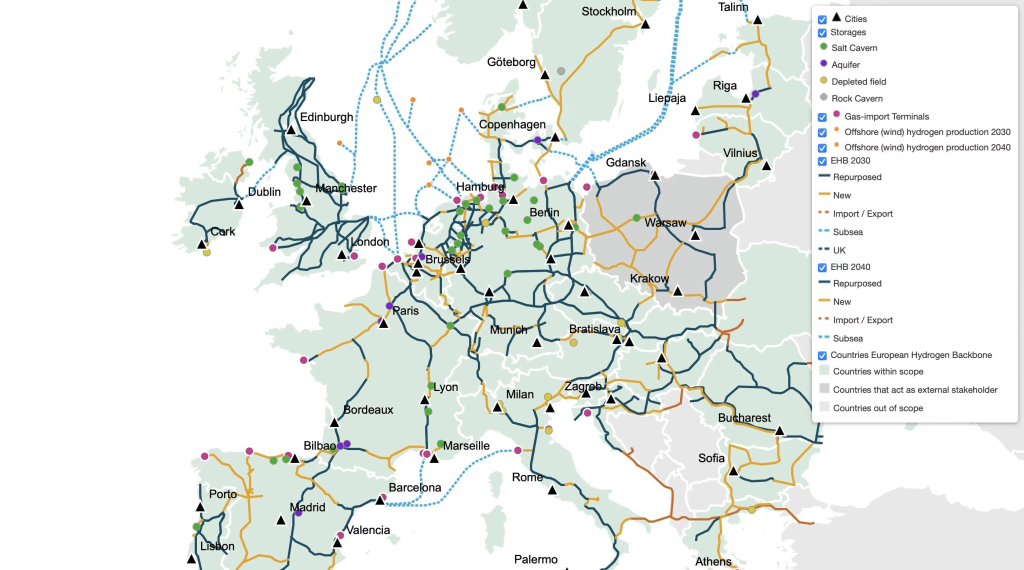
Based on the European Hydrogen Observatory’s report from November 2024, at the end of 2023, 512 hydrogen producer facilities were in use all across the EU, which meant a total capacity of approximately 11.23 million tons of domestic hydrogen production (European Hydrogen Observatory, November 2024, p. 12). However, it is important to note that the report does not state that these facilities are producing green hydrogen. The official numbers for green hydrogen production from the report are 207 clean hydrogen production and consumption projects, out of which 141 are already in operation (European Hydrogen Observatory, November 2024, p. 21). The three European states with the highest expected increase in domestic green hydrogen production, considering hydrogen projects under construction, are Sweden, France, and Germany, with combined additional capacities until 2026 of approximately 219,000 tons of renewable hydrogen (European Hydrogen Observatory, November 2024, p. 23). The production of green hydrogen is one challenge the EU must find a solution for, but the transportation of hydrogen is another. Currently, the Union is aiming to install 11,600km of hydrogen pipelines by 2030, and 39,700km by 2040. Even though new initiatives in some European countries are expected to significantly increase domestic production of renewable hydrogen, the projected production volumes by 2030 will by no means add up to the 10 million tons targeted by the EU.
Agreements for import
In the past years, several European member states signed agreements with external partners for green hydrogen imports. Based on these agreements, it can be said that Germany, the Netherlands and Italy are dominating the European green hydrogen import sector, but the exporter states are more diversified. For this analysis, six different cases were selected to be analysed, where EU member states agreed on importing green hydrogen from abroad. The cases were selected based on the location of the exporter state, since the closer the exporting state is geographically to Europe, the more realistic is the plan to import a large volume of green hydrogen from them. For these reasons, actors like Australia, China or the U.S. are not involved in the analysis. The six main external states are: (1) Oman, (2) Saudi Arabia, (3) Egypt, (4) Tunisia and Algeria (H2 corridor), (5) Morocco, and finally (6) Norway. Currently, there are two different forms in which green hydrogen can be transported: in the form of hydrogen (in this group, several subgroups can be created, depending on the state of the hydrogen cluster) and in the form of ammonia. The states mentioned above can be sorted into three different groups, based on the form of green hydrogen transportation.
(1) Saudi Arabia is the only member of the first group that is aiming to transport the produced green hydrogen in the form of ammonia. Rijad signed several agreements with Germany and Italy, in which Saudi Arabia commits to exporting approximately 200,000 tons of green hydrogen per year into the European market.
(2) The second group contains states which are expecting to balance the export with the form of ammonia and green hydrogen at the same time. These states are Egypt and Morocco. Some sources say approximately 1,5 million tons of renewable hydrogen will be exported from Egypt towards the European Union, while Rabat is aiming to export around 0,5-1 million tons of green hydrogen, in the form of both hydrogen and ammonia.
(3) The third group involves states that are focusing on exporting the produced green hydrogen in its original form, with potentially several different states of matter. Oman, Norway, as well as Tunisia and Algeria, with the SoutH2 corridor, have all already signed agreements with several European states. Oman is expected to export 1 million tons of green hydrogen by 2030 towards the Netherlands and Germany, based on the signed agreement. The SoutH2 corridor is said to cover approximately 40% of the REPowerEU import targets, from Tunisia and Algeria, towards Italy, Austria and Germany. For Norwegian hydrogen exports to other European countries, a new study by Norwegian Hydrogen, a leading Norwegian producer of green hydrogen, indicated that the announced project scale is 50,000 tons of green hydrogen, commencing in 2027, which could form the base of a safe and long-term cooperation between the Nordic state and European partner states.
To present the problem of the current REPowerEU goals, I collected the export volumes of the agreements and cooperations mentioned above to see if, in an ideal case, they could meet the EU targets, or not:
- Saudi Arabia: 200,000 tons
- Oman: 1,000,000 tons
- Egypt: 1,765,000 tons
- Tunisia: & Algeria 4,000,000 tons
- Morocco: 500,000 – 1,000,000 tons
- Norway: 50,000 tons
Theoretically, these are the amounts of exports that are either the exporter states are able or willing to sell to the European Union. In total, this is approximately 8,015,000 tons of green hydrogen, which is still falling behind the 10,000,000 tons as the target in the REPowerEU. It is also important to highlight, these import volumes are the maximized capacity of each exporter state, which means that to reach 8 million tons of green hydrogen imports, everything must work out perfectly. Another challenge that must be taken into consideration is the actual capacity of the receiver ports. Since most imports target the Dutch ports of Rotterdam and Amsterdam, which have a capacity of 200,000 tons per year, the actual reception and processing of green hydrogen remains a challenge that the Union must address, even if the EU’s hydrogen partners manage to fulfil all agreements on the full 8,000,000 tons.
North – South inequality
Another problem is the strong North European dominance in the case of green hydrogen import. Most of the currently announced agreements and partnerships are aiming to bring green hydrogen or ammonia towards the Netherlands or Germany. Although there are already plans for some Greek import hubs, besides the SoutH2 corridor, the majority of the imports are targeting the Northern region of the continent. This imbalance could cause challenges in the future, since first of all, most of these ports are not ready to deal with such a huge amount of green hydrogen imports, secondly the transport of the green hydrogen from these ports towards the inner European regions is still not advanced enough yet, to offer a solution for other member states too.
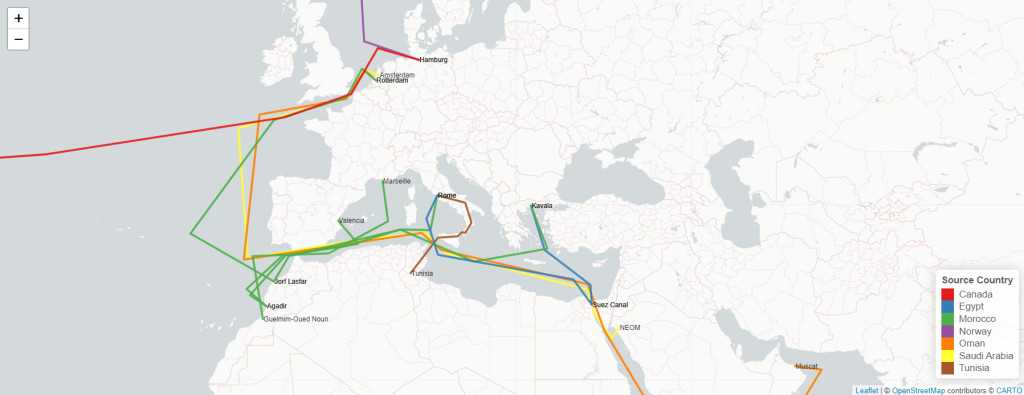
As shown in the map above, an important amount of green hydrogen transport goes through the Mediterranean and ends in the Netherlands. Although it could be argued that “only” Oman and Saudi Arabia transport green hydrogen to the Dutch ports, the main problem is the volume of the transport. The Saudi Neom project aims to produce daily 600 tons of green hydrogen for export, while Oman has signed a deal for approximately 1 million tons of exported green hydrogen to the Dutch ports. At the same time, the possible volumes of imported green hydrogen to the South European regions are falling behind the Dutch and German import volumes.
Conclusion
It is clear that Europe has learnt from the mistake it made when it became heavily reliant on Russian fossil fuels, and is currently aiming to diversify its energy imports among several exporter states. The importance of diversification can be seen through the current war in Ukraine, since almost the whole continent faced an energy crisis when it stopped importing Russian fuels. These days, with the diversification of the energy import supply chain among several North-African and Persian Gulf states, the EU member states are showing that they have learnt the lesson, and do not want to face the same challenge over again. Although it is crucial to highlight, based on the current agreements and announced projects, it is fair to say the expected export volume is going to be close to the previously set goals by REPowerEU, but the domestic production is falling behind expectations. As it was already mentioned above, based on the European Hydrogen Observatory’s report from November 2024, the European domestic renewable hydrogen production is going to be dominated by three main states, Sweden, France and Germany, and in the close future, these states are expected to increase their green hydrogen production by approximately 219,000 tons per year. Even if other European states join the domestic production, it is not likely to add such a high volume that it will make the European Union meet the 10 million tons that was set by REPowerEU. Also, the currently set 10 million tons of imports and 10 million tons of domestic production should be shifted towards more reliance on domestic production, to minimalize the reliance on external partners. For this, Europe needs to create domestic mega projects like the Saudi NEOM project, which has the capacity to produce 600 tons per day.
The last challenge the European states must face before gaining the ability to meet their goals is the underdeveloped infrastructure. Currently, some ports like Amsterdam, Rotterdam, or Hamburg are meant to receive most of the imported green hydrogen. Not only do these ports need to increase their capacity to manage the high import volume, but the states also need to find a solution for the transformation of the ammonia that is used as a tool to transport green hydrogen, for example, from Saudi Arabia, Egypt, or Morocco. To be able to crack the ammonia and re-gain the green hydrogen from it, states need to invest in special facilities, and possibly locate these facilities around the important ports, which function as the entrance point to the European market.
In conclusion, the European member states are progressing towards a well-diversified supply chain in green hydrogen import, falling behind on the domestic production, and facing several challenges on the local infrastructure to receive, transform and transport the imported green hydrogen. The goals that were set by REPowerEU are more ambitious than realistic, especially in light of the expected dates to meet those targets. To sustain the development of renewable energy in the European Union, it is going to be crucial to set more realistic goals, increase the infrastructure capacity, and slowly turn the 50-50 percentage share between import and domestic production towards a heavier reliance on domestic production.