






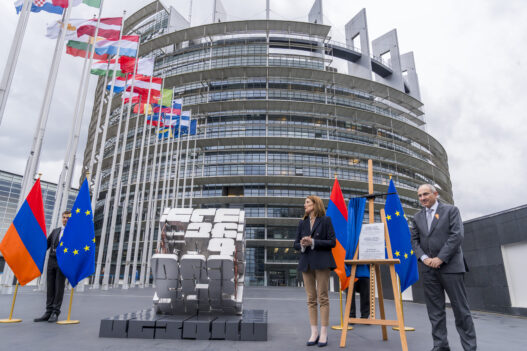
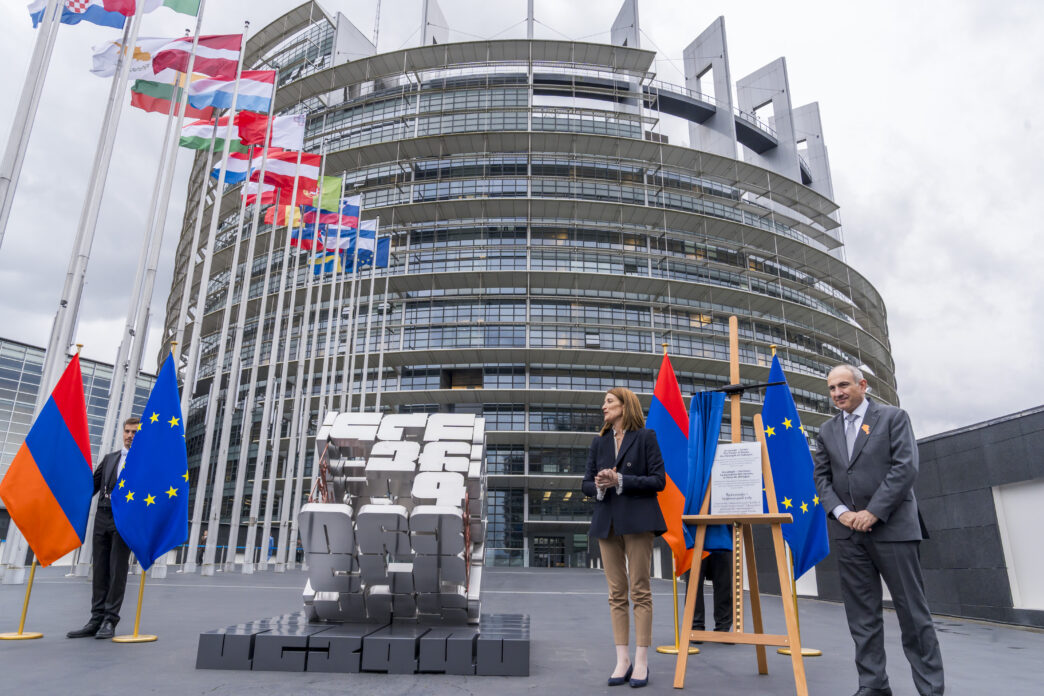
The eighth summit of the European Political Community (EPC) will convene in Yerevan on 4 May 2026, followed by the first-ever EU-Armenia Summit on 5 May. This consecutive hosting of both summits represents an exceptional and historic political signal of pan-European solidarity with Armenia, an EU candidate country since March 2025.
The EPC: origins and strategic objectives
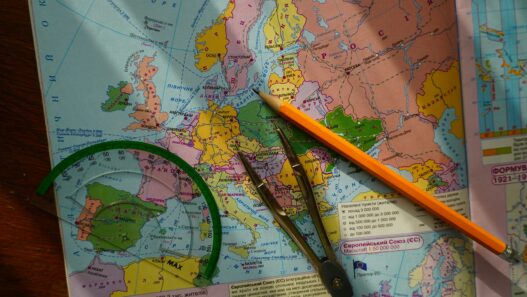
Created in October 2022 at the initiative of French President Emmanuel Macron in response to Russia’s aggression against Ukraine, the EPC brings together over 40 European leaders to foster “strategic intimacy” and strengthen cooperation on continental challenges including security, stability and prosperity. The platform explicitly distinguishes itself from the EU enlargement policy, instead aiming to stabilise European borders and rebuild relations with countries such as the United Kingdom, Turkey and Ukraine. Priority areas include energy, critical infrastructure, cybersecurity, migration and regional cooperation.
The EPC operates without a permanent secretariat, dedicated budget or staff, with each summit organised by the host country supported by a limited French taskforce established in January 2023. This deliberate informality constitutes both its strength and weakness: it enables frank exchanges between leaders without the constraint of binding final declarations, but raises questions about transparency, accountability and capacity to deliver tangible results.
Summit agenda: beyond the Armenian dimension
While Armenia’s hosting holds particular significance, the Yerevan summit will address broader European challenges under the theme “Building the Future: Unity and Stability in Europe”. According to the Finnish government, small group discussions will focus on three priority areas:
- strengthening democratic resilience;
- responding to hybrid threats;
- and advancing connectivity policy and reinforcing economic security in the context of the green transition.
Armenian Prime Minister Nikol Pashinyan indicated in October 2025 that connectivity will constitute a key topic, emphasising mutual interest in implementing the Middle Corridor and ensuring unimpeded connectivity of goods, energy and fibre-optic cables between Europe, the South Caucasus and Central Asia. As Armenia will host COP17 on Biodiversity in 2027, the summit may also serve as a platform to discuss the green transition agenda with outcomes subsequently brought to the global arena.
Finland has highlighted that strengthening Europe-wide support for Ukraine remains an important priority at this summit, as at previous meetings. Previous EPC summits have consistently focused on strengthening Ukraine, disinformation and electoral manipulation, tackling traditional and hybrid threats, economic security and migration.
The Armenian context: geopolitical stakes
For the first time, the EPC convenes in the South Caucasus, a region peripheral to the European continent but crucial for energy security and stability. The summit occurs at a critical juncture: five weeks before Armenian legislative elections on 7 June 2026, whose integrity is threatened by systematic Russian hybrid operations. The European Parliament adopted a resolution on 30 April 2026 expressing concern over disinformation campaigns, cyberattacks and mobilisation of local proxies orchestrated by Moscow to influence the ballot.
The consecutive organisation of both summits in Yerevan reflects the EU’s commitment to supporting Armenia’s peace, reform and resilience agenda against multifaceted Russian pressures. This deployment occurs in a delicate regional context marked by the Armenian-Azerbaijani normalisation process and tense relations with Moscow following Pashinyan’s pro-European positioning.
Expected deliverables and institutional consolidation
The European Parliament explicitly calls on European and Armenian leaders to use this opportunity to develop “ambitious and concrete deliverables”. Identified priorities include strengthening connectivity in energy, transport and digital infrastructure, and supporting peace, security and prosperity in the South Caucasus.
The EU-Armenia Strategic Partnership Agenda adopted in December 2025 covers democracy, judicial reform, human rights and anti-corruption. The EU Resilience and Growth Plan, endowed with €270 million, constitutes the central financial instrument of this reinforced partnership. The Armenian-Azerbaijani normalisation process represents another major challenge, with multimodal connectivity projects across Armenian territory linking continental Azerbaijan to its Nakhchivan exclave, in strict respect of Armenian sovereignty and territorial integrity.
The double summit in Yerevan offers an opportunity to strengthen the EPC’s institutional visibility by demonstrating its capacity to address concrete security challenges beyond general discussions. The traditional absence of binding final communiqués within the EPC framework could be counterbalanced by results formalised during the bilateral EU-Armenia summit on 5 May, bringing together the European Council President, the Commission President and the High Representative for Foreign Affairs. The EPC’s capacity to move from family photo stage to genuine foreign policy instrument remains conditional on its ability to produce measurable results beyond declarations of intent.
Sources
- European Parliament, “Joint Motion for a Resolution on supporting democratic resilience in Armenia” (28 April 2026)
- European Parliament, “Motion for a Resolution on supporting democratic resilience in Armenia” (24 April 2026)
- European Parliament, “Outcome of the European Political Community and European Council meeting” (October 2022)
- Government of Finland, “Prime Minister Orpo to represent Finland at European Political Community Summit in Yerevan” (28 April 2026)
- Government of Armenia, “Address by Prime Minister Nikol Pashinyan at the 8th European Political Community Summit announcement” (1 October 2025)
- Institut Jacques Delors, “A European Political Community for a geopolitical era” (September 2025)
- ISS European Union, “A stage without a script? How can the European Political Community live up to its ambition” (May 2025)
- Delors Centre, “European Political Community: From family photo to strategic forum” (October 2022)