





Authors: Gábor Papp (Research Fellow at HIIA) and Máté Kováts (Research Fellow at HIIA)
Venezuela, the bottleneck
Following the US intervention on January 3, 2026, the United States gained control over Venezuela’s oil reserves for an indefinite period. Venezuela’s oil exports thus fell into American hands, and at the same time, Donald Trump asked the big American oil companies to become active participants in the development of the Venezuelan oil sector. The situation that has developed and its possible effects, discussed below, fit into the framework of the resurgent Monroe Doctrine and the United States’ pursuit of energy dominance. These are two concepts that occupy a prominent place in current US foreign policy. The essence of the Monroe Doctrine is for America to strengthen its position and oust its rivals from its immediate sphere of influence. The goals of the pursuit of energy dominance are well illustrated by Donald Trump’s 2025 inauguration speech, in which he stated that they would break energy prices, fill their strategic reserves to the brim, and export American energy all over the world.[1] Of these objectives, efforts to boost exports have been particularly spectacular in recent times, whether in liquefied natural gas (LNG), nuclear energy or, as the example of Venezuela shows, crude oil. It follows from all this that events in Venezuela could have far-reaching regional and global implications.
Regional concentration of power
By imposing a blockade on Venezuela, the United States has gained control over the world’s largest known oil reserves, amounting to more than 300 billion barrels.[2] Considering that global oil production is around 100 million barrels per day, Venezuela’s oil alone would be enough to last for nearly eight years. However, reserves are one thing, but production and exports are another. Venezuela’s daily production is less than one million barrels, which means that it accounts for less than 1% of global production. Furthermore, exports are made very difficult by US sanctions imposed on the country, although these sanctions appear to be easing as US control increases.[3]
Despite all this, there is one country that has traditionally sourced most of its crude oil needs from Venezuela, and that is Cuba. Crude oil plays a prominent role in the country’s energy mix and electricity production. Thus, by gaining influence over Venezuelan exports, the United States has also dramatically increased its influence over Cuba from one moment to the next. If the US decides to cut or delay this quasi-umbilical cord, it could exert enormous pressure on Cuba, which in extreme cases could even lead to the country’s collapse. In Cuba, the issue of energy supply has long been plagued by structural difficulties and the resulting series of power outages, as has been the case in recent days.[4] The strengthening of control over the country and its deliberate application is well illustrated by Donald Trump’s threat to impose tariffs on any country that sells oil to Cuba.[5]
However, American expansion does not always cause tension. In fact, there is one conflict in which Venezuela’s strong American control may actually be the solution. This conflict is none other than the territorial dispute between Venezuela and neighboring Guyana. The issue began to flare up in the mid-2010s, or rather, Venezuela ignited it after ExxonMobil announced in 2015[6] that it had discovered significant oil reserves in Guyana. Venezuela then took increasingly hostile steps, which at one point escalated to the point where the United Kingdom sent a warship to Guyana at Christmas 2023 to demonstrate its support.[7] Last March, the Maduro regime also got into a conflict with the United States over the territory.[8] With the US removing Maduro from the equation, this territorial conflict seems to have reached a standstill for the time being. The calmer atmosphere is also benefiting ExxonMobil, which operates in Guyana.
Global energy game
In line with the Monroe Doctrine, the current US administration is stirring up trouble in the Western Hemisphere, including in Venezuela. Chinese oil imports and the tens of billions of dollars in loans that have flowed into the country from China are a major thorn in the side of the US administration.[9] In addition to all this, however, the events in Venezuela could have serious, even far-reaching global implications, one reason being that the country not only has vast oil reserves, but is also a member of the Organization of Petroleum Exporting Countries (OPEC).
Since its establishment, OPEC has become a major player in shaping world oil prices, controlling and managing production. Based on available data for 2024, approximately 80% of the world’s oil reserves[10] are concentrated in the hands of OPEC member states, while production is just under 40%. The organization plays a prominent role in determining the market price of crude oil, using supply and demand techniques. It is therefore not surprising that Donald Trump has repeatedly voiced his concerns about OPEC’s dominance[11] and called on member states to stop price manipulation. This is understandable, given that although the United States is the world’s largest producer of crude oil, the combined production of OPEC member states still exceeds that of the US. This situation is exacerbated by the fact that Saudi Arabia, also an OPEC member, exports more oil than the US alone. These two factors may be seen as a relative disadvantage by an administration that envisions energy dominance. It follows from all this that the US may even plan to weaken OPEC in order to improve its position.
For Washington, Saudi Arabia has been a suitable partner in maintaining prices at an ideal level in recent years. Thanks to its large oil reserves, the Saudi kingdom was easily able to suddenly increase or decrease production volumes—in order to move world market prices in a certain direction—without causing critical damage to the country’s economy. In recent years, however, Riyadh’s extensive economic diversification has called into question the kingdom’s unbroken role in representing US interests at the oil market. This has made it a priority for the White House to develop alternative solutions that will allow it to continue to exert the desired influence on oil prices. These solutions may include gaining a stronger position in the oil sectors of other OPEC member states.
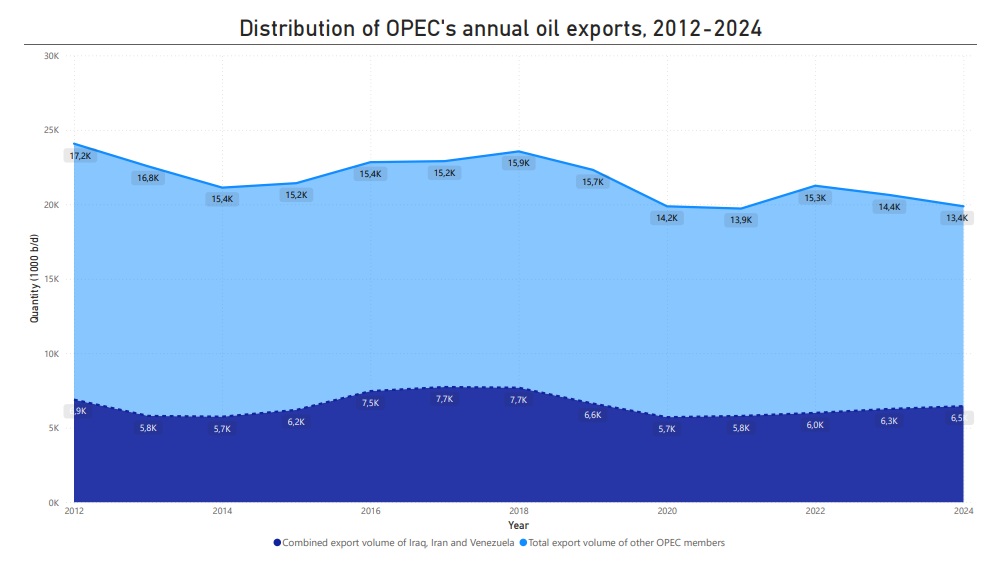
Currently, among OPEC member states, taking into account both the export volume and political situation of each country, three countries are suitable for Washington to use to control oil prices and weaken OPEC’s otherwise unblemished unity and thus its role in the global market: Iraq, Iran, and Venezuela. These three countries are responsible for approximately one-third of OPEC’s annual crude oil exports, which could give Washington enough influence to assert its interests against the previously much-criticized organization. In addition to the current export volume, it is also important to note that these three countries hold more than 50% of OPEC member states’ oil reserves, which would greatly expand Washington’s room for maneuver in the future, providing an opportunity to build long-term dominance by slowly increasing the appropriate production volume. The blockade of Venezuela could therefore fit into such a strategy aimed at weakening OPEC, and it is possible that the Iranian conflict also has this dimension.
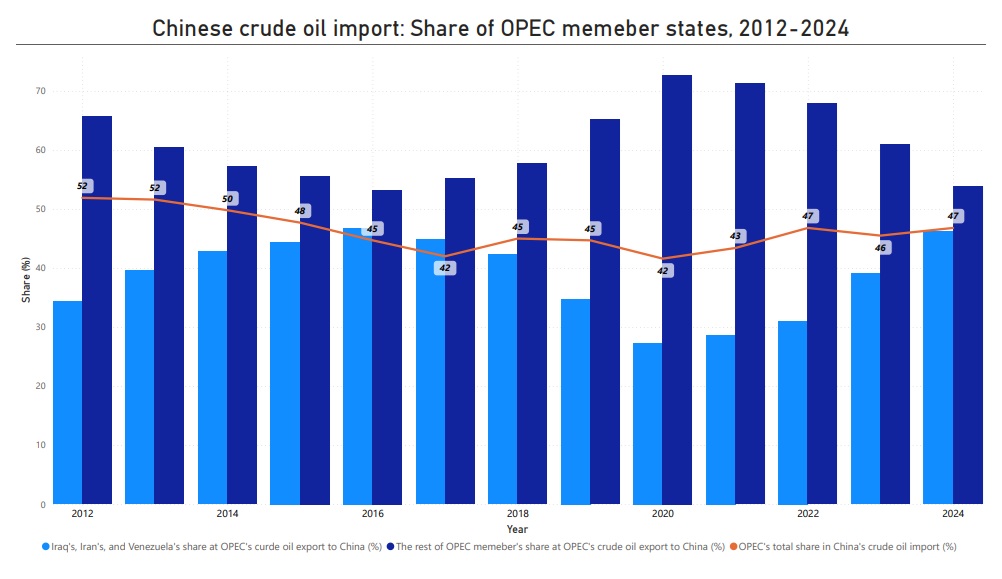
Within this, slightly more than 45% of total OPEC crude oil exports to China came from three countries: Iraq, Iran, and Venezuela. This highlights a strong dependency for Beijing, one of the most vulnerable points of which, if not the most vulnerable, is the three countries mentioned above: Iraq, Iran, and Venezuela. If Washington were able to successfully exert pressure and possibly gain ground in these countries’ oil production or exports, it could greatly strengthen its position vis-à-vis China. This would be no small weapon in the economic war currently raging between them, as the more the US can destabilize or influence China’s imports from OPEC, which are crucial to China, the more it can put China in a difficult economic position. It is therefore clear that by weakening OPEC, the US could kill two birds with one stone. In fact, it could even kill three.
China’s shrinking room for maneuver in the field of fossil fuels, caused by the weakening of OPEC, could lead to it being forced to strengthen its ties with Russia in this area. However, it is far from certain that this would be a positive development for either China or Russia. Although their friendship knows no bounds on paper, in practice we can see that they are by no means rushing headlong into each other’s arms in every case. This is precisely because both sides have already realized that it may not be in their interest to become increasingly dependent on each other, especially in terms of energy, having learned from the events of world politics in recent years. Thus, contrary to the traditional narrative that Russia and China must be separated from each other in order to weaken them, the seemingly paradoxical scenario may ultimately arise that, on the contrary, “pressing them together” may have the desired effect. Ultimately, the United States could even play on this by forcing the two players into such a necessary cooperation in an attempt to weaken them.
Outlook
As can be seen from the above examples, when examining the events in Venezuela in terms of the quest for energy dominance, a number of possibilities appear to be opening up for the United States. However, the final outcome and effectiveness of these will largely depend on the specific events that actually unfold in the Iraq-Iran-Venezuela triangle.
In Iraq, for example, taking advantage of the uncertainty surrounding the Russian company Lukoil, the American oil giant Chevron has been in advanced negotiations with the Iraqi government for months to take control of the West Qurna 2 oil field, which Iraq recently nationalized.[17] This oil field accounts for approximately 0.5% of the world’s total oil supply.[18] Thus, it could become a strategically important source of strength for Washington, giving it greater say in Iraqi oil production and sales. Not to mention that Iraq is OPEC’s second largest oil producer after Saudi Arabia and an important source of imports for China, so developments in Iraq could also have an impact on the latter.
The current uncertain political and economic situation in Iran also offers serious opportunities for Washington. A possible regime change, or even just a rapprochement between the leaders of the two countries, could redirect Iran’s oil exports, which are currently oriented towards China. If the current regime were to be replaced, American oil companies would likely step in to organize and boost oil production and export processes in order to ensure Iran’s economic stability, raising serious questions about the future of Iranian export destinations. It remains to be seen whether, in such a scenario involving the expansion of American companies, Washington would be able to take advantage of the opportunity to further restrict China’s global maneuverability through its influence on Iranian energy imports.
The future of oil production in Venezuela is also a thorny issue, and it is no coincidence that, despite Donald Trump’s call, major oil companies are not yet lining up to invest in Venezuela. Although there has been some positive feedback on the subject, Exxon’s CEO has declared Venezuela unfit for investment, citing current legal and commercial difficulties.[19] Given Venezuela’s current situation, it is also worth noting that the wave of nationalization during the Chávez era[20] has not yet been erased from the collective memory of oil companies, and the compensation payments that have been delayed for almost 20 years are understandably not the most motivating incentive. The situation is further complicated by the fact that Venezuelan oil is very expensive to extract due to its specific characteristics, while the US grand strategy aims to further reduce oil prices. All this could lead to a widening gap between production costs and future profits.
Finally, it should be noted that it is vital for Washington to avoid a series of events similar to the oil price collapse of 2014-2016 on its path to energy dominance. One of the main causes of the historic crash, if not the main cause, was the overproduction of American shale oil, which drastically depressed the world market price of oil, which subsequently collapsed almost completely. Based on this case, Venezuelan, Iraqi, and Iranian oil reserves may be a more long-term solution for Washington, and their exploitation could lead to a slow increase in production volume over many years, while a sudden increase in production could have counterproductive results for US plans.
In summary, gaining control over Venezuela could become an important element in a game in which the stakes are increasing the regional influence of the United States, strengthening its energy dominance, and weakening OPEC, China, and Russia.
Literature and References
Battersby, Amanda. ‘US Warns Venezuela after Its Vessels Threaten ExxonMobil’s Stabroek FPSOs Offshore Guyana’. Upstreamonline.Com, 3 March 2025. https://www.upstreamonline.com/politics/us-warns-venezuela-after-its-vessels-threaten-exxonmobil-s-stabroek-fpsos-offshore-guyana/2-1-1786771.
‘Chevron May Buy Lukoil’s Iraqi Stake If Terms Are Right | Energy Intelligence’. Accessed 5 March 2026. https://www.energyintel.com/0000019c-0013-db06-a1bc-f437ca870000.
‘Cuba Hit by Severe Blackouts, Risks Humanitarian Crisis’. Pluralia, n.d. Accessed 5 March 2026. https://pluralia.com/en/news/cuba-hit-by-severe-blackouts-risks-humanitarian-crisis/.
‘Exclusive: Chevron Seeks Better Terms from Iraq before Taking over Lukoil Oilfield, Sources Say | Reuters’. Accessed 5 March 2026. https://www.reuters.com/business/energy/chevron-seeks-better-terms-iraq-before-taking-over-lukoil-oilfield-sources-say-2026-01-27/.
‘Home | Statistical Review of World Energy’. Accessed 5 March 2026. https://www.energyinst.org/statistical-review.
‘OIES-PPT-Rewiring-Venezuelan-Crude-Oil-12Jan25.Pdf’. n.d. Accessed 5 March 2026. https://www.oxfordenergy.org/wpcms/wp-content/uploads/2026/01/OIES-PPT-Rewiring-Venezuelan-Crude-Oil-12Jan25.pdf.
Organization of the Petroleum Exporting Countries. ‘Organization of the Petroleum Exporting Countries’. Accessed 5 March 2026. https://www.opec.org/pr-detail/1484568-2-july-2025.html.
‘Proven Oil Reserves by Country (2026)’. Accessed 5 March 2026. https://www.globalfirepower.com/proven-oil-reserves-by-country.php.
Rennolds, Nathan. ‘Exxon CEO Calls Venezuela “uninvestable” during Meeting with Trump’. Business Insider. Accessed 5 March 2026. https://www.businessinsider.com/exxon-ceo-darren-woods-calls-venezuela-uninvestable-2026-1.
‘Royal Navy Patrol Ship Visits Guyana amid Border Claim’. Accessed 5 March 2026. https://www.royalnavy.mod.uk/news/2024/january/18/240118-trent-in-guyana.
‘The Inaugural Address – The White House’. Accessed 5 March 2026. https://www.whitehouse.gov/remarks/2025/01/the-inaugural-address/.
‘Trump Asked OPEC for More Oil. His Allies Say That’s Weird – E&E News by POLITICO’. Accessed 5 March 2026. https://www.eenews.net/articles/trump-asked-opec-for-more-oil-his-allies-say-thats-weird/.
‘Trump Threatens Tariffs on Goods from Countries That Sell Oil to Cuba | Trump Tariffs | The Guardian’. Accessed 5 March 2026. https://www.theguardian.com/us-news/2026/jan/29/trump-tariffs-cuba-oil.
‘UN Comtrade’. Accessed 5 March 2026. https://comtradeplus.un.org/TradeFlow?AggregateBy=none&BreakdownMode=plus&CommodityCodes=2709&Flows=X&Frequency=A&Partners=0&Reporters=all&period=2024&utm.
US Army War College – Strategic Studies Institute. ‘Strategic Insights: Guyana-Venezuela: The Essequibo Region Dispute’. Accessed 5 March 2026. https://ssi.armywarcollege.edu/SSI-Media/Recent-Publications/Article/3993020/strategic-insights-guyana-venezuela-the-essequibo-region-dispute/.
‘US Lifts Some Venezuela Sanctions to Ease Oil Sales | Reuters’. Accessed 5 March 2026. https://www.reuters.com/business/energy/us-eases-sanctions-venezuelan-oil-industry-2026-01-29/.
‘Venezuela Takes Over Control of Extra-Heavy Oil Projects’. Accessed 5 March 2026. https://www.spglobal.com/marketintelligence/en/mi/country-industry-forecasting.html?id=106598135.
[1] ‘The Inaugural Address – The White House’, accessed 5 March 2026, https://www.whitehouse.gov/remarks/2025/01/the-inaugural-address/.
[2] ‘Proven Oil Reserves by Country (2026)’, accessed 5 March 2026, https://www.globalfirepower.com/proven-oil-reserves-by-country.php.
[3] ‘US Lifts Some Venezuela Sanctions to Ease Oil Sales | Reuters’, accessed 5 March 2026, https://www.reuters.com/business/energy/us-eases-sanctions-venezuelan-oil-industry-2026-01-29/.
[4] ‘Cuba Hit by Severe Blackouts, Risks Humanitarian Crisis’, Pluralia, n.d., accessed 5 March 2026, https://pluralia.com/en/news/cuba-hit-by-severe-blackouts-risks-humanitarian-crisis/.
[5] ‘Trump Threatens Tariffs on Goods from Countries That Sell Oil to Cuba | Trump Tariffs | The Guardian’, accessed 5 March 2026, https://www.theguardian.com/us-news/2026/jan/29/trump-tariffs-cuba-oil.
[6] ‘Strategic Insights: Guyana-Venezuela: The Essequibo Region Dispute’, US Army War College – Strategic Studies Institute, accessed 5 March 2026, https://ssi.armywarcollege.edu/SSI-Media/Recent-Publications/Article/3993020/strategic-insights-guyana-venezuela-the-essequibo-region-dispute/.
[7] ‘Royal Navy Patrol Ship Visits Guyana amid Border Claim’, accessed 5 March 2026, https://www.royalnavy.mod.uk/news/2024/january/18/240118-trent-in-guyana.
[8] Amanda Battersby, ‘US Warns Venezuela after Its Vessels Threaten ExxonMobil’s Stabroek FPSOs Offshore Guyana’, Upstreamonline.Com, 3 March 2025, https://www.upstreamonline.com/politics/us-warns-venezuela-after-its-vessels-threaten-exxonmobil-s-stabroek-fpsos-offshore-guyana/2-1-1786771.
[9] ‘OIES-PPT-Rewiring-Venezuelan-Crude-Oil-12Jan25.Pdf’, accessed 5 March 2026, https://www.oxfordenergy.org/wpcms/wp-content/uploads/2026/01/OIES-PPT-Rewiring-Venezuelan-Crude-Oil-12Jan25.pdf.
[10] ‘Organization of the Petroleum Exporting Countries’, Organization of the Petroleum Exporting Countries, accessed 5 March 2026, https://www.opec.org/pr-detail/1484568-2-july-2025.html.
[11] ‘Trump Asked OPEC for More Oil. His Allies Say That’s Weird – E&E News by POLITICO’, accessed 5 March 2026, https://www.eenews.net/articles/trump-asked-opec-for-more-oil-his-allies-say-thats-weird/.
[12] Other OPEC members include Saudi Arabia, Nigeria, Kuwait, Libya, the Republic of Congo, Gabon, Algeria, and Equatorial Guinea.
[13] ‘UN Comtrade’, accessed 5 March 2026, https://comtradeplus.un.org/TradeFlow?AggregateBy=none&BreakdownMode=plus&CommodityCodes=2709&Flows=X&Frequency=A&Partners=0&Reporters=all&period=2024&utm.
[14] ‘Home | Statistical Review of World Energy’, accessed 5 March 2026, https://www.energyinst.org/statistical-review.
[15] Other OPEC members include Saudi Arabia, Nigeria, Kuwait, Libya, the Republic of Congo, Gabon, Algeria, Equatorial Guinea
[16] ‘UN Comtrade’.
[17] ‘Chevron May Buy Lukoil’s Iraqi Stake If Terms Are Right | Energy Intelligence’, accessed 5 March 2026, https://www.energyintel.com/0000019c-0013-db06-a1bc-f437ca870000.
[18] ‘Exclusive: Chevron Seeks Better Terms from Iraq before Taking over Lukoil Oilfield, Sources Say | Reuters’, accessed 5 March 2026, https://www.reuters.com/business/energy/chevron-seeks-better-terms-iraq-before-taking-over-lukoil-oilfield-sources-say-2026-01-27/.
[19] Nathan Rennolds, ‘Exxon CEO Calls Venezuela “uninvestable” during Meeting with Trump’, Business Insider, accessed 5 March 2026, https://www.businessinsider.com/exxon-ceo-darren-woods-calls-venezuela-uninvestable-2026-1.
[20] ‘Venezuela Takes Over Control of Extra-Heavy Oil Projects’, accessed 5 March 2026, https://www.spglobal.com/marketintelligence/en/mi/country-industry-forecasting.html?id=106598135.