





This analysis discovers Hungary’s digital ecosystem, revealing its strengths and weaknesses. By connecting quantitative data about the country’s digital economy sectors with the broader geopolitical context, the analysis describes how a well-strategized improvement in Hungary’s digital economy could lead to geopolitical leverage, not only in the Danube region but also in the European Union. By connecting Western capital with the Eastern growth market, the state could overcome the main challenge most countries face in the case of the digital economy and evolve from an agenda-taker to an agenda-setter actor, with increased leverage within the European Union.
Digital Entrepreneurship as a strategic sector for Hungary
As global economic competition increasingly shifts toward digital value creation, the ability of states to convert digital capacity into domestic economic power has become a central determinant of long-term growth and autonomy. Worldwide, the statistics show that both FDIs and corporate investments have been significantly increasing in the past half-decade. In 2020, the total value of FDIs targeted at the digital economy sectors was 131 billion USD, while this number had increased to 360 billion USD by 2024.[1] In the corporate investments in 2022, the total value of investments was 1.85 trillion USD[2], and based on prediction it can reach approximately 3.9 trillion USD by 2027[3]. These numbers show the real importance of developing a strong digital economic ecosystem for every state, which expects to see economic growth and stability in the upcoming decades. In the case of Hungary, the core digital sector accounts for roughly 6–7% of Hungary’s gross value added[4], while broader estimates that include embedded digital activities across the economy place the digital economy’s contribution at around 10% of GDP.[5]
A strong domestic digital sector could strengthen several strategically important areas – such as advanced manufacturing, logistics and trade, or energy and infrastructure digitalization – thereby enhancing Hungary’s economic independence and enabling the state to move from an agenda-taker to a more active agenda-setting role at the regional level. The geographical position of Hungary allows the state to connect to advanced Western European states and follow their improvement and position itself as an example for eastern and south-eastern states, which need connections towards more advanced states to keep up with the increasing importance of digitalization. By fitting between the groups and positioning itself as a bridge between them, the Hungarian government could take benefits from both independence and beneficial dependency.
To gain the ability to improve Hungary’s digital sectors, it is crucial to understand its current position. By learning the sectors’ strengths and weaknesses, the progress of improvement can be targeted on the bottleneck pillars, to achieve the greatest possible improvement in the shortest possible time. To gain this knowledge, this paper suggests using the newly announced Digital Entrepreneurship Ecosystem Index[6] (DEE Index), created and launched by the Vienna Institute of Global Studies (VIGS), as a primary source. This Index provides not only country-specific data about the status of different digital sectors but also explains the raw numbers in a broader context by analysing the Danube region as a whole. The data from the DEE Index reveals Hungary’s current position in the Danube region and suggests creating a comparison between Hungary and the regional leader, Austria. However, it is important to state already that although Austria is a great object for comparison, Hungary should not copy the digital ecosystem from the regional leader but rather use it as guidance and a tool for creating a Hungary-specific, sustainable, and dominant digital economic ecosystem. The policy recommendations, which are detailed below, were all designed to support the government’s work in finding the country’s potential position as a regional hub and act as a bridge between the Western capital and the Eastern growth market.
The DEE Index as a policy diagnostic tool
The Digital Entrepreneurship Ecosystem Index is a system-level diagnostic tool that was developed to present how digitalization supports the positive outcome of entrepreneurial and economic sectors. The index itself does not focus only on digital development as a technological progression, but rather on the outcome of the interactions between several actors in these sectors, such as users, firms, platforms, and institutions. VIGS developed this index to have the ability to compare countries, regions, and continents based on the developed criteria.
DEE Index can be seen as a crucial tool for policymakers, since the learnt data reveals the structural bottlenecks for each state, and for the Danube region as a whole. By understanding the structural weaknesses, policymakers gain the opportunity to develop policies in order to develop the country’s ecosystem. Besides the access to structural weaknesses and strengths, the index offers support for comparative analysis and policy learning from different states. By enabling meaningful comparison with structurally similar countries – such as Austria in Hungary’s case – it facilitates realistic benchmarking and adaptation rather than imitation. This makes the index especially suitable for regional policy discussions and strategic planning.
Hungary’s digital ecosystem
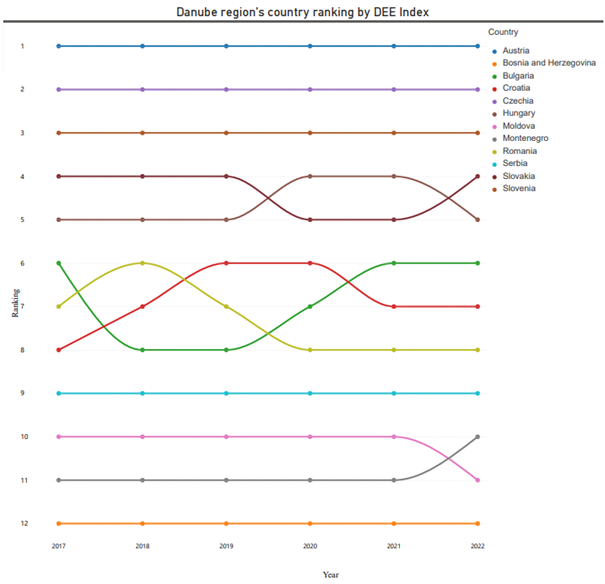
The results for Hungary by the DEE Index look complex, since the state is currently positioned between the regional leader and the bottom one states, somewhere in the middle, closer to the top 1/3 in the Danube region.[7]
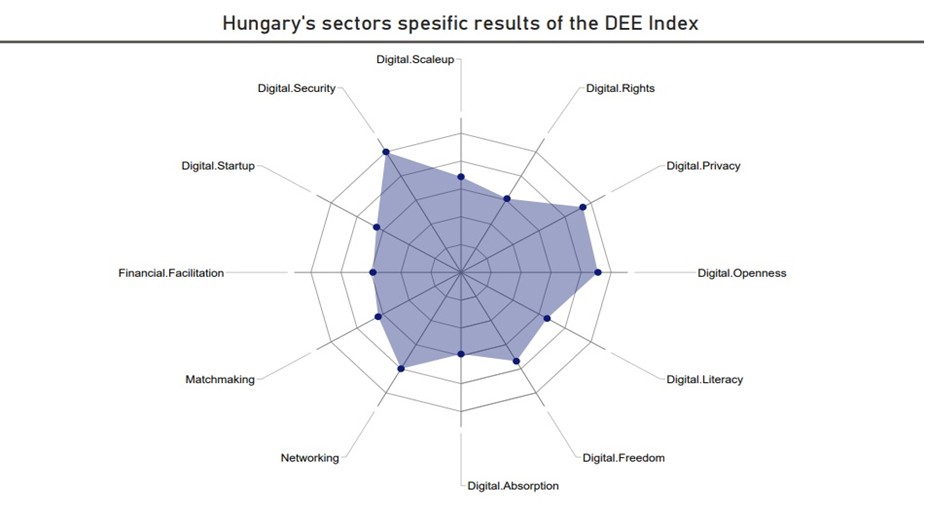
Once the country-specific data is considered (see Figure 2 below), a strong differentiation appears between the sectors in Hungary. The government developed digital economy sectors wisely in recent years, which helped them to strengthen several key sectors that can provide the base of an uprising digital economy. However, the state faces unavoidable challenges in the actual digitalization process across the different economic sectors. The Hungarian digital ecosystem is characterized by strong state-driven foundations but weak bottom-up activation. While regulatory protection, security, and digital openness are well developed, limited user engagement, fragmented matchmaking, and underdeveloped scale-up mechanisms prevent the ecosystem from reaching critical mass.
Strengths of the Hungarian digital economy
One of the strongest sectors for Hungary is the Digital Security pillar, which collects the protection against cyber threats, including cybersecurity regulation and secure digital infrastructures. From the policymaker’s point of view, this pillar is crucial in the support of user confidence, platform adaption and investments in digital business models. The second strongest pillar is Digital Privacy. This captures the protection of personal data and user autonomy, including data protection laws. By this, a significant increase in trust and willingness to participate is expected by the users and the business at the same time. The third strong pillar for Hungary is the Digital Openness. This provides information about how accessible and inclusive the digital infrastructure is, including internet access and network coverage. With a strong digital openness, it is possible for users and firms to thrive in the digital economy.
The strong parts of the Hungarian digital economy suggest that the government did what it had to do to provide a safe environment for both users and firms, in order to start adapting to digitalization, and include it in their everyday life and work. However, even if the top-down work is more or less done, the system shows several weaknesses that cause disharmony and hold back Hungary from succeeding in the digital economy.
The bottleneck of the Hungarian digital economy
The weakest pillar for Hungary in its digital economy is the Financial Facilitation. This pillar measures digital financial services, fintech adoption, digital payments, and alternative financing mechanisms. Basically, this should support the startups’ scale-up process. Without strong scale-up opportunities, the willingness of launching Startup is Hungary is decreasing, since these firms are built to successfully scale up with a financially beneficial exit at the end. The second weakest pillar is Digital Absorption. This pillar is responsible for the ability of existing firms and institutions to adopt and integrate digital technologies in the operational process. Since Hungary’s firm structure is dominated by incumbent and mature enterprises, many of which operate within established production and organizational models. This limits their capacity to rapidly absorb and integrate digital technologies, contributing to weaker digital absorption at the ecosystem level. The strengthening of this pillar would be crucial in order to develop a comprehensive system of a highly digitalised economy, which includes new digital firms as well as the mature companies that have adapted to the new structures. The third weakest pillar, Digital Rights, measures the extent to which individuals are able to freely access, create, and innovate in digital environments. This dimension is critical, as digital entrepreneurship depends not only on firms and infrastructure but also on active, empowered users who contribute ideas, content, and demand to digital platforms. Weak digital rights limit user participation and experimentation, thereby constraining the development of a dynamic and inclusive digital entrepreneurship ecosystem. The fourth and final weak point for the Hungarian digital economy is the Matchmaking pillar. It shows how efficiently the digital system connects users with firms, services, capital, and opportunities. Effective and well-working matchmaking is crucial, since it accelerates entrepreneurial growth. A weak matchmaking pillar fragments the ecosystem and holds it back from further evolution.
In general, the weaker pillars of the Hungarian digital economy suggest that a better bottom-up participation would be necessary for both the Hungarian firms and users. Stronger interaction between firms, users, capital, and platforms would strengthen the digital economy crucially and would help the system evolve further. The main challenge with these bottleneck pillars is that they can not be totally solved in a top-down methodology. The government must participate as a motivating actor with strong support for economic actors to actually deal with these challenges, but without other actors and their bottom-up activities, these challenges cannot be overcome.
Austria as a realistic comparator
Based on the VIGS’ analysis, Austria is the regional leader in the digital economy within the Danube region.[10] Comparing the Austrian system with the Hungarian one can provide useful insights into how Hungary should strengthen its different sectors, to be able to keep up with the leading state and possibly try to take over and become the regional dominant actor. Also, comparing these two states stands on more realistic grounds than comparing Hungary with either a Nordic state or with a Western one. Austria and Hungary are geographically and economically close to each other, and both operate within the same European Union regulatory framework.
If the Austrian sectoral results are analysed properly, several similarities can be recognised with the Hungarian structure. Austria also has strong digital security and privacy. The government also created strong digital openness and literacy, and in general, the country benefits the same way from stable institutions as Hungary.
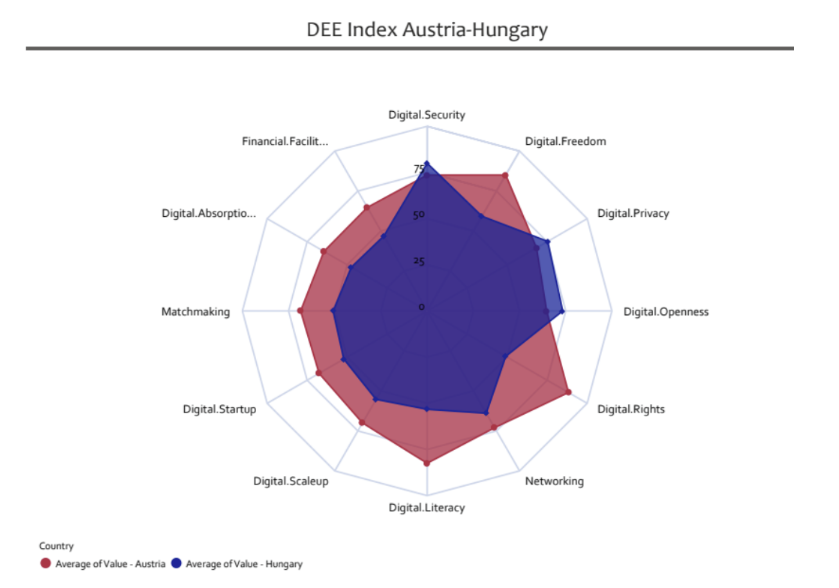
However, compared to the weakest pillars of Hungary’s digital economy – Digital Rights, Digital Absorption, Matchmaking, and Financial Facilitation – these pillars in Austria are all consistently outperforming the Hungarian ones. These results suggest that the Austrian digital economic ecosystem enables firms to be founded, to grow, to connect, and to scale with a possible high-income exit. In comparison, in Hungary – as it was detailed above – the ecosystem supports the firms to exist, but less to grow, connect, or easily expand and scale up. Although Austria has institutionalized mechanisms that reduce coordination failures and risks at later stages while supporting easy expansion and possible scale-ups, Hungary cannot copy this system wholesale. It is crucial to understand how different these two states situation is, which does not allow them to simply copy the other systems as a whole. Instead, Hungary should focus on adapting specific ecosystem functions, which can provide the most effective support for the weakest pillars of the state’s digital ecosystem.
Policy recommendations
As this policy brief identified the weakest pillars for the Hungarian digital ecosystem – based on the DEE Index results – the policy recommendations only focus on these sectors. Two pillars are being selected to reflect on: Digital Absorption and Financial Facilitation. These pillars were chosen since both connect to larger systemic deficits or weaknesses that are holding back the country’s digital economy from improving further. Financial Facilitation is strongly connected to the Startups’ scale-up and exit process. This phase is a crucial element of a sustainable and beneficial digital ecosystem, which Hungary is currently missing out on. By strengthening this pillar, the state could attract investors, which would not only benefit the domestic startups but also increase the income of the government from this sector. Although the difference between Hungary and Austria in the Digital Abortion pillar does not suggest highlighting the urgency to improve it by the Hungarian government, it could still bring a significant structural change for Hungary, which could bring benefits not only from financial aspects, but also in supporting domestic digital startups and creating a healthier and more sustainable relationship between the domestic economic actors. Finally, it is important to emphasize that the role of the Hungarian state is not to directly manage digital entrepreneurship, but to act as a catalyst, shaping incentives, reducing coordination failures, and enabling bottom-up dynamics.
First policy recommendation: Strengthen the scale-up and exit mechanisms
By strengthening the country’s scale-up and exit opportunities, the state could not only strengthen its innovation autonomy but also gain fiscal power, reach a stronger position within the European Union, and increase economic sovereignty. Stronger fiscal capacity could help the Hungarian government co-finance EU projects, better influence – compared to current times – budget negotiations, and prevent the fall of strategic sectors during a potential economic crisis. At the same time, a stronger position within the European Union – combined with a stronger fiscal capacity – could increase the state’s informal influence among EU member states, allow Hungary to take a better part in shaping EU industrial, digital, and competition policy, and finally, would make it harder for other EU states to sideline Budapest during crucial negotiations about the future of the European Union.
Second policy recommendation: Improve digital absorption through incumbent firms
A potentially higher digital absorption could support Hungary’s supply-chain resilience and decrease the sanction exposures. These are all crucial elements for every state to protect its geopolitical room for manoeuvre. By strengthening the country’s supply-chain resilience, the government could reorient production (if necessary) and maintain economic stability, even in globally challenging times. By decreasing the sanction exposure level of the country, the government would be able to diversify markets, enable rapid adjustments, and reduce systemic vulnerability to external partners. After the beginning of the Russia-Ukraine war, the European Union learnt the importance of diversification and room for manoeuvre through high prices and several years of economic challenges. By improving the country’s digital absorption level, the government could prevent, or at least decrease the chance of a similar scenario happening with Hungary.
Third policy recommendation: Build ecosystem density and matchmaking
Since Hungary’s geographical location and political leadership allow the state to act as a bridge between the West and the East, the state and the financial actors should aim to position Hungary as the regional hub for scale-ups and exits for digital Startups. The state should leverage Hungary’s geopolitical location and foreign economic relations to link Western capital with the Eastern growth market. Besides leveraging its own connections, the state should host regional platforms, where domestic and external digital startups could meet with different financial actors, to support the matchmaking process. By creating a strong regional platform image, Hungary could gain not only financial benefits, but also support domestic startups to be seen, and last but not least, could strengthen the potential brain drain process, and attract startups to relocate to Hungary and strengthen the state’s digital economy. At the same time, the domestic financial actors should bring a higher volume of capital, expertise, and exit opportunities to support Hungary’s ambitions to be a regional hub for scale-ups and exits. This position – for Hungary – would attract foreign Startups, investors, and intermediaries to locate scale-up and exit activities.
Managing the Digital Ecosystem: Strategic Gains Without Structural Overhaul
The above detailed policy recommendations are designed to deliver changes by a 3-5 year horizon and focus on ecosystem management and not a full-scale structural change/rebuild. These changes would all support stronger scale-ups, higher productivity, and increase matchmakings, while also decreasing dependency on external actors. As it was stated above, the global investments into digital economy actors are consistently increasing, which anticipates an increased importance of strong and independent digital economic ecosystems. By adapting to a better functioning digital economy ecosystem, Hungary could increase its independence while also increasing its dominant position towards regional states, creating beneficial dependent relationships. These recommendations would also help the government position the country as a regional hub, connecting the Western capital with the Eastern growth market, while also offering potential markets and investors for the domestic digital startups, to fulfil their scale-up and exit plans.
Bibliography and sources
Ács, Zoltán, László Szerb, and Strefan Apostol. ‘DEEI_Final-Report-Danube-Region’. VIGS Institute, 29 October 2025.
Horwarth, Josh. ‘45+ Key Digital Transformation Statistics (2025)’. Exploding Topics, 26 November 2024. https://explodingtopics.com/blog/digital-transformation-stats.
International Trade Administration. ‘Hungary – Digital Economy’. 12 0 2026. https://www.trade.gov/country-commercial-guides/hungary-digital-economy.
Irwin-Hunt, Alex. ‘Soaring Digital Economy FDI Sparks Divide Concerns’. FDi Interlligence, 19 June 2025. https://www.fdiintelligence.com/content/11d32222-6988-44af-91ba-afb90fe22f0d.
[1] Irwin-Hunt, ‘Soaring Digital Economy FDI Sparks Divide Concerns’.
[2] Horwarth, ‘45+ Key Digital Transformation Statistics (2025)’.
[3] Horwarth, ‘45+ Key Digital Transformation Statistics (2025)’.
[4] Int. Trade Adm., ‘Hungary – Digital Economy’.
[5] Int. Trade Adm., ‘Hungary – Digital Economy’.
[6] Ács et al., ‘DEEI_Final-Report-Danube-Region’.
[7] Ács et al., ‘DEEI_Final-Report-Danube-Region’.
[8] Ács et al., ‘DEEI_Final-Report-Danube-Region’.
[9] Ács et al., ‘DEEI_Final-Report-Danube-Region’.
[10] It is important to highlight that VIGS decided to leave Germany out of the Danube region’s country list, which allows Austria to become the leading actor.
[11] Ács et al., ‘DEEI_Final-Report-Danube-Region’.