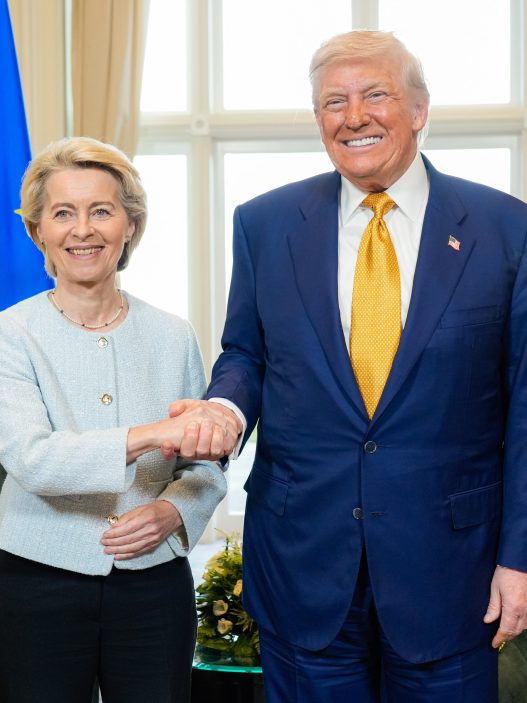









Previous roles: Pattinson played Cedric Diggory in Harry Potter, Edward Cullen in Twilight and Bruce Wayne in The Batman.
Behind the camera: Denis Villeneuve will direct from a script by Peaky Blinders creator Steven Knight. Villeneuve said Pattinson has “the timeless soul of 007”.
British roots, US studio: British novelist Ian Fleming introduced the MI6 agent in Casino Royale in 1953. The new film will be the first since US studio Amazon MGM took creative control of the franchise in 2025.
Release: The film is expected in 2028. The studio has not yet announced an exact date.
Sources: Amazon MGM Studios, Reuters, ITV News
AI-assisted: Reviewed by the Briefing Team.
More Quick Briefs:
·National Politics·authoritarianism·Democratic Backsliding·Georgia·Nino Kalandadze
·National Politics·authoritarianism·Democratic Backsliding·Georgia·Nino Kalandadze
Former Georgian Minister Warns of Deepening Authoritarian Consolidation ↗︎
Georgia's former deputy foreign affairs minister Nino Kalandadze has raised concerns over Georgia's authoritarian consolidation in an exclusive interview with euobserver.
→Former Georgian deputy foreign affairs minister Nino Kalandadze expressed concerns of the country's autocratic consolidation
→The interview highlights how the democratic achievements of the past have been unsustainable in Georgia
→As per Kalandadze, the prior governments have worked hard to fight organized crime and widespread corruption
→Nowadays Georgia has reached "the final stage of autocratic consolidation" but its people remain "freedom-loving and civilized"
→Source: Euobserver
·Migration·Canary Islands·Crisis·El Hierro·Immigrant·Migration·Migration emergency·Spain
·Migration·Canary Islands·Crisis·El Hierro·Immigrant·Migration·Migration emergency·Spain
More Than 2000 Migrants Reach Canary Islands in Two Days ↗︎
Two weeks before Spain is to hold a general election, the country's Canary Islands saw an influx of nearly 2200 migrants with makeshift boats in just 2 days.
→Around 2200 migrants have reached Spain's Canary Islands in two days using boats
→Spain's maritime rescue services report assisting 1324 people aboard dinghies
→Most of the migrants, coming mainly from West Africa, have reached the small island of El Hierro
→Spain has declared a migration emergency on the islands earlier, due to a rise in arrivals in recent weeks
→Source։ AP news
·African Relations·Health Policy·Democratic Republic of Congo·Ebola·Epidemic·Uganda·WHO
·African Relations·Health Policy·Democratic Republic of Congo·Ebola·Epidemic·Uganda·WHO
Ebola Epidemic: DRC’s deadliest ever, Conflicts make situation worse ↗︎
The World Health Organisation declared the Ebola outbreak in the Democratic Republic of Congo (DRC) and Uganda a global public health emergency.
Updates
→News: Ebola outbreak in the Democratic Republic of the Congo spreads at a record pace, with fatalities rising rapidly (Reuters)
→New numbers, new infections (CDC)
→Update (23.10.2026): News: Woman diagnosed with Ebola in Nigeria identified as wife of Swiss diplomat (BBC News)
→Update (20.10.2026): News: Nigeria confirms first Ebola case amid regional outbreak (WHO)
→Update (15.10.2026): Reportage: Bunia fights to protect families from DR Congo’s deadliest Ebola outbreak (RFI)
→Update (01.10.2026): News: Thousands flee Ebola-hit Congo camp, raising fears of wider disease spread (Reuters)
→Update (24.09.2026): News: WHO says Congo’s Ebola outbreak remains out of control amid health worker shortage (PBS NewsHour)
→Update (20.09.2026): News: Congo prioritizes Ebola health care workers for Ervebo vaccine effective against different virus strain (AP)
→Update (26.08.2023): Conflict drives DRC cholera outbreak (RFI)
→Update (20.08.2026): Ebola vaccines allocated to Congo (WHO)
→Update (13.08.2026): WHO chief warns of deadliest Ebola outbreak (BBC News)
→Update (10.08.2026): Interview with expert: How missing international aid increasingly exacerbates the crisis (ZDFheute)
→Update (05.08.2026): Expert speaks about potential future Ebola vaccine (FAZ)
→Update (July 24, 2026): First person gets new experimental vaccine for Ebola (BBC)
→Update (July 13, 2026): Ebola vaccine made in UK now ready for trials (BBC)
→Update (July 09, 2026): Ebola rumours fuel attacks on health workers (BBC)
→Update (July 03, 2026): Ebola treatments trial begins in DR Congo (BBC)
→Update (June 15, 2026): Recovery of Ebola patients offers rare moments of joy (BBC)
→Update (June 02, 2026): Protests against US Ebola quarantine centre plan in Kenya, two deaths (BBC)
→Update (June 01, 2026): Three Ebola vaccines in development (BBC)
→Update (May 31, 2026): How Ebola spreads and why it is so dangerous (BBC)
→Update (May 31, 2026): Medical charity Médecins Sans Frontières (MSF) has warned about Ebola in DRC: "Deeply alarming" situation (BBC)
→Update (May 25, 2026): Many African countries want to cooperate to prevent the virus from further spreading (BBC); the EU and UNICEF mobilise over 100 metric tonnes of emergency supplies to DRC (UNICEF)
→Update (May 24, 2026): African Centres for Disease Control warns of 10 other countries being at risk (BBC)
→Update (May 22, 2026): Drastic missing information and education about the danger of Ebola within the population. Regional conflicts affect the situation. The population has high levels of mistrust of the government, corruption, and institutions like hospitals (BBC). WHO warned of very high national and regional spread, a potential epidemic and healthcare risks, but low global influence (BBC)
→May 21, 2026:
→WHO and the African Union declared a public health emergency over the Bundibugyo Ebola outbreak, which started in Eastern Congo (Ituri)
→Bundibugyo Ebola is a rare Ebola strain with no approved specific vaccine or treatment yet; a vaccine could take 9 months
→WHO reported approximately 600 suspected cases and 139 suspected deaths, but the situation is highly fluid
→Sources: WHO, BBC
·Security & Defence·War in Ukraine·Council of the EU·European Council·European Union·Hybrid Warfare·Russia·Sanctions
·Security & Defence·War in Ukraine·Council of the EU·European Council·European Union·Hybrid Warfare·Russia·Sanctions
EU Targets Russia’s War Financing and Hybrid Operations ↗︎
On 16 November, the EU adopted two sets of sanctions targeting Russia’s war revenues and actors it links to disinformation and cyberattacks.
→War financing: The EU listed 12 people and 101 entities, including nearly 50 Russian banks and financial institutions, as well as oil companies and businesses linked to Russia’s shadow fleet.
→Hybrid operations: The EU listed 30 people and two entities, including the Social Design Agency, which the Council says ran disinformation campaigns in Europe, and NoName057(16), a pro-Russian hacking group.
→Election interference: EUobserver reported that Alliance4Europe researchers identified at least 8,505 fake accounts they linked to Russia ahead of Sweden’s September election. The finding does not establish whether the accounts affected voting.
→Enforcement and diplomacy: The measures freeze listed assets and bar EU persons and companies from providing funds to those listed. Ministers called for stronger action against sanctions evasion and put a ceasefire and security guarantees for Ukraine first in peace talks.
→Sources: Council of the EU, Foreign Affairs Council, EUobserver
→AI-assisted: Reviewed by the Briefing Team.
·Geopolitics·Inside Europe·Security & Defence·Trade Policy·UK·Andy Burnham·Brejoin·Closer Cooperation·Conservatives·European Union·UK-EU Summit
·Geopolitics·Inside Europe·Security & Defence·Trade Policy·UK·Andy Burnham·Brejoin·Closer Cooperation·Conservatives·European Union·UK-EU Summit
Brejoin? Burnham Reopens Debate on Britain Rejoining the EU ↗︎
Ahead of the 20 November UK-EU summit, Centre for European Reform director Charles Grant argues that Prime Minister Andy Burnham has reopened the debate on EU membership, though he sees little chance of Britain rejoining within a decade.
Updates
→News: UK Prime Minister Andy Burnham says Brexit has diminished Britain’s influence and calls for closer ties with the European Union (POLITICO)
→Commentary: UK Prime Minister Andy Burnham faces renewed questions over Brexit and the case for closer relations with the European Union (EUObserver)
→News: EU foreign policy chief Kaja Kallas calls for gradual UK-EU rapprochement ahead of next week’s summit, advocating small steps towards closer cooperation (EUObserver)
→The immediate agenda: Burnham is seeking closer cooperation on food trade, energy and security.
→The case for closer ties: Grant argues that weaker trade with the EU drives the debate in Britain, while EU governments have more to gain from closer security and defence ties.
→Domestic opposition: The Conservatives oppose rejoining, and senior Labour figures are wary of reopening the debate, particularly over free movement.
→The EU’s terms: Grant expects most member states to welcome a British return but sees France as a possible obstacle. He doubts the UK would recover its former EU budget rebate.
→Sources: Centre for European Reform, European Council, The Guardian
→Transparency Note: AI-assisted. Reviewed by the Briefing Team.
·European Governance·Foreign Policy·Geopolitics·Inside Europe·Security & Defence·War in Ukraine·António Costa·Ceasefire·Council of the EU·Dublin Summit·European Political Community·peace talks·Russia·USA
·European Governance·Foreign Policy·Geopolitics·Inside Europe·Security & Defence·War in Ukraine·António Costa·Ceasefire·Council of the EU·Dublin Summit·European Political Community·peace talks·Russia·USA
Dublin Summits Expose Divisions Over Europe’s Role in Ukraine Peace Talks ↗︎
EU leaders entered Friday’s informal summit in Dublin divided over who should represent Europe in US-brokered talks to end Russia’s war against Ukraine.
Updates
→News: EU foreign policy chief Kaja Kallas struggles to secure a role in Ukraine peace negotiations as European leaders shape their diplomatic approach (POLITICO)
→News: EU’s mandate for Russia-Ukraine peace negotiations takes shape as Russian President Vladimir Putin escalates the war (EUObserver)
→News: EU foreign policy chief Kaja Kallas insists a ceasefire must precede peace negotiations over Ukraine (Rapporteur)
→A seat at the table: After meeting US envoys in Dublin on Thursday, Volodymyr Zelenskyy said Europeans would join the next round of talks. Moscow had yet to confirm their participation.
→Who speaks for Europe: Luxembourg backed European Council President António Costa, while German Chancellor Friedrich Merz defended the existing format of France, Germany and the UK.
→What’s at stake: At Thursday’s European Political Community summit, Costa called for a ceasefire and stressed Ukraine’s right to choose its own alliances.
→Friday’s meeting: EU leaders put Europe’s role in the talks on the agenda. An agreement on who would represent Europe remained unconfirmed at publication.
→Sources: European Council, Euronews, Le Monde
→Transparency Note: AI-assisted. Reviewed by the Briefing Team.
·European Law·Sports and Politics·European Commission·FIFA·UEFA
·European Law·Sports and Politics·European Commission·FIFA·UEFA
Infantino Under Fire, Diallo Challenges Him Before Reelection in March 2027 ↗︎
The European Commission has warned that FIFA's planned sale of commercial rights linked to the FIFA World Cup could violate EU competition law.
Updates
→News: UEFA backs French Football Federation President Philippe Diallo to challenge Gianni Infantino for the FIFA presidency in March 2027 (Reuters)
→Update (24.10.2026): News: FIFA President Gianni Infantino says he has the backing of the “vast majority” (BBC Sport)
→Update (23.10.2026): News: Asian Football Confederation pledges support for FIFA president (Reuters)
→Update (15.10.2026): News: European football officials challenge Infantino’s FIFA leadership (The Guardian)
→Update (21.09.2026): News: Infantino says he is open to talks over FIFA reform (BBC)
→Update (06.09.2026): News: Infantino wants another term as FIFA president (BBC Sport)
→Update (27.08.2026): UEFA prepares case against Infantino (Sky Sports)
→Update (10.08.2026): Infantino faces growing opposition (ZEIT)
→Update (03.08.2026): Infantino under scrutiny on investment deal (ZEIT)
→Update (01.08.2026): Gianni Infantino ‘has lost UEFA’s confidence’ (The Guardian)
→Update (01.08.2026): FIFA chief Infantino abandons World Cup sell-off plans after threat of future World Championship boycott by UEFA (DW)
→Update (July 30, 2026): UEFA to hold emergency meeting today over FIFA plan to sell $4bn stake (Sky News UK)
→Quick Brief:
→The Commission raised concerns over FIFA's planned commercial rights sale
→EU officials warned the process may restrict competition and market access
→FIFA could face regulatory scrutiny if the sale breaches EU antitrust rules
→The case highlights the EU's willingness to apply competition law to major global sporting organisations
→Source: Euractiv
→Transparency Note: Use of AI
·African Relations·Europe in the world·Human Rights·Migration·Amnesty International·Austria·Denmark·European Union·Germany·Greece·M23·Netherlands·Return Hubs·Rwanda
·African Relations·Europe in the world·Human Rights·Migration·Amnesty International·Austria·Denmark·European Union·Germany·Greece·M23·Netherlands·Return Hubs·Rwanda
Five EU Countries Prepare Rwanda Return Hub Deal ↗︎
Austria, Denmark, Germany, Greece and the Netherlands are expected to outline plans for a return hub in Rwanda in Vienna on 16 November, with a formal announcement or signing still unconfirmed.
Updates
→News: Five EU countries promote a Rwanda deportation partnership, but no formal agreement has been reached and key details remain undisclosed (EUObserver)
→Who could be sent: The scheme would cover people who have exhausted their legal options to stay. The five governments see the hub as a way to deter irregular migration under the EU’s new return rules.
→How it could work: Euronews reports that a pilot could take a few hundred people from spring or summer 2027. The five countries would cover transfers and accommodation, but costs remain unclear.
→Legal safeguards: EU rules require partner countries to respect human rights and prohibit transfers to places where people face persecution or serious harm. Amnesty International warns that guaranteeing access to legal remedies and independent oversight could be difficult.
→Rwanda’s record: Amnesty cites repression of government critics in Rwanda and says Kigali backs the armed group formerly known as M23, which it has documented committing serious abuses in eastern Democratic Republic of the Congo.
→Sources: Reuters, Euronews, Amnesty International Austria
→AI-assisted: Reviewed by the Briefing Team.
·Inside Europe·Justice Policy and European Law·Rule of Law·Constitutional Court·Court of Justice of the European Union·Donald Tusk·European Union·Karol Nawrocki·PIS·Poland·Tribunal
·Inside Europe·Justice Policy and European Law·Rule of Law·Constitutional Court·Court of Justice of the European Union·Donald Tusk·European Union·Karol Nawrocki·PIS·Poland·Tribunal
Poland’s Constitutional Court Crisis Escalates ↗︎
Poland’s long-running dispute over judicial independence has escalated into a confrontation between Donald Tusk’s government and President Karol Nawrocki at the Constitutional Tribunal.
Updates
→News: Poland’s central bank freezes all Constitutional Tribunal payments amid a leadership dispute, prompting Prime Minister Donald Tusk’s government to accuse the bank of political interference (Polskie Radio)
→News: Polish President Karol Nawrocki sets a firm condition for meeting Prime Minister Donald Tusk amid tensions between the presidential palace and government (Wirtualna Polska)
→News: Poland’s government signals openness to EU mediation in its escalating Constitutional Tribunal crisis, according to the justice minister (EUObserver)
→News: Polish Deputy Prime Minister Władysław Kosiniak-Kamysz proposes constitutional amendments to replace all Constitutional Tribunal judges, while parliamentary speaker Włodzimierz Czarzasty doubts sufficient support can be secured (Polskie Radio)
→Commentary: Donald Tusk’s efforts to reclaim Poland’s Constitutional Tribunal are justified, but his methods raise concerns about the rule of law (EUObserver)
→News: Poland’s PiS files criminal complaint against eight Constitutional Tribunal judges as parliamentary leader Mariusz Błaszczak accuses them of acting as an organised criminal group (Polskie Radio)
→News: Polish Prime Minister Donald Tusk proposes talks with President Karol Nawrocki to ease Constitutional Tribunal crisis (Euronews)
→News: Eight Polish Constitutional Tribunal judges claim quorum and approve 2027 budget amid deepening leadership crisis (Notes from Poland)
→Analysis: Poland’s Constitutional Tribunal crisis deepens political divisions ahead of the 2027 election (POLITICO)
→News: Poland’s Constitutional Tribunal faces crucial test amid escalating political power struggle (Rapporteur)
→Explainer: Poland’s political right turns Constitutional Tribunal dispute into an electoral battleground, drawing the EU into the conflict (EUObserver)
→Analysis: Poland’s Constitutional Tribunal crisis raises questions about how to restore the court’s public legitimacy and trust in the rule of law (ECFR)
→Update (02.11.2026): Explainer: Reuters examines the causes of Poland’s constitutional crisis and the political struggle over its highest court (Reuters)
→Update (02.11.2026): News: European Commission backs Donald Tusk’s government amid Poland’s escalating Constitutional Tribunal crisis (Rapporteur)
→Update (01.11.2026): News: Polish president holds crisis talks following dramatic confrontation at the Constitutional Tribunal (Le Monde)
→Update (01.11.2026): Analysis: Poland’s Kaczyński stages constitutional court confrontation and raises prospect of Polexit as he launches his 2027 political comeback bid (EUObserver)
→Leadership disputed: Judge Anna Korwin-Piotrowska announced the suspension of Tribunal president Bogdan Święczkowski on 30 October and assumed its leadership. The move’s legality is contested
→Long-running conflict: The crisis began under PiS in 2015. Since replacing its government in December 2023, Tusk’s coalition has sought to reverse judicial changes criticised for politicising the courts
→Political confrontation: Nawrocki, backed by PiS, calls the latest intervention a forcible takeover. Tusk says it restores the rule of law, following blocked appointments of parliament-elected judges
→European stakes: In December 2025, the EU’s highest court found that appointment irregularities undermined the Tribunal’s independence and that its rulings breached fundamental EU-law principles
→Sources: Euronews, Reuters, Court of Justice of the EU
→Transparency Note: Prepared with AI assistance.
·National Politics·Aleksandr Vučić·Serbia
·National Politics·Aleksandr Vučić·Serbia
Serbia’s student-led movement wins parliamentary elections Following Nationwide Protests ↗︎
Serbian President Aleksandar Vučić announced his resignation and early elections after months of anti-government protests that have become the biggest challenge to his 12 years in power.
Updates
→Analysis: Serbia’s student-led protest movement faces its first major parliamentary test as it seeks to translate mass mobilisation into political influence (Rapporteur)
→Analysis: Serbia’s student-led political movement faces the challenge of forming a stable anti-corruption government (EUObserver)
→Update (29.10.2026): News: Head of Serbia’s public broadcaster RTS resigns following student-backed election victory (Reuters)
→Update (28.10.2026): Analysis: Vučić’s departure after 14 years offers the EU a second chance to rebuild relations with Serbia (CEPS)
→Update (28.10.2026): Interview: International Crisis Group analyst Marko Prelec says Serbia’s election winners seek closer EU relations (Euronews)
→Update (28.10.2026): Profile: Reuters introduces Serbia’s potential new leaders, including a banker, former basketball star, cardiologist and chemist, following the student-backed election victory (Reuters)
→Update (27.10.2026): News: Serbia’s student-backed election victory opens path to media reforms as press freedom groups demand independent oversight (N1 Serbia)
→Update (27.10.2026): News: Serbian broadcaster apologises for biased reporting following student-backed election victory (National Herald)
→Update (27.10.2026): News: Serbia’s student-backed election victory raises hopes for the country’s European future (Rapporteur)
→Update (26.10.2026): News: OSCE Reports Unequal Campaign Conditions and Voter Intimidation in Serbia’s Parliamentary Elections (OSCE/ODIHR).
→Update (26.10.2026): News: Serbia’s student-backed electoral list secures a decisive victory (Radar)
→Update (26.10.2026): Interview: University of Belgrade political scientist Bojan Vranić calls Vučić’s electoral defeat a historic moment for Serbian democracy (Euronews)
→Update (26.10.2026): News: Serbia awaits student-backed leaders’ governing plans following Vučić’s electoral defeat (Reuters)
→Update (25.10.2026): News: Serbia’s student-led movement wins parliamentary elections, marking a major political shift (Rapporteur)
→Update (25.10.2026): News: Serbia’s President Aleksandar Vučić concedes defeat following tense parliamentary elections (POLITICO)
→Update (24.10.2026): News: OSCE/ODIHR monitors Serbia’s elections (OSCE/ODIHR)
→Update (23.10.2026): News: Serbia’s student protests challenge President Vučić’s grip on power ahead of elections (POLITICO)
→Update (23.10.2026): News: Hundreds of thousands gather for student-led rally in Serbia (Rapporteur)
→Update (22.10.2026): Analysis: Serbian election observers warn of voter influence through Vučić’s “helicopter money” payments (CRTA)
→Update (22.10.2026): Analysis: Can Serbia’s student-led movement challenge Vučić’s political system in the elections? (EUobserver)
→Update (20.10.2026): Analysis: Five post-election scenarios for Serbia’s political future under Vučić (ECFR)
→Update (20.10.2026): News: Council of Europe sends election observers to Serbia ahead of parliamentary vote (Council of Europe)
→Update (20.10.2026): News: Serbia accuses EU election observers of political bias (Rapporteur)
→Update (16.10.2026): News: International observers warn of electoral irregularities ahead of Serbia’s parliamentary elections (Associated Press)
→Update (15.10.2026): News: OSCE deploys international observers for Serbia’s parliamentary elections on 25 October (OSCE Parliamentary Assembly)
→Update (14.10.2026): Video: Serbian volunteers prepare to closely monitor elections (DW)
→Update (12.10.2026): News: European Parliament sends seven observers to monitor Serbia’s elections (Srpske)
→Update (28.09.2026): News: Serbian President Aleksandar Vučić announces resignation and plans to become prime minister (Le Monde)
→Update (09.09.2026): News: Vučić calls snap election after dissolving Serbian parliament (POLITICO)
→Quick Brief:
→Aleksandr Vučić announced that he will resign in the coming weeks following 18-months of anti-government protests
→He announced his intention to campaign for the ruling Serbian Progressive Party (SNS) in the upcoming parliamentary elections
→His electoral list is going to be called "United Serbia" reminiscent of Putin's "United Russia"
→Vučić's second term as president would end at the end of May next year.
→Source: EURACTIV
·Media and Journalism·National Politics·Czechia·Government·Media Independence·Press Freedom
·Media and Journalism·National Politics·Czechia·Government·Media Independence·Press Freedom
Czech Government Faces Criticism Over Media Access ↗︎
A leading Czech newspaper argues that the government's treatment of journalists reflects a broader deterioration in media freedom and democratic standards.
Updates
→News: Czech Prime Minister Andrej Babiš skips the Velvet Revolution anniversary commemorations amid mass protests against his government’s policies (Rapporteur)
→News: Hundreds of thousands protest in Prague against Prime Minister Andrej Babiš’s plans to abolish public broadcasting fees, warning of threats to media independence (Reuters)
→News: Czech Prime Minister Andrej Babiš faces growing protests over public media funding reforms, with critics warning of threats to editorial independence (Deutsche Welle)
→News: European Commission vows to protect media freedom as Czech Prime Minister Andrej Babiš’s public broadcasting reform raises concerns among MEPs (EUObserver)
→The commentary accuses the government of restricting media access through selective accreditation and pressure on journalists
→It argues that recent practices go beyond the tactics typically associated with populist governments
→Media organisations have warned that such measures could undermine press freedom and government accountability
→The debate highlights growing concerns about democratic governance and media independence in an EU member state
→Sources: Hospodářské noviny
→Transparency Note: Use of AI
·Climate Policy·Energy Policy·Environmental Policy·United Nations·Australia·Clean Electricity·COP31·Council of the EU·European Commission·European Union·Fossil Fuels·UNEP
·Climate Policy·Energy Policy·Environmental Policy·United Nations·Australia·Clean Electricity·COP31·Council of the EU·European Commission·European Union·Fossil Fuels·UNEP
Fossil Fuels and Climate Finance Top COP31 Agenda: Electifrication Now! But Is It Clean? ↗︎
Governments meet in Antalya from 9 to 20 November to discuss how to move away from fossil fuels and close the funding gap for countries adapting to climate change.
Updates
→News: COP31 draft agreement calls for an immediate transition away from fossil fuels as countries negotiate a new global climate deal (Rapporteur)
→News: UN climate chief urges faster progress at COP31 as divisions over fossil fuels threaten international climate negotiations (Reuters)
→Official Announcement: EU and Global Green Growth Institute sign €10 million agreement aiming to mobilise €1 billion in climate-aligned investment (European Commission)
→News: Climate-vulnerable developing nations demand greater financial support at COP31 to address climate-related disasters, while wealthy countries face criticism for their limited commitments (Reuters)
→News: Small island nations seek to channel remittances from overseas communities into climate resilience projects as they face growing threats from climate change (Reuters)
→News: COP31 highlights human rights and environmental concerns over critical mineral mining as demand grows for materials needed for the clean energy transition (AP)
→News: UN Secretary-General António Guterres warns of accelerating climate change at COP31 and urges stronger global action on fossil fuels and climate justice (Reuters, United Nations)
→Official Announcement: EU signs Global Geothermal Pledge at COP31, reaffirming its commitment to expanding geothermal energy as part of the clean energy transition (European Commission)
→Official Announcement: EU and Organisation of African, Caribbean and Pacific States reaffirm climate commitments at COP31, focusing on translating shared priorities into concrete action (Council of the EU)
→Analysis: Six key issues to watch at COP31 climate talks, including emissions reductions, climate finance and international cooperation (Rapporteur)
→News: Turkish villagers urge COP31 leaders to witness the environmental devastation caused by coal mining and energy production (Reuters)
→The summit: Turkey hosts COP31, while Australia leads the negotiations. Heads of state and government meet on 11 and 12 November
→Fossil fuels: Brazil’s outgoing COP presidency published a voluntary roadmap on 3 November. It calls for fossil fuel production and demand to fall as clean energy expands
→Adaptation finance: Developing countries received $28.2–31.7 billion in international public adaptation finance in 2024. The UN Environment Programme estimates they will need around $305 billion annually by 2035
→EU position: The EU will press governments to implement their national climate plans, accelerate the shift away from fossil fuels and expand the use of clean electricity
→Sources: Council of the EU, COP30 Presidency, UNEP, UNFCCC
→Transparency Note: AI-assisted. Reviewed by the Briefing Team.